I have been watching live music since the Seventies, from pub bands, to Led Zeppelin at Knebworth, and the Rolling Stones in stadiums. Yet The Robin has become one of my favourite venues to see a band play. First at Brierley Hill where I have fond memories of Jess Roden gigs, and now at Bilston, a knowledgeable , friendly and enthusiastic crowd invariably bring the best out of touring bands. Roy Wood at Christmas at the Robin has become a bit of an institution, and tonights’ show had the added personal dimension of Roy making the first single I ever bought, “Fire Brigade”.
Nostalgia shows can be dangerous territory, especially when performed by those whose talent originally was mercurial and whose motivation now is purely cash driven. Neither is true of Roy Wood. His canon of material, first with The Move, and then with Wizard is substantial, and the smile on his face and each member of his nine piece band evidence of pleasure motivating the evening.
Justin Hyde with Big Up the 90’s
Support act were “Big Up the 90’s”, essentially the hugely successful “A Kick up the 80’s” with a different set list. Lead singer and keyboard player Justin Hyde is multi talented and has fronted up several bands playing original as well as cover material. Their set was widely eclectic, comfortable with rock based numbers , less so with pop, particularly those associated with female singers.
As the lights went down, a sell out crowd roared their approval as Roy blasted into “California Man” before steaming headlong into a slew of hits from his back catalogue of which “See My Baby Jive”, “Fire Brigade” and “Blackberry Way” stood out. The band is no ramshackle assembly. Few tour with a four piece brass section, but Roy does, and the sound, particularly in a tight standing venue, richly rewards that commitment. Generally older singers recruiting pretty younger blondes to sing support vocals is vaguely embarrassing, but not here. Shell Naylor has a distinguished singing career in musical theatre. That stage presence and vocal experience shows as her voice blended and complimented, adding to, not subtracting from, the songs. On bass, Neil Simpson from the Climax Blues Band was in imperious form, as was his comapanion in rhythm, Roy Adams on drums.
Roy Wood
They finished with “I Wish It Could be Christmas Every Day”, forty years on from when it first charted. And it probably has felt like Christmas for Roy every time the royalty cheques come in from one of the most successful Christmas songs of modern times, every year for forty years! He, and the band sang it with love, and conviction without a hint of ennui for a fitting end to a great night.
Snow White is one of the better pantomime stories. The versatile Sutton Arts Theatre company chose their production well for this year. Director Emily Armstrong has done a fabulous job in putting her own spin on the story, in conjunction with writer Peter Wilman, to produce one of the best amateur pantomime productions I have seen for a very long time. In this instance the term “amateur” relates to the performers giving their time for free only, as the professionalism evident in every aspect of proceedings is the predominant impression, entertaining, and delighting, a full house.
Stage Director John Islip had his work cut out, and excelled. The scenery was colourful and robust, some scene changes complex, and there was the technical challenge of a talking mirror, which behaved itself impeccably. It was a visual delight, as were the lavish costumes.
Children played the seven dwarfs. Patsy Broom, Alicia McBrine, Fynn Sweeney, Carianne Wright, Rosie Sweeney, Luke Flaherty, Seanna Rondet and Harrison Casey filling the roles convincingly with enthusiasm and humour, a tribute to both the Director, and Choreographer Emma Allen.
The role of dame is pivotal to a pantomime’s success, Rob Phillips as Dolly Mixture, played her in the style of Don Mclean. His two handers involving love interest Lord Steward, played deadpan by Dave Douglas, with hoary jokes and slapstick comedy, were a treat, particularly the scene with a roaming bear.
Aimee Horner is a delight as Snow White, innocent and cute, without being twee. Her Prince Charming, or in this case Prince George, a dashing Arron Armstrong- Craddock, starts off as a geek, but is much more comfortable when he can shake off the shackles of his books and sweep his girl off her feet. Louise Farmer has been a stalwart of several of the Company’s productions this year. She appears as the Spirit of Gracechurch, narrating between scenes, and providing confidence and presence to the younger members of the cast during chorus and ensemble choreography numbers.
However the scene stealer in this production is Liz Webster as the wicked stepmother, Queen Griselda. I overheard a young girl behind me, part of a particularly vocal and animated audience, remarking to her mother that she was scared by Liz’s performance. Amidst the ritual booing , hissing and call and response , that was what impressed. It had edge. Sassy and sexy, cold and calculating. She lapped up ad libs from the audience and threw in a very contemporary Nigella Lawson quip for good measure. She was brilliant. Her long suffering sidekick Gobrot was played memorably by Mark Natrass in the style of a dim Baldrick, and appeared quite excited by the prospect of a thrashing from Griselda: “I’ll see how the evening goes”
This is a tremendous show suitable for young children and adults alike who all vociferously enjoyed themselves from start to finish. Ths songs are performed with brio, energy and panache, and yes there is an audience particpation bit! A perfect appetiser for the festive season, Snow White and the Seven Dwarfs runs until the 14th December – go and see it!
And so December draws 2013 to a close, although the Christmas period is generally fallow with the notable exception of Word Wizards in Buxton on Friday 27th, the first few weeks are suitably vibrant. Wordsmiths, on Monday 2nd , featuring the stellar Helen Mort and a supporting bill, looks particularly strong. Worcester Speakeasy on 12th goes from strength to strength.
Sunday 1st Buzzwords, Upstairs at The Exmouth Arms, Bath Road, Cheltenham- Workshop, led by David Morley 7pm,Guest readings and open mic 8pm
Guest poet: David Morley
£5 waged, £3 unwaged
Monday 2nd Wordsmiths, Warwick Arts Centre Coventry, CV4 7ALat 7:45pm
With poets Salena Godden, Helen Mort, Claire Trévien and Ben Norris
Join us for the UK’s first live poetry talk show, featuring a crossover of poets you know from the pages of books and from the festival stages. Jo Bell, your host for this celebration of all things spoken, brings together four poets and encourages them to share secrets, tell tales and share the magic of words and wonderment with the audience in this intimate performance space.
This is a rare opportunity to witness some of the finest established and up-and-coming wordsmiths sharing their stories, poems and opinions as they engage in a no-holds-barred conversation and performance right before your widened eyes!
This series of events is collaboration between Nine Arches Press and Apples and Snakes, with support from Warwick Arts Centre.
Find out more about Wordsmiths and Co:
Twitter: @WordsmithsandCo
Wordsmiths & Co Films on You Tube
Wordsmiths & Co Podcasts on SoundCloud
Start time: 7:45pm Running Time: Approx. 90 mins
Tickets: £5.50
Mon 2ndPoetry Open Sandwich, Housmans Bar,27 high street, Church Stretton,SY6 6BX
An evening of poetry in Church Stretton. A delicious Open Mic Poetry filling sandwiched between two slices of our performance poetry production – A Play on Words.
Tickets are £1 from Housmans redeemable against a drink.
If you want to perform some poetry contact David or Ceri Wright for a slot.
Tues 3rd Open Mic, Nightblue Fruit , Playwrights, Coventry, 7:45pm until 10:15pm.Open Mic spaces only available on arrival (5 mins max).Free in Tony Owen hosts
Wed 4th Spire Writes White Swan,16 St Mary’s Gate, S41 7TJ Chesterfield
The nights are getting longer and it’s getting colder, but before the festive season kicks off properly, you can still cheer yourself up with an evening of live literature in Chesterfield. For December, we’ve got special guests Zaffar Kunial and Claire-Jane Carter.
Born in Birmingham, Zaffar Kunial currently lives in Sheffield. In 2011 he was placed third in the National Poetry Competition. At the Northern Writers’ Awards 2013, he was awarded £5,000 to support him to work on his debut poetry collection.
Claire-Jane Carter is a poet, climber and runner based in Sheffield. Her work has appeared in The Sheffield Anthology as well as other publications. She is interested in kinaesthetic and temporal experience in nature and has researched the links between poetry and choreography.
As usual, there’ll be an open mic (since it’s December, feel free to bring a festive poem, or just waft a sprig of tinsel about) and a fine selection of ales at the bar.
We’ll finish in time for the last train back to Sheffield and there’s a large car park next to The White Swan for drivers.
Wed 4th Poetic essence. Talk Bar, Priory Queensway, Birmingham City Centre, 7.30pm
Poetic Essence home to all spoken word artists, musicians and singers to express themselves freely to a diverse crowd jam packed with networking opportunities and a platform to success!!! Wed 4th Simon Fletcher and Jeff Phelps, a reading from The Poetry of Shropshire at Wolverhampton Central Library on Wednesday of next week (December 4). The event will be at 5.45pm and is free. All are welcome
Wed 4thBlack Pear anthology launch,Drummonds, The Swan with Two Nicks, 28 New Street, Worcester WR5 1BU, 7.30pm
The stories in the anthology reflect the diverse talents of people living and writing in Worcestershire, the Black Pear County. Black Pear Press will regularly publish novels, poetry and short stories, with some of its publications originating from the Worcestershire LitFest & Fringe. https://www.facebook.com/events/519594058148862/
Thurs 5th Dec, Shrewsbury Coffee House, Castle gates, 7.30pm;It’s a free event, but we will be asking for donations. I had been thinking of selling tickets for £5 each, as a guide to what you might think of bringing along.
Still warm from our Edinburgh Fringe appearance, Someone’s Mum, Jay Walker and Ms Beeton will entertain, challenge and perplex with a mix of drama, poetry and baking. A fundraiser – details to follow.
Lilian Bates (aka ‘Gran’ to those of us who were her neighbours in Shrewsbury) died earlier this year at a grand age, and her family set up the charity in her memory. Lilian’s Haven is part of a bigger project now called the Cedar Trust which works in an impoverished fishing community in Chennai. Gran’s part of the charity works with children (which is appropriate because she loved children, and used to work as a dinner lady, or lunchtime supervisor as I think the role is now called). The charity offers some teaching to young children who wouldn’t normally get to school, plus very basic but essential care such as feeding and weighing. Lilian’s son John, who has links with the charity, and others of her family will be coming along.I wanted to do something to honour Gran’s memory, and the themes of Threesome, and in particular the take on achieving liberation through baking (!) seemed appropriate as Gran was also known for her excellent Christmas Cakes and Victoria Sponges. She may have been less impressed with some of the language we use – it’s not gratuitous, but expect some honesty, and don’t bring your young children. Teenagers, however, would find it disappointingly mild.
Thurs 5th Poetry Jam, Urban Coffee Co. Birmingham.7pm
Poetry Jam is rocking up a storm in Birmingham. Come Jam on the first Thursday of every month at Urban Coffee Company (Church Street) and see for yourself. Come along for coffee, cake and real talk. Jam with a diverse array of poets and spoken word artists from across the region. Everyone welcome!
Fri 6th Word Smack,The Roland Music Academy at Rotherham College,Rotherham College of Arts and Technology, Eastwood Building, Eastwood Lane, S65 1EG Rotherham, 7.15 £5
The word Smack Cabaret finally returns to Rotherham in December with a fine cast of performers ready to entertain your socks off and then iron them and hand them back all toasty and warm. Featuring … Precious Cleaver is a ‘folkish’ singer who has a song about a dog on a bicycle and one about a little pig and one about the world coming to an end – that one’s a bit gloomy. People ask him “Why are you singing?” and he tells them “I sing to bring a little happiness into people’s lives…whether they like it or not.” So, bring along your tambourines and join in with the Precious Cleaver Folkish Sing-along! “Had everyone in stiches and singing along” Shambala Festival “Wonderful strange song and hilarious too!” Bakewell Festival “I laughed so much I nearly wet myself and then my face hurt.” Audience member – Cabaret BoomBoo Gav Roberts Rotherham’s heart and soul poetry activist, social commentator, founder of ROMP and all round good egg http://www.youtube.com/watch?v=UtzLWYTwspY ROMP Madame Zucchini- vegetable theatre “My favourite Squash-based entertainer” – Tracey Johnson “what a triumph! She has turned a seed into a sumptuous harvest” “Loved it! The Romeo and Juliet denouement had me falling over with laughter” http://madamezucchini.co.uk/ Sean Morley alternative stand up comedian and night sparrow http://www.youtube.com/watch?v=BXUIherUx0c Byran 200 robot from the future back to battle the forces of admin and Andrew Costa classical guitar supremo all hosted by Stan skinny www.stanskinny.co.uk doors open at 7.15pm cost £5
Sat 7th Hard Graft ,Wednesbury Town hall, 7.30pm
Debut performance of this new musical commemorating the centenary of the 1913 Tube Strike.
Standard tickets are £5 and Special Addition Tickets, which include a copy of the script are £10. All proceeds will be going to the Major’s Charity.
Tues 10thWalsall Central Library,Lichfield Street, Walsall, WS1 1TR,
from 4-5pm. Tel: 01922 653120 or 653121
Jonathan Collings’ much loved adaptation of this,Charles Dickens Christmas classic.
Families welcome (children from 7 years old).
Tues 10th Mouth & Music, Boars Head,39 Worcester St Kidderminster
For our last Mouth and Music of the year, we welcome wacky Worcestershire Poet Laureate and musician Tim Cranmore who will entertain us with poetry – and a carrot. Tim has performed across the UK and on TV with the London Vegetable Orchestra playing a variety of vegetables and is skilled at turning carrots in particular into fully functioning, if short-lived, instruments.
Also featured is a popular Mouth and Music regular – singer/songwriter Humdrum Express, with his “up-tempo exasperation, poetic put-downs and bitter-sweet tales of delusion.”
This month’s MC is Sarah Tamar.
The theme for the evening is PANTOMIME and there will be a prize for the best fancy dress.
Open mic sign up is from 7.30 (5 mins spoken word or 2 songs) and the show starts at 8.00.
Wed 11thRoom 101, Library of Birmingham, Centenary Square, Broad treet,Birmingham
B1 2ND, 7.15pm Cost:£6 / £4
Join Nine Arches Press and Writing West Midlands to celebrate the launch of Maps & Legends: Poetry to Find your Way By, edited by Jo Bell. Featuring poets Matt Merritt, Angela France, Maria Taylor, David Morley, Daniel Sluman, David Hart, Roz Goddard and others.
Take a poetry-pathway less travelled and enjoy this navigation through poems from a variety of new and established voices from the contemporary poetry landscape.
This anthology celebrates five years of independent publishing by Nine Arches Press, and features a selection of poetry that they have put on the map during this time. This is poetry from the leading edge, plotting points from urban backwaters, to landmarks of personal and public histories, and way beyond; out into the poem’s wild imagined spaces, shadow places that can’t be found on the official maps or surveys and are firmly off the beaten track.
All ticket holders will receive a 25% discount on the anthology on the night.
How to Book:
To book your place, please contact our box office The Box on 0121 245 4455 or you can book online here.
Wed, Dec 11th 2014, 7.30pm, The Voicebox, Forman Street, Derby DE1 1JQ.
Our popular open night returns for a seasonal themed pick and mix of tales and songs and music, with hot spot special guests, musicians Ron Middleton and Paul Kearns. Also featuring our pop-up restaurant, so evening meal included.
Tickets £10 (all) on the door, but as it is a meal, please book in advance if you can – at Tel
Thurs 12thChristmas SpeakEasy. Worcester SpeakEasy, The Old Rectifying House, North Parade, Worcester WR1 3 NN 7:30pm Friday 13th Naomi Paul will be performing a comedy set for Communities against the Cuts benefit, The British Oak,
1364 Pershore Rd, B30 2XS 8 till late £3 Phone 07582 610 944 07582 610 944
fri 13th Wednesbury Open Mic Open Mic Poetry,Wednesbury Museum and Art Gallery ,7.30 pm, £3, with Den Payne, third friday
Fri 13th Word Up Christmas Specal Yorks Bakery Café, Birmingham. More Info
Welcome to the Word Up Christmas Special – and what a special night it will be. This will be the last Word Up, both Mark and Ro will be hosting together. We urge anyone who has in any way, shape or form supported Word Up to come along and enjoy this last night with us. We want to see you all to celebrate something so special. If you fancy the usual Word Up shenanigans with an extra bit of sparkle, then join us!
Contact: email word–up@hotmail.com, or tweet us: @wordup_brum
Fri 27th Word Wizards Buckingham Hotel, opp the Pavillion Gdns , Buxton Monthly 19.30. christamas special, anythng goes More info Poetryslamuk@aol.com 01298 77362
Our once a year Free for All, – No Rules – No Time Limits – Songs – Group Poems – Comedy – Sketches – Juggling – Magic
Come along and strut your stuff – or just enjoy a great evening of live entertainment.
Wed 8th Spire Writes, White Swan,16 St Mary’s Gate, S41 7TJ Chesterfield, 7.45
It’s January. It’s miserable outside. You’ve got no money…. Luckily, there’s a free poetry night happening in a cosy upstairs room of a Chesterfield pub! Sorted. Our guests for the new year will be the amazing Jo Bell and Alan Buckley.
JO BELL is a poet, boat dweller and the national Canal Laureate for the Poetry Society and Canal and River Trust. Twice nominated for the Ted Hughes Award, her work is lively and vivid.
Jean Sprackland has described ALAN BUCKLEY’s work as “…alive with the need to understand. These poems are like X-rays, which see through the surfaces of things…”. Alan’s pamphlet “Shiver” (tall-lighthouse) was a Poetry Book Society choice. He has been widely published in magazines including The Dark Horse, Magma and The Rialto and he was shortlisted for the inaugural Picador Poetry Prize. He works in Oxford as a psychotherapist, and as a school writer-in-residence for the charity First Story.
As usual, there’ll be open mic slots, real ale at the bar and we’ll finish in time for the last train.
All welcome.
Thurs 9th Tea on the Square, Much wenlock, Liz Lefroy is our special guest at Poetry Breakfast this Thursday morning at Tea on the Square. Liz runs the now famous Shrewsbury Coffee House poetry readings every month and won the 2011 Roy Fisher Prize for new work in poetry, endowed by Carol Ann Duffy. Gillian Clarke said Liz’s first published pamphlet was ‘a triumph’. Join us to hear Liz reading and enjoy coffee & croissants and good company, at Tea on the Square this Thursday, January 9th, at 9am. What a way to start the day! All very welcome.
Thursday 9 January 2014 Worcester SpeakEasy, the Worcestershire LitFest & Fringe spoken word evening takes place at 19:30 on the second Thursday of each month at The Old Rectifying House, North Parade, Worcester WR1 3NN. Next event is . To book a slot email Maggie or Fergus at speakeasy.litfest@gmail.com or via a Facebook PM (private message) http://www.facebook.com/worcsspeakeasy
Thursday 9 January 2014PUREandGOODandRIGHT is an Open Mic poetry event taking place at The Fox,32 Clarendon Ave, Leamington spa, CV32 4RZ
Every second THURSDAY of the month (except December)
Next event: Thursday 9 January
7.30 p.m start
This month our special guest is …Dwane Reads
Hailing from Derby and performing in different guise since 1985 (Live Art, Music & Poetry), Dwane has taken his poetry out and about and clocked up 160 gigs across the country to date. Performances include festivals, a support slot for the legendary John Cooper Clarke at the Flowerpot Derby (Oct 2011), and a successful One-man show “Big Bet Boy & Tales Of other Crazy Fools”, which opened at the Buxton Fringe in July 2012.
His anthology ‘The annoying megaphone pigeon’ was recently released via Piggy Bank press, and his poetry has been described as:’ funny & serious & quite magnificent’: Silhouette Press (2013)He has featured his poetry on BBC radio Derby, Nottingham, plus community internet stations. Trips are planned for Eire and Germany later on in the year including gigs & radio appearances. Catch him in Leamington Spa while you can!
DEFINITELY AN EVENING NOT TO BE MISSED! You can book an Open mic slot on the night!
Admission £3 (£2 Student/OAP) From time to time we are located upstairs, so please let us know if you require disabled access before the event.
If you would like to know more about the night email: pgrpoetry@gmail.com
Friday 10th January 2014Culture, Real Ale and Poetry” Burton Pub Poetry night at the Old Cottage Tavern (Byrkley Street, behind Town Hall). Starts 8pm.
Usual format. Please bring along your favourite light-hearted poems, monologues or limericks to share. Original or borrowed equally welcome. Do invite any interested friends. Hosted by Adrian Thompson.
Check http://www.pubpoet.blogspot.com for up to date info.
Join in or just sit back and enjoy!
Sunday 12th January hoodwink elixir The Stables Bar,Behind The Bull Hotel,High Street
Stony Stratford,MK11 1AQ8pm – 11.00pm
Spoken word returns to its spiritual home in The Stables Bar, behind the Bull Hotel in Stony Stratford.
This is the Hoodwink Elixir – an open forum dedicated to the performance and promotion of spoken word in all its forms and guises: poetry, storytelling, stand-up, public speaking, dramatic monologue, oratory and soliloquy – anything with a vocal point. All are welcome to enter this creative space and give a voice to thought.
The Hoodwink Elixir will host regular open mic spoken word events on the second Sunday of every month, with performance slots available to anyone who has something to say. Each month will bring a featured performance from a special guest speaker and this month Red Phoenix, international storyteller, word-weaver and myth-maker will regale you with tales to leave you spellbound.
This is the Hoodwink Elixir – an open space dedicated to the performance and celebration of the spoken word in all forms and guises.
Poets, storytellers, speakers, stand-ups, orators, versifiers and soliloquisers, all are welcome to speak out and share their words and thoughts.
Got something to say? Come and have a word!
Entry: £3.00
Tuesday 14th January 2014. Scribal Gathering The Crown, Market Square, Stony StratfordDoors at 7.30 for 8pm start
January brings with it fresh starts and new beginnings, and Scribal Gathering returns to ring in the new year with a feast of spoken word celebrations and musical resolutions.
As we cross the threshold into 2014, let us cast aside the shadows of last year and invite two-faced Janus to exercise diplomacy and see us safely forward. This is the year that all our hopes and dreams will be rewarded, and so make a start by getting yourselves down to Stony Stratford’s premiere open mic music and poetry event and supporting the emerging performers and established talent that keep the light of creativity shining through the long nights and wistful dawns.
The featured performers this month will be The Screaming House Madrigals, kicking off the first of a series of gigs and milestones for the forthcoming year, and the outgoing Bard of Stony Stratford, Richard Frost, offering an annual round up in his final official appearance before a new incumbent is instated a week later.
There are open mic slots available for anyone who wants to share their creativity and join the jamboree, as well as the usual magic and mayhem that makes Scribal Gathering the place to be to take the next steps into the future.
Thurs 16th Hit The ode Victoria PH Birmingham, 7.30pm. £5 in
Apples and Snakes presents
HIT THE ODE
Hit the Ode brings the most exciting poets from the region, the country and the world to the heart of Birmingham.
Join us! We have poems. Poems you’ve played tag with when you were younger; poems dug up by puzzled archaeologists; poems seen racing down the ring-road on big wheel tricycles. Good poems. Come and get them.
Open mic: half of the open mic slots available via email (bohdan@applesandsnakes.org), the other half can be claimed on the door on the day of the event.
Wednesday, January 22, 2014, Luke Wright, Birmingham uni,6:30pm-All Ages
University of Birmingham (map)
Muirhead Tower
Lecture Room G15
University of Birmingham
Birmingham, UK
The poet and lecturer Luke Kennard has asked luke wright to come and read at the university where he teaches. It’s a free event and open to anyone. It’s also the only time you’re likely to see Luke right in Brum this year. Come come.
Wed 30th January 2014 42 Worcester, the Worcestershire gothic, horror, sci-fi and fantasy event, returns with an open theme . Held at Drummonds, The Swan with Two Nicks, 28 New Street, Worcester WR1 2DP on the final Wednesday of each month, 42 Worcester starts at 19:30. You can book a slot via the Facebook page: or email Andrew at andrew@42worcester.com
Saturday 8th February Poetry Love Slam at the Arena Theatre Wolverhampton. 7.30pm.
It’s a great night of entertainment…
“Follow the pheromones and check out the competition as Valentine versifiers declare their most passionate poetry in a cut and thrust contest to woo and win the hearts of the applaudience.
Heavenly hosts Sara-Jane Arbury and Marcus Moore compère thee to a slammer’s way, while judges rate the writing, measure the performances and find the wordster with the X-factor.”
Tickets: £10 full price/£8 concessions (concessions are usually available if you are under 16, a student in full time education, over 60, a recipient of Job Seekers Allowance, University of Wolverhampton staff and/or alumni. Please bring proof of status.)
BOX OFFICE (01902) 321 321 (01902) 321 321
Book online http://www.arenatheatre.info (There is an additional transaction fee of £1.00 when booking online).
Tues 28th January, Poetry Bites, kitchen Garden Cafe,kings Heath 7.30pm when the guests are Angela France and Daniel Sluman. Both of them are from Cheltenham and both have collections out from Nine Arches. It’s a welcome return for Angela, editor of Iota, whose latest collection is ‘Hide’. Daniel’s debut collection, ‘Absence has a weight of its own’, is already making a huge impact. Poetry Bites also includes floor spots (about 3 minutes) where you can share your own work with an appreciative and supportive audience. To book a spot, arrive by 7.15pm or email jacquirowe@hotmail.co.uk
Future dates: 25th March (Helen Calcutt and Sarah James), 27th May, 22nd July, 23rd September, 25th November. All at 7.30pm (food served from 6.30pm). The Kitchen Garden Cafe, York Road, Kings Heath, Birmingham B14 7SA, entry through Fletcher’s, a few yards up the road. £5 (£4 concs) including readers. Poetry Bites receives no external funding, so the entry fee covers the cost of the venue and expenses.
New Jersey Nights is an interesting new phenomena. The fifties, sixties and seventies spawned a slew of memorable popular music, the originators of which are now largely either dead, or in their dotage. First, tribute bands came along to keep their memory alive, then came stage musicals. New Jersey Nights develops the lineage by capitalising on the success of another stage musical, The Jersey Boys, and also showcases the music of Frankie Valli and the Four Seasons who were played by John Hawkins, Ricki Rojas, Damion Scarcella and Simon Schofield. The three part harmony behind “ Valli’s” soaring falsetto voice are convincing but the star of the show is offstage, songwriter Bob Gaudio , whose songwriting is celebrated in this show.
The credentials of the Four Seasons are impressive.An American band from New Jersey they became internationally successful in the mid-1960s. Since 1970, they have also been known as Frankie Valli and the Four Seasons. In 1960, the group known as the Four Lovers evolved into the Four Seasons, with Frankie Valli as the lead singer, Bob Gaudio (formerly of the Royal Teens) on keyboards and tenor vocals, Tommy DeVito on lead guitar and baritone vocals, and Nick Massi on bass guitar and bass vocals. They were inducted into the Rock and Roll Hall of Fame in 1990, and joined the Vocal Group Hall of Fame in 1999. They are one of the best-selling musical groups of all time, having sold an estimated 100 million records worldwide.
A jukebox musical in concert form with a live band on stage, not only are all the hits despatched, but also a sprinkling of other period songs are included. Female dancers and backing singers create a cabaret style feel to flesh out the restrictions of four men behind a microphone. The classics, such as “Big Girls Don’t Cry”, “Sherry”, “Walk Like A Man” and “My Eyes Adored You”, were spot on, the covers , “Be My Baby”, “Why Do Fools Fall In Love”, “My Girl” and “Da Doo Ron Ron” bubbled and burned. The upbeat first half is slowed down for the opening of the second set, with a number of ballads, but picks up for the last quarter of the show, bringing the audience to their feet to sing and dance in the aisles. There is no shortage of material upon which to draw.
The show is a spectacular celebration of the music of Frankie Valli and The Four Seasons, and takes the audience on a nostalgic musical journey through the career of one of the biggest selling groups of all time.From the back street studio in New Jersey where it all began, this vibrant production includes all of The Four Seasons greatest hits.
While the music soars, the production values are more modest ,the set is basic , and the supporting choreography sometimes awkward but the main numbers are performed with ebullience and gusto nonetheless by dancers Bethany Dows, Robyn Ford, Phoebe Henderson, Jonathan Cook, Simone Cristofaro and Charlie England .
The vocals and harmonies are uniformly strong, such that they are spotlighted in an acapella section including a comedy introduction to Blue Moon and the highlight of the evening Silence is Golden. The music is authentic and faithful to the originals under musical director Matt Randall.
You can catch up with the fun at the Grand, which had the audience on their feet and hollering for more, for the rest of the week, the run is from 19th – 23rd November 2013, and then again at Capital FM Arena Nottingham on 7th of December – 2 shows
The poetic community overwhelmingly features good people doing good things. Spoken Worlds celebrated its 5th birthday on 15th November, hosted and curated by Gary Carr. The Old Cottage Tavern is the third home for this event and has proved a suitable and popular venue. Gary offers his time, energy and PA system free of charge for the benefit of the local and poetic community, one of life’s good guys.
James Nash
So it was a appropriate that his selfless commitment was rewarded by the generosity of another of poetry’s good guys, James Nash, who travelled down from Leeds at his own expense to guest headline the event and generally make himself available to the gathered faithful. James is an eminent northern poet, academic, teacher, broadcaster, journalist and poetry activist whose work has been widely published. His workshops and lectures are much in demand . His collection Coma Songs featured strongly in his performance alongside a string of hugely impressive sonnets and an homage to Gary Linneker! James delighted and engaged sending me home reflecting that I really must practise with my poetry…
The open mic featured veteran performers and more recent converts. One of the pleasures of Spoken Worlds is that rules are absent, experimentation is positively encouraged and that those enjoying such freedom rarely abuse it. Phil Binding moved from railways to album covers this time with a strong piece on album covers as designed by the late Storm Thorgerson leaving the cognoscenti frantically trying to identify as many references as possible. Recently inaugurated Staffordshire Poet Laureate Tom Wyre has thrown his heart and soul into his appointment, attending dozens of events in almost as many days. He chose to supplement his own work by reading an extract from Under Milk Wood prior to his pilgrimage to Laugharne at the weekend. Prolific and passionate, I am anticipating an alliterative snowstorm inspired by his visit and some imaginative rhymes for laver bread, cockles , Mumbles and Eynon’s pies. It was a particular delight to see Nicky Pywell perform again after her recent surgery which has offered such obvious benefits. Terri Jolland always has something interesting to say, as does Margaret Torr. Mike Alma travels a long way, a testament to the credibility of proceedings and contributed richly alongside with Mal Dewhirst and his places poem.
Spoken worlds next gathers on 25th January at The Old Cottage Tavern, Byrkley St, Buronon Trent at 7.30pm. Free admission, sign up on the night for open mic spots.
I went to see this film wanting to enjoy it. I like space movies, think it is an underrepresented genre currently, and thought that a big budget with Clooney and Bullock would guarantee a worthwhile film. I was wrong.
The plot is simple, astronauts working in orbit are threatened by a debris field, catastrophically compromising their mission, and the race is on to return home.
Visually the film is sumptuous, the special effects are tremendous, but the dialogue is as vacuous as space itself, and, bereft, of any big idea, the story becomes a little tedious. Much of the film is monologue. If you are either Shakespeare with a gift for soliloquy, or have a challenging proposition as in Duncan Jones’ “Moon” then you can overcome that, but Director and writers Alfonso Cuarón, Jonás Cuarón, are neither.
The characters are desperately underwritten. There are a few knowing jokes about Clooney’s looks, Bullock is both a top scientist and a dimwit. Yet there is none of the courage of Apollo 13, no wonder of 2001 a Space Odyssey, no intrigue of Moon. This is Hollywood at its worst. Lack of characterisation also results in the scriptwriters’ nightmare, we are not that bothered about the fate of the protagonists. Compound that with a lack of jeopardy, and it all becomes a little flat.
Some points simply irritate. Many of the spectacular views of earth are unidentifiable, save for a nice shot of the Nile Delta, how a super intelligent scientist fails to realise that opening the hatch door in water will result in a sinking is risible, and the anonymous identity of the landing site is a missed opportunity to build on the international dimension of the story. The 3D effects are perfunctory and lame, a hand coming out of the screen, floating debris, and that is about it.
I suspect that there may be a generational aspect to the acclaim this film has received. If you are too young to have seen the great space films of the past, then this rebooting with fine effects may be enough. For the rest of us it is not.A let down.
This was the second night of opera presented by Ellen Kent , La Boheme having been successfully played the night before. Many of that cast assumed new principle roles and many in the audience had come for a second helping of operatic splendour. La Boheme benefits from a theatre setting, its romantic intimacy mirrored by the auditorium. Aida, by contrast, is a grand affair, often presented in amphitheatres and arenas so the demands are on the staging to reach out rather than draw in. As such it counterpoints the talents of Puccini and Verdi rather well.
Aida itself was first performed in 1871 . The Egyptians have captured and enslaved Aida, an Ethiopian princess. An Egyptian military commander, Radamès, struggles to choose between his love for her and his loyalty to the Pharaoh. But the Pharaoh’s daughter Amneris is in love with Radamès, and so unfolds a classic tale of jealousy, tragedy, ambition and unrequited love.
I had the pleasure of meeting Ellen the night before. Her enthusiasm for opera and her productions was obvious as was her determination to both meet the needs of opera aficionados whilst appealing to those who might normally avoid the genre. Surtitles assist those not familiar with the story and a burgeoning cast, with spectacle and special effects galore, all aim to entice first – timers.
Director,producer and Impressario Ellen Kent
The staging features temple dancers, ballet , Bedouin dancers, and the ceremonial march with a much vaunted pyrotechnic display featuring a wall of fire and a cast of local extras to swell the numbers of the march as slaves and soldiers.
Principle roles were taken by Elena Dee as Aida, Sorin Lupu as Radames and Iurie Gisca as Amonasro the King of Ethiopia.Soprano Dee sings the titular role of Aida with passion and conviction. Standout performances include Act III’s “Qui Radamès verrà!” and “O patria mia (O cieli azzurri)” Although it took her some time to settle into the pitches of the latter in a nostalgic rendition all was forgiven when she nailed the aria’s famous high C.
Lupu clearly enjoys himself as Radames. From Act I’s “Se quel guerrier io fossi!” and “Celeste Aida” to Act IV’s “Vedi? Di morte l’angelo,” he preens and struts breathing life into an underwritten role.
Nicolae Dohotaru conducted the Chisinau National Opera and Philharmonic from Moldova with a fine operatic sweep , althougth the strings in the opening overture seemed a little uncertain However overall it was a production that was up to the task and did justice to the bi-centenary of Verdi’s death.
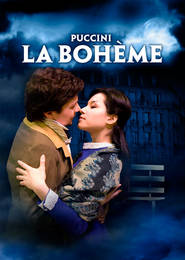
It is quite a couple of days for opera fans at the Grand, with La Boheme last night, and Aida tonight, both by Ellen Kent . Puccini’s La Boheme demands proper staging, and this production delivers that. It is a traditional show , with well choreographed crowd scenes and authentic, realistic sets that transform from the artists garret to the Café Momus, and from the Barriere d’Enfer back to the garret – the platform for music and drama is sumptuously set. Local talent is represented by children from stage schools, a local dog and a brass band. Spectacle abounds, snow falls and everything is a little larger than life.
The story is inspired by Henri Murger’s novel Scenes de la Vie de Boheme, although most of the libretto is original. It tells of the love affair between seamstress Mimi (Elena Dee) and penniless poet Rodolfo (Sorin Lupa) ,beautifully introduced by their first encounter with “Si, mi chiamano Mimi” in which soprano Dee excels, displaying her slight edge and fast vibrato .Rodolfo’s preceding “Che Gelida Manina”is nuanced and poignant. Baritone Petru Racovita, meanwhile, is the appealing Marcello, opposite Ecaterina Danu’s beautifully characterised Musetta, glamorous, commanding, and with a gleaming, lyric soprano that lifts the soul. There’s a nicely uptight Schaunard from Iurie Gisca, and an endearing Colline from Valeriu Cojocaru. Romance, tragedy and death, the staples of a good opera are all present and correct, played with respect and commitment by a fine ensemble.
La Bohème is awash with well known glorious arias and duets, particularly Mimì and Rodolfo’s arias and duet in Act I,culminating in O Soave Fanciulla . They set a fearsome pace and standard for the rest of the evening. In Act Two, Musetta’s waltz, Quando M’en vo,” glitters as she strains for Marcello’s attention stealing time with him by means of a ruse regarding a tight shoe. The dramatic closing quartet of the Third Act, Addio dolce svegliare alla mattina! ,is brilliantly played out as Rodolfo and Mimi are reconciled, and Marcello and Musetta quarrel in antithetical counterpoint. The closing Fourth Act is stolen by Colline’s Vecchia Zimarra as he pawns his overcoat to pay for medicine for the ailing Mimi.
Nicolae Dohotaru’s conducting oozes warm orchestral sonorities, and is at its best with the arias which have have the slow, grave beauty and cadence of symphonic adagios. La Boheme is remarkable for being a classic opera, first performed 117 years ago in 1896, for which a recording exists conducted by the original conductor.In 1946, fifty years after the opera’s premiere, Toscanini reprised his conducting a performance on radio, offering contemporary conductors, and musicians, an unique insight into how Puccini envisioned the original score.
A temporary hitch with the surtitles at the beginning was soon rectified with Ellen herself coming front of house between Acts to apologise, a perfect demonstration of how hands on she is with her productions. She presents Aida tomorrow at the Grand before continuing on tour with La Boheme and Nabucco, details of which are available on: http://www.ellenkent.com/how-to-book.htm
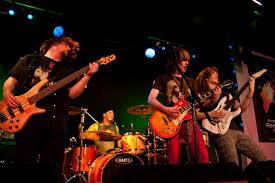
Demolition Derby is the creation of local Rock devotee Georgie “Goldie Locks” and this year’s instalment is the fourth in the series. Eschewing the manufactured pap of the likes of X Factor and The Voice, this event plays to the vast army of rock fans that lurk everywhere, but whose interest is poorly represented on television and radio. Rock always is best experienced live, unsurprisingly the Hairy Dog in Beckett St, Derby was packed.
Walkway
First up on Friday were Walkway who comprise; Chris Ready (Lead Vocals / Rhythm Guitar / Keys), James Ready (Lead Guitar / Backing Vocals), Alex Rosedale (Bass Guitar / Backing vocals),Joe Evans (Drums / Percussion / Backing Vocals) and have supported the likes of The Darkness and Black Stone Cherry. Their influences were unmistakeable as they charged through a storming set honed over the past five years mixing covers with material from their debut album “Top Shelf Content”. They were brilliant. “Comfortably Numb” and “Sharp Dressed Man” stood out, but the tour de force was the encore of “Freebird” with guitarist James Ready soloing the night away and leaping into the crowd and going walkabout. Gary Rossington would have been as impressed as we were!
Headlining the evening were Sack Sabbath playing homage to Black Sabbath. I was fortunate enough to see the Sabbs twice in their heyday in 1976, and 1977. It was only live that it was possible to understand how the band worked. Centre stage would be Tony Iommi, musical director, ( a phrase no-one would have dared used then!), a static brooding figure, lashing out the licks with a venom a ships Boatswain would have savoured. Stage left Geezer Butler would never look at drummer Bill Ward, instead they seemed locked in a telepathic, diabolic trance, laying down a pounding rhythm celebrated best in Children of the Grave. And then there was Ozzy, cheerleader, wizard, icon and, singer, his distinctive high pitched vocals essential if they were to be heard over the growling roar of the rest of the band. It is quite a standard to live up to and Sack Sabbath delivered.
Ozzy does his stuff
Naturally Ozzy hogs the show living up to Nick Kent’s defining description of his likeness on stage to a demented sea lion. Geezer strangely has taken to playing his bass in the style of John Entwhistle rather than in “gunslinger” mode but is no less effective for it. The set celebrates the classic years but opens with the closing numbers that Sabbath played at the time, namely “Children of the Grave” and “NIB”, I would have loved to have heard “Killing Yourself to Live” again as an opener, and for them to have walked on to the strains of “Supertzar”, but maybe another day. A Sabbath crowd know what they want, and Sack Sabbath know how to give it to them. A great show. A great night.
Demolition Derby continues on Saturday night with Towers of Stone and Metal Fatigue
Each year Cork and Coventry act as a staging point for a poetry exchange, swapping poets, poetry, experience and humanity. This year Rab Urquhart and Julie Field (aka Julie Goo) were Cork’s representatives for an itinerary that now includes three separate performances, the first of which was at the traditional opener, Night Blue Fruit in Coventry on Tuesday with local dignitaries in attendance, hosted by organiser and co-ordinator Tony Owen.
On Wednesday Cork came to Lichfield for the first time, hosted by the Lichfield Poets at the Kings Head. A strong open mic section included; Lichfield Poets Tom Wyre, Ian Ward, Mike McKay, Mike Seaton, Ben McNair and David Calcutt; Past Staffordshire Poet Laureate Mal Dewhirst; from Burton on Trent Gary Carr and Terri Jolland; from Stourbridge Mika Alma; from Leicestershire Jayne Stanton, and complimented by Tony Owen from Coventry.
The Lichfield Poets then performed a selection of original poems about Lichfield and Staffordshire before the main Event.
On Thursday the tour came to an end at The Old Crown in Digbeth, surrounded by pubs like the Kerryman, The Dubliner and the Irish Centre emphasising that this is the Irish Quarter of the city. Rab Urquhart even wore a “peaky blinders” flat cap to fit in with the location. Sponsored by the Irish in Birmingham charity, whose representative was Pat Murphy Wright, in association with Birmingham Poetry collective Write Down Speak Up, another open mic session preceded Rab and Julie. Open micers included Tom Roberts, Mike Alma, Tom Wyre and Tessa Lowe, and from WDSU, Charlie Jordan, Kurly McGeachie and a welcome appearance from Dreadlock Alien.
Host Gary Longden in censorious mode
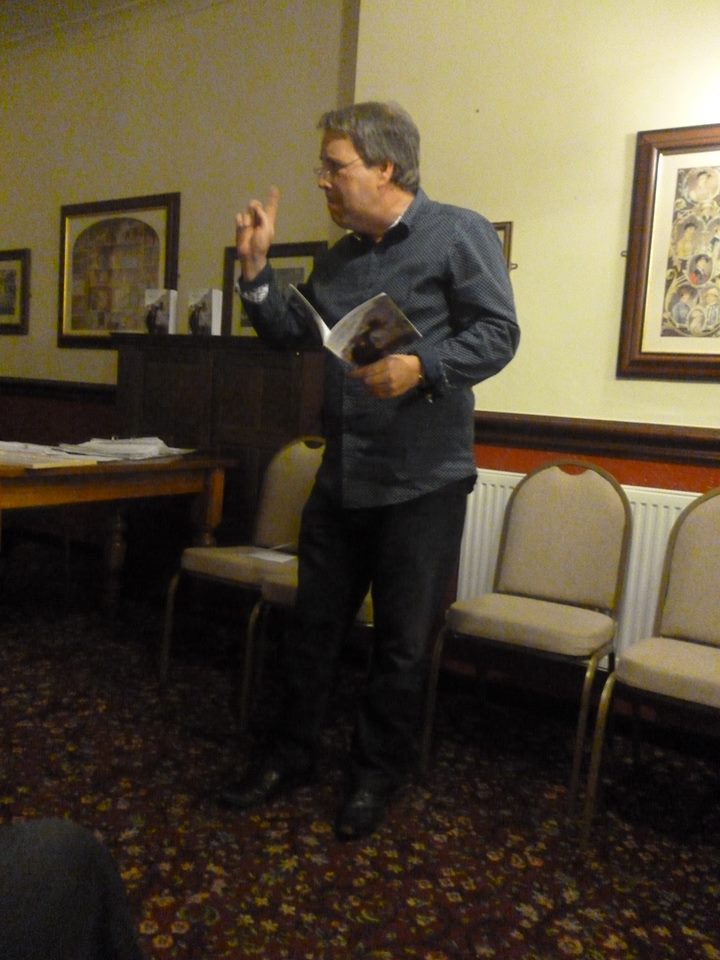
The Cork Poets came prepared with a book offering a selection from both poets, who were pleasingly diverse and accomplished performers. Julie was witty with an intellect which eschewed cheap laughs, and carried a message for tolerance which was understated, but unmistakeable, captured brilliantly in “Dear Society”. Rab wove his Scottish heritage with themes from his adopted city, laconic in “ A Chinese Proverb”, teasing with his piece on Scottish patriotism, and an unashamed tigerphile! Both poets perform regularly at O’Bheal, a weekly poetry evening , held on a Monday,at The Long Valley, Winthrop st, Cork, the Midlands was fortunate to have these two fine poets on loan for a few days.
Cork Poet Rab Urquhart
The value of this exchange was reinforced continuously as new expressions and ideas sprung from the same language divided only by the Irish Sea, as Dreadlock Alien exclaimed, “Well Done”.