Buddy- The Buddy Holly Story, Sutton Coldfield Musical Theatre, Garrick Theatre, Lichfield

buddy

“Buddy – The Buddy Holly Story ” has now been touring for twenty five years , celebrating the songs of an artist whose recording career lasted barely two years, but whose music endures some fifty six years after his untimely and tragic death. A jukebox musical, the two halves mainly comprise his rise to fame and studio work in the first half, and an extended concert sequence in the second.

Dan Ankatell takes the eponymous, demanding, lead role , which requires a performer who can sing, act, play competent electric lead guitar, as well as have a passing resemblance to Buddy Holly himself. Angular and enthusiastic, Ankatell is credible and lively in the part, ably supported by a large chorus for the big numbers. His confidence grew as the night unfolded, dealing with a faulty guitar connection at one point with an ease that Buddy himself would have smiled at.

The real Buddy Holly in action at Birmingham Town Hall in 1958

The real Buddy Holly in action at Birmingham Town Hall in 1958

The plot fairly thinly joins the dots between the music, but it is the songs which star. They have transcended their late fifties origins to become standards which by a process of cultural osmosis are as fresh now as they were when written. Rock n roll aficionados will feel the tradition has been well represented, new generations continue to sign up to the cause.

Amongst numerous satisfying cameos, Helen Simon delights as Maria Elena, hotter than a desert at midday, and with a convincing Latin accent. Pete Beck marvellously milked the part of the Big Bopper for all it was worth ,and Tony Orbell injected some vital energy and pace into the Clearlake concert sequence. Dave Hill also made the most of scheming producer Norman Petty .Of the dancers, Sally-Jane Adams consistently caught the eye with her dynamism, brio, and crisp movement.

The Garrick’s stage was packed to capacity by the cast which at its peak numbered over fifty . A Spartan, but versatile, set which incorporates recording studios, concert halls, radio stations, and living space, provided a fitting sense of occasion, culminating in the theatre stage becoming a concert stage.

bud

There is no secret to this show’s success and longevity, the songs are very strong. Contemporary hits “Shout”, “ La Bamba” and “Johnny B Goode” flesh out the Holly numbers, offering variety, shade and musical context. Musical Director Sheila Pearson does a good job utilising her considerable chorus providing a new dimension to songs whose original arrangements were quite sparse. Choreographer Maggie Jackson has no shortage of willing dancers whom she manages both to squeeze on stage, and squeeze the best out of.

Veteran Director Lynne Hill is a safe pair of hands for a show like this with an impressive roll call of successful past productions to her name. Her strengths lie in her technical proficiency and vision for the big set pieces, skills which were pleasingly on display for this accomplished production. A full opening night house was thrilled by the show during which the “magic programme” winner hailed, improbably , not from Sutton Coldfield, Lichfield or Clearlake, but Guatemala! “Buddy” runs until Saturday 6th June .


Posted in Behind the Arras Reviews | Leave a comment

Neville’s Island – Sutton Arts Theatre

neville

Neville’s Island was the first play penned by author Tim Firth in 1992 and was originally   commissioned by Alan Ayckbourn . Firth later found fame with Calendar Girls, and was a contemporary of Nick Hancock and David Badiel, and the script has a 90’s tint to it. The four handed, all male, cast, finds itself stranded, in somewhat contrived circumstances on a Lake District island after a corporate team bonding expedition goes wrong, working its way through comedy , horror, satire and psychological thriller.

John Islip and his stage team will be delighted to have won the first round of applause of the night as the lights went up on a carefully crafted, dendritic heavy, single set. A forest of conifers were denied their Christmas date with destiny , and silver birches swayed, lending a physical verisimilitude, augmented by some particularly effective camouflage nets. The play’s title alludes to Devils Island, but in truth there is little threatening about their surroundings nor is there the menace which laced the film Deliverance, which explored similar themes, some twenty years earlier.

The advantage of the small single island set is an innate sense of claustrophobia, the down side is the action is inevitably confined and static. Currently Bear Grylls is leading a survival series entitled The Island in which two teams of women and men are stranded on separate islands and have to fend for themselves, the team dynamics between the play and television programmes are not dissimilar. The play opens with the protagonists dripping from a wrecked boat, but the show is no damp squib. The mists roll in, contact with land is lost, blood appears, and tempers fray.

Three of the actors are on stage for the whole of the production, only one disappearing briefly, making this quite a demanding show for the players. Rod Bissett does well with the awkward part of Neville whose job it is to try to keep everybody calm as team leader. Ben Field has the most interesting part as Roy , a Christian and ornithologist, dealing with the after effects of a nervous breakdown after losing his mother, combining pathos with comedy in hugely demanding circumstances.

The irritant in the team is Dan Goodreid who is first-rate as Gordon: he presents us with the archetypal party-pooper who, having neither a domestic life nor identity of his own, achieves fulfilment by destroying other people’s. Office geek Angus, played by Phillip Beadsmoore, writhes likably as the uxorious Angus , plagued by fears of an errant wife whilst carrying equipment consistent with an assault on Everest rather than a Lake District weekend away. But this is an ensemble piece and every actor works hard to produce a team production rather than grandstanding their own comic cameos.

Act One is a fairly light –hearted and frothy affair, as the men become accustomed to their new surroundings, but the second Act veers into darker territory as adversity fails to bring the best out of them. The plot can be a little clunky. It is difficult to be cut off from the rest of the world in the Lake District, and the one dead mobile phone, and waters around their island supposedly infested with deadly pike, require a certain amount of suspension of disbelief.

Director Joanne Ellis squeezes the most out of the comedy with the fate of their only sausage at prayer the comic highlight of the evening. Generically, the laughs are of the Men Behaving Badly variety, but Joanne has left the original script intact save for a few minor tweaks and the laughs hold out well. A particular mention should go to Ben Field who had to assume the part of Roy at a few hours notice, following the original actor’s indisposition. He acquitted himself with considerable distinction, ably supported by director and cast.

An appreciative audience enjoyed an entertaining show which runs till Saturday 9th May.

Posted in Behind the Arras Reviews | 1 Comment

Live at the Brixton Academy- Simon Parkes

A riotous life in the music business

brixton 3

As a teenager I learned the gig going ropes in London. The Hammersmith Odeon, Rainbow Theatre Finsbury and Wembley Empire Pool (as was) became regular haunts, as well as occasional visits elsewhere. It was the 70’s, the halcyon days of gig going. Prices were affordable, tours frequent, tickets fairly easy to get. I never went to the Brixton Academy for several reasons, but was well aware of its reputation. When I heard about the book I thought it might be worth a read as it cross- referenced bands, and an era, with which I was well familiar. However it was only as I read it, that I realised what a little gem it is.

brixton 2

The author, and proprietor of the Academy is Simon Parkes. A posh kid, a rich kid, a privileged kid, but not a pretentious kid. He rubbed shoulders with Prince Andrew, but the family fortune was in catching, gutting and packaging fish, the middle of which he undertook as a family rite of passage. He was also born with a malformed arm as a consequence of the Thalidomide tragedy, a handicap which seems to have driven him rather than held him back. Wisely, his time growing up is dealt with briefly and concisely, it’s the music we are really interested in, nonetheless it is a fascinating sequence , but it the music that this book will be read for and little time is lost in reaching the meat of the story.

As soon as he arrives in Brixton, the narrative shifts up a gear and never relents, with drama, anecdote and a rich social history commentary of time, place and participants. If he had not been a music impresario Parkes could have been a diplomat, so consummate is his skill in negotiating the bear-traps of the detail of his story. On the one hand he declares that he had no truck with drug dealing, on the other, he was arranging for others to supply key players, from road managers, through band members to foreign music executives. He bemoans the reputation of Brixton for gangs and violence, but spends much of the book telling the stories of the drug, gang, violence heavy world that is its milieu. He pulls every trick in the book, yet is generous to his key rivals Harvey Goldsmith and Vince Power, and never name checks his opposite numbers at the Hammersmith Odeon whose business he took south of the river.

Most of his close contacts are referred to by first names and nicknames only, there are no contemporary photos, family detail and where he lives are discussed in the broadest possible terms, all suggesting that his rise to the top did not come without a cost.

What makes this book work is his obvious enthusiasm for the music. As a contemporary of his I empathised with his excitement at attending those early seventies gigs, and was jealous that he lived the dream, whilst I and many others simply dreamed the dream. Of course his family background helped him to raise £130,000 to take on the dream in a way that most other people could not. But his work ethic and enthusiasm for the business is what delivered and converted the dream into reality.
brixton 4

The murky underworld of a cash rich, gangland predator, environment is compelling. He spells out what the scams were, distances himself from them, but is a little coy on how much legitimate cash he was making. How he chances upon what amounts to the toughest security outfit in London is a little bit blurred, as is his ability to retain them, for a job description which makes minding Columbian Cocaine Barons seem relatively easy. But with sawn off shot gun toting heavies by his side, and guard dogs on a short leash, he triumphs, and we share his triumphs with him.

There are anecdotes aplenty, suspicious reggae bands make eleventh hour show stopping demands, police outriders in numbers normally associated with the Queen race to recover Keith Richards in return for free tickets, and a mean and moody rapper demands for his rider nothing more than KFC.

J S Rafaeli has done a tremendous job co-writing this, as have publishers serpentstail in editing it. Suggs Macpherson has a biography out about a similar period in London. In it he boasts eschewing the services of professional writers in favour of his own hand, with unsatisfactory results. Here the writing his witty, brisk and unpretentious, a fabulous, exciting and rewarding read.

Posted in Blog | Tagged , , , | Leave a comment

Bedroom Farce, Sutton Arts Theatre

bedroom farce 1When you ask Barrie Atchison to direct an Ayckbourn play it’s like recruiting Jose Mourinho to manage your football team, you are guaranteed a safe pair of hands, and success. And so it proved on this, the opening night.

Although the word farce is in the title, this is a comedy. There are no banging doors, or falling trousers. Atchison eschews a Seventies set and fashion for the contemporary, and the script survives being wrenched from the period to the present surprisingly well.

The single set comprises three bedrooms on two levels for four couples. John Islip and his stage team have done a tremendous job cramming the bedroom paraphernalia of three very different couples into a relatively small space.

First performed in 1977, the comedy explores the fissures in four marriages. The only bedroom-less couple, the roving and highly neurotic Susannah and Trevor (Louise Farmer and Jimmy-Joe Corbett) drag and impose their problems around the other three bedrooms, creating chaos in their wake, not least on the best set-piece of the night, when their fight ruins a house party.
bedroom farce

The older couple, Ernest and Delia (Allan Lane and Hazel Evans),go wild by sharing tinned fish in bed, and anchor the night with a warm, characterful performance. Lane’s grumpy old man becomes grumpier and grumpier, Evans’ dutiful wife becomes wilier and wilier in dealing with her long standing marriage partner.

Nick and Jan (Jon Hall and Emma Woodcock) bitter , irritable, and resigned, have both settled for second best, know it, and accept their lot. Hall has to play the physical comedy for all its worth as he is incapacitated by a bad back for proceedings, Woodcock is sassy and lively opposite him, barely suppressing her frustration with her supine husband

Malcolm and Kate (Dave Douglas and Hellie England), provide the froth and pace, but they have their secrets too amidst silly bedroom games . Crucially, England injects vital enthusiasm and dynamism to the production after the scene setting opening.

Aykbourn’s take on marriage is a little bleak, but the play is always funny. The appallingly selfish, Trevor and Susannah expose the fault lines in other people’s marriages, all of which survive the examination. Any man who has ever had to assemble flat pack furniture will laugh out loud, as will any woman who has found herself having to get dressed in a tight situation.

Director Barrie Atchison grasps the mechanical demands of an Ayckbourn play admirably, juxtaposing rueful, disquieting home truths with knock-about comedy. A witty and rewarding evening’s entertainment. “You can learn a lot from people’s bedrooms”

Bedroom Farce runs until Saturday 28th March.

Posted in Behind the Arras Reviews | 1 Comment

Boston Marriage, Highbury Theatre Studio, Sutton Coldfield

boston 1
A three handed play, with all -female cast, by David Mamet, written in 1999. “Boston Marriage” is set a century earlier, the title being a euphemism, said to have been in use in New England in the decades spanning the late 19th and early 20th centuries, to describe two women living together, independent of financial support from a man. The place is assumed to be Boston, New England.

The term “Boston marriage” became associated with Henry James’s The Bostonians (1886), a novel involving a long-term co-habiting relationship between two unmarried women. Although James himself never used the term, his sister Alice, who lived in such a relationship with another woman, Katherine Loring, was among his sources .

Plays about, or featuring, gay men are not uncommon, those featuring lesbian relationships less so. However acceptance of women living together in ambiguous circumstances has been more socially accepted over the years than men doing likewise. The plot is modest, the script verbose, making it a challenging play for a director. If it is played as a niche lesbian drama it narrows its audience, if played as a straight parlour play its raison d’etre is lost, if sexed up, the border between comedy and vulgarity can be fine.

Director Sandra Haynes aims for subtle, rather than vulgar, comedy, and implied, rather than overt sexuality.

Alison Cahill is the stay-at-home Anna, mistress to a wealthy man who maintains her lavish, kept lifestyle, while her lover Claire (Joanne Richards) has met an innocent young woman whom she hopes to bring to Anna’s house to seduce. Although pivotal to the plot, we never physically meet the intended prey. Anna is waspish and overbearing, Claire is all aloof social refinement mixed with carnal lust. Both principals handled their word heavy, demanding roles, admirably, although I read more sexual chemistry and tension in the play than is portrayed here.

Between the two lovers is the put-upon Scottish maid Catherine (Jen Godbehere) , whom Anna calls with equal indifference Mary, and any other name that comes to mind. Catherine’s quick wit, sly disobedience and cheeky subversion are nicely played, and Godbehere’s confidence in the part grew as the play progressed. The cruel bullying by Anna of Catherine is explained by her desire for her, as evidenced by her proposition , mirroring Claire’s desires for a younger woman too.
boston 2

The badinage is witty and quick-fire, designed to shock, that the outwardly refined can be so filthy of thought and bedroom desire. Curiously the language uses frequent anachronisms ( “Go tell it to the marines”) combined with obscure and arcane words and phrases a century old, all delivered in iambic pentameter making it a demanding piece for the actors to learn.

The studio performance was particularly apt for this single set production, a parlour play performed in a parlour. “Boston Marriage” runs until Saturday 14th March.

Posted in Behind the Arras Reviews | Leave a comment

Hansel and Gretel- WNO, Birmingham Hippodrome

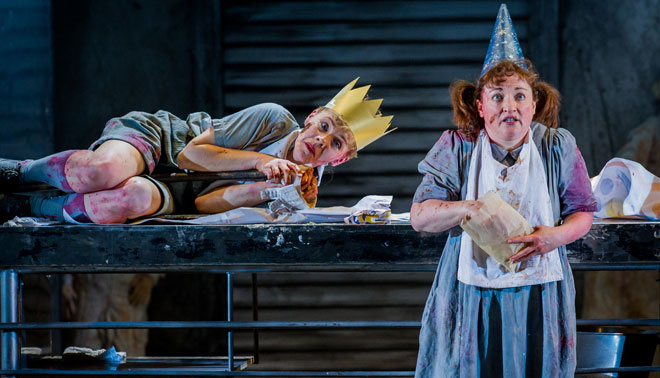
Hansel&Gretel4
“Hansel and Gretel” is a Märchenoper (fairy tale opera) by nineteenth-century composer Engelbert Humperdinck, based on the eponymous Grimm brothers’ fairy tale . The first four rows of the stalls at the Hippodrome had been removed to accommodate a full orchestra in a pit packed with musicians, and burgeoning with the sounds of the rich score, a Strauss influence noticeably present. What a delight to have a full orchestra playing for a change at Opera.

The Grimm brothers fairy tale is grotesque and macabre, this production does those values full justice. Gretel (Ailish Tynan ) and Hansel (Jurgita Adamonyté) lead the production playing children with no awkwardness, the latters’ mezzo soprano a delight, their combination oozing innocence and adventure.

Hansel&Gretel3

The set opens, stark and austere and ends in an industrial kitchen with a finale so grotesque, that Quentin Tarantino would have hesitated to pitch it for one of his films. Director Richard Jones’s vision is ambitious, and delivered. Conductor Lothar Koenigs leads the magnificent orchestra to produce a light, sensitive nuanced tone against a bleak backdrop, from which the twee rustic idyll of other productions has been stripped.

Hansel&Gretel 1

Adrian Thompson’s witch is a winning comic vision, twerking, smirking and luring before her demise, an end which is gross out humour at its basest. However the most accomplished and complete scene was the “Abendsegen” (“Evening Benediction”) from act 2. The melody has a child like simplicity, the Wagnerian harmonies soar, and for a moment you are transported to church and back to your own childhood where an evening prayer can fend off bad dreams.

Elsewhere the set pieces are presented in some style. Actors lurk dressed as trees, a banquet is served by a fish and fat headed chefs while The Sandman (Meriel Andrew) stalks a banquet table, caressing a skeletal spectre.
Hansel&Gretel 2

This is a magnificent production and a timely reminder of how good composer Engelbert Humperdink was. Gluttony, greed, self indulgence and excess are all gloriously explored, a triumph for the Welsh National Opera.

It tours until 11 April alongside performances of “The Magic Flute” and “Chorus”, a greatest opera hits production.

Posted in Behind the Arras Reviews | Tagged , , | Leave a comment

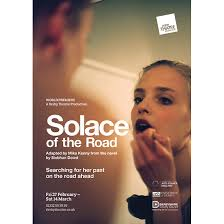
Solace of the Road- Derby Playhouse

solace
Derby playhouse is fortunate indeed to be staging the world premiere of Siobhan Dowd’s novel of loss and homecoming which was shortlisted for the Costa Children’s Book Award 2009, the Guardian Children’s Fiction Prize 2009 and the Bisto Children’s Book of the Year Award 2010 and has been adapted for the stage by Olivier Award-winning writer Mike Kenny.Dowd died from breast cancer in 2007 at the age of 47. Solace of the Road was her final novel, published posthumously.

Rebecca Ryan plays Holly/Solace

Rebecca Ryan plays Holly/Solace

The play follows the fortunes of Holly, transforming into Solace by means of her foster mother’s wig, and is played by Rebecca Ryan who will be familiar to many people through her roles in the Channel 4 series Shameless and the BBC drama Waterloo Road. When Holly’s favourite care worker leaves for another job , she is fostered out to a well-meaning, but cloying, middle class couple, Polly Lister plays her foster mother and several other characters in a virtuoso performance. Materially she is well looked after but hates school and is sure that “home” should be more than this, and that if she can just get to Ireland she will find her lost mother and a better life. She takes her foster mother’s wig to make herself look older and sets off on her adventure, physically transformed, then spiritually transformed.

solace4
Rebecca Ryan is an engaging and convincing Holly, smart and hard enough to manipulate her foster mother, but naive enough to think she can walk to happiness. She is complex, with passion, anger, sadness, and laughter all part of a rich package . When she wears the wig, she assumes a new name (Solace), and assumes a new persona, simultaneously empowering her, and placing herself in danger. As the story unfolds you wait to see how she might fall by the wayside on her journey. She’s picked up by a man in a nightclub. She gets a lift from a lonely pig-farmer. The worst is inevitable, isn’t it? Although she is beset by danger on every side, Holly also encounters hospitality, kindness, and a heart warming conclusion.

There are currently over 70,000 children in care in the UK and this story will appeal to those in that position, all teenagers who will empathise with Holly’s dilemma, and adults who will shake their heads at her impetuosity, but admire her spirit. Teens who have not lived through similar experiences will come away with a deeper empathy for teens who have, and those teens who have lived through abuse or homelessness may come away with hope, and a deeper understanding of the consequences of their actions, good and bad. Drink, drugs, shoplifting, domestic violence and suicide all find a platform, but this is an uplifting, not grim, tale.

Although on the one hand this is a story about Holly it is also about people who did something to help her and asked for nothing back.

Derby Theatre’s artistic director Sarah Brigham, one of the few women in the role nationally, has done an excellent job to realise this on a stage imaginatively set by Barney George, and has worked tirelessly to involve young people locally in its story by working with Derbyshire schools.

Sarah explained: “Solace’ is a play primarily aimed at a younger audience and has had these people in mind from the outset. Derby Theatre’s has worked in an exemplary manner to engage with children in care across Derbyshire through the development of this piece. Children in care have been into rehearsals and worked alongside the company to help inform this piece and the characters we meet.”

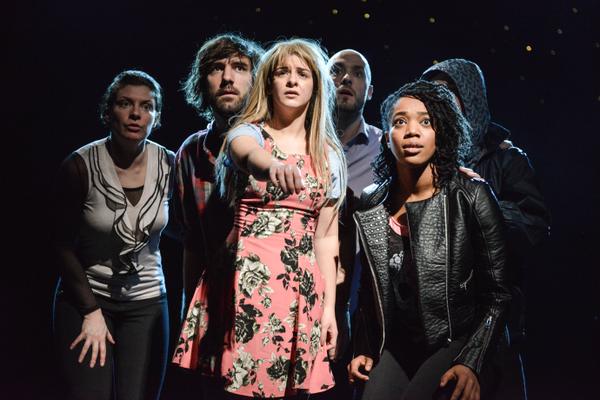
The rest of the cast includes Naomi Ackie, Neal Craig, Jack Finch and Robert Vernon who all take on multi roles with considerable aplomb. “Sweet Dreams Are Made of This” is performed, sung and reprised on several occasions, its sinister menacing undertones perfectly suited to the mood of the production.

The play inevitably starts slowly as the scene, and characters, are set, then careers towards an emotional final scene in the first act, never slackening its emotional ride for the entire second act. Rebecca Ryan is superb, carrying the production and inspiring all around her, all squeezing a lyrical but convincing script to the maximum, evoking a well deserved and rousing ovation at the play’s end. I can see this play being performed for many years to come and becoming a favourite for performance in secondary schools.

.

Solace of the Road runs until Saturday 14 March.

The cast in rehearsal.

The cast in rehearsal.

Posted in Behind the Arras Reviews | Tagged , , , , , , , , , , , | Leave a comment

“Avenue Q” Highbury Theatre, Sutton Coldfield

q4
I came to this production “cold”, knowing nothing about the show, having little regard for puppets, and a disregard for much American humour. Little did I know how much my theatrical spirit would be enriched and my views changed over the proceeding two and a half hours!

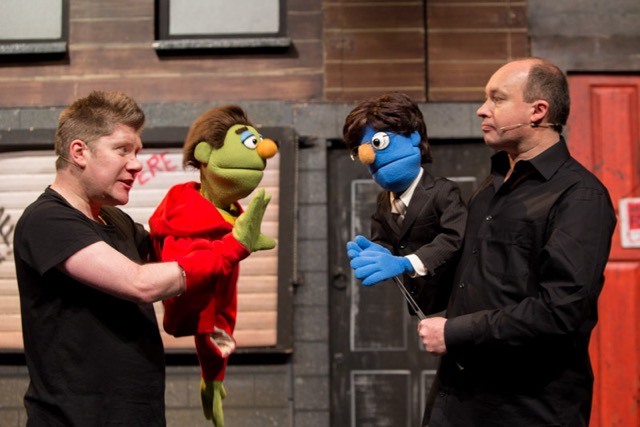
Richard Ham as Princeton

Richard Ham as Princeton

Avenue Q is a downmarket New York street inhabited by humans and puppets. The show revolves around Princeton, a college graduate searching for a purpose amidst his penury, surrounded by a nymphomaniac puppet, a masturbating monster and a Korean harridan, amongst others. It is an adults only production which draws on the idealistic world of children’s television characters, and then imagines what will happen when they grow up.

The cast consists of three human characters and eleven puppet characters who interact as if human, Sesame Street-style. The puppets are animated and voiced by actor/puppeteers who are present, unconcealed, onstage, but remain “invisible” relative to the storyline. The same puppet may be operated by different puppeteers in different scenes, and the actor voicing the puppet may not be the one animating it. One puppeteer sometimes voices two or more puppets simultaneously. Conversely, the so-called “live-hands” puppets require two puppeteers — again, in full view of the audience. It is a complex show to stage, but six months in rehearsal pay off.

Highbury Theatre itself is a little gem, tucked away on the Sutton Coldfield/ Erdington border. Modern and well appointed, the higgledy- piggledy café and bar lounge provide plenty of space for refreshment, whilst the auditorium itself is up to date, with comfortable seating and well raked tiers.

Producers Keith Hayes and Nigel Higgs have gone the extra mile on production values, and are paid back in spades. A professional set has been imported rather than an improvised constructed version being built, the puppets are the bespoke creations made by Paul Jomain for the West End run, and instruction on how to use them was provided first hand by West End puppeteer Nigel Plaskitt.

The cast are divided into two teams for the two week run, such are the demands of the production. Unsurprisingly the colourful puppets are superb, operated by black clad actors, but with both acting meaning that there are often twice as many expressions to observe as people on stage. Although a musical, the libretto is strong and humorous, reaching out way beyond its American origins with some neat contemporary and local references added in.

But it is the songs which shine. “Everyone is a little racist sometimes” is painfully funny with lines such as “Ethnic jokes might be uncouth/ But you laugh because/ They’re based on truth”. However the stand out moment is the outrageously crude show-stopper, “You Can Be as loud as the hell you want ( When You’re Makin Love)” . The sight of puppets bent over a table “at it”, their puppeteers bent over the table simulating being at it, whilst other puppets perform oral sex, and a monster masturbates while watching, is not standard theatre fare, and had the entire audience roaring with laugher at the ever –increasing contortions on the puppets and puppeteers’ faces.

The large and rotating cast deliver a tour de force as an ensemble, with no weak links. On the night, Liz Webster, an actress for whom amplification is usually unnecessary, was outstanding as Korean harridan Christmas Eve. She convincingly terrifies fiancé Brian (Richard Beckett) throughout, yet sings a beautiful solo , and duet (with Kate Monster) too; “When You Ruv Someone”. Karisse Willets delights as Kate Monster, and Suzy Donnelly sways and sashays a treat as Lucy the Slut. Richard Ham holds things together nicely as Princeton and Dave Fox’s Gary Coleman is streetwise and fun. Counterpointing the main characters, Dave Carey and Mark Murphy are a wonderful comic double act as the onanistic Trekkie Monster, and Duncan McLaurie offers a poignant, sensitive portrayal of Rod the closet gay who retains his friendship with Nicky, nicely played by Simon Baker.

Coming out as a puppet isn't easy

Coming out as a puppet isn’t easy

The original production was conceived by Robert Lopez and Jeff Marx, but it is this terrific company, and Keith Hayes vision which shine through. A great show, memorably realised, offering laughs, reflection, coming of age poignancy, and good old fashioned bawdiness, a brilliant night’s entertainment.

Avenue Q is on at the Highbury Theatre Centre until February 28. To book tickets call 07931 033661 or visit http://www.avenueq.org.

Directors Nigel Higgs ( left) and Keith Hayes (right) with ensemble behind

Directors Nigel Higgs ( left) and Keith Hayes (right) with ensemble behind

Posted in Behind the Arras Reviews | 2 Comments

The Nutcracker, Russian State Ballet of Siberia, Wolverhampton Grand.

nut 1
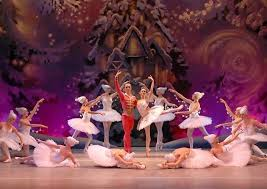
The Russian State Ballet of Siberia came to Wolverhampton on Sunday afternoon in the middle of an extended provincial tour showcasing four ballets. Although Wolverhampton is considerably warmer than Siberia at this time of year ( a good reason for decamping from a Russian Winter) a sharp nip in the Black Country air would have made the company feel at home. The afternoon’s performance was of The Nutcracker, on Monday they perform Swan Lake, before proceeding to Edinburgh.

Artistic Director Sergei Bobrov omits the Sugar Plum Fairy in a nod to Socialist Realism in Soviet Ballet in a production heavy on cast numbers and costume, but a little light on scenery.

The score by Tchaikovsky, now just over a hundred years old, is familiar and has endured, the melancholy, descending scale melody for the adagio of the Grand Pas de Deux, still stirs. Conductor Alexander Yudasin keeps time well, although a slower than usual tempo occasionally passed to languid resulting in the crescendos sounding a little rushed. Disappointingly the dance of the Sugar Plum Fairy was played on a keyboard rather than a Celesta, aficionados will accept no substitute.

Marie, the prima ballerina delights, played by the elegant Natalia Bobrova ,always seems to be performing well within her capacity, whilst executing her curtseys and bows with studied aplomb. Her partner, Ivan Karnaukov, as the Prince was muscular and dashing.

The story of toys coming alive was popularised in film by Toy Story, but on stage takes on a magic of its own as an army of toy soldiers battle against a gang of mice . The spectacle is impressive but the first half set is let down by a painted backdrop incorporating a Christmas tree which fails to meet the performed production standards. Closing the first half the waltz of the snowflakes is a joy although some of the battement movement could have been tighter.

In the second half the divertissement sequence of national dance sumptuously dressed by Christina Fyodorova including Spanish, Arabic, Chinese, and Russian, and dancers delighted.

A lavish walk down with over twenty five dancers on stage was a visual feast leaving the audience entranced and satisfied. The Russian State Ballet of Siberia continue on tour till mid March performing The Nutcracker, Swan Lake, Coppelia and La Fille Mal Gardee.
Gary Longden

Posted in Behind the Arras Reviews | Tagged , , | Leave a comment

A Doll’s House, Sutton Arts Theatre

dolls house
This production is the latest example of the bold programming by Sutton Arts Theatre. Straight plays always have to work harder to win an audience than other theatrical genres, and period writing has to work harder still. Yet “ A Doll’s House” is one of the most performed plays of all time and Ibsen competes with Shakespeare as the most performed playwright. Written 135 years ago, its examination of women, marriage, and the human condition endures.

Central to any successful performance of this play is the part of Nora. One of the best parts ever written for a woman, she is on stage throughout, has numerous monologues and has to carry, and lead, the emotions of the drama. Michelle Dawes as Nora does just that. Beautiful, fretful, wilful, and doubtful, her stunning luscious costumes provide a visual focus to a compelling performance which oozes paranoia and panic before resolution.

Opposite her Stuart Goodwin as her husband Torvald is wide-eyed and soppy, oblivious to his wife’s financial problems and emotional needs. It’s a difficult task, playing the part of a devoted husband to an emotionally estranged wife, but Goodwin pulls it off. His final bewilderment at his abandonment was particularly poignant.

Dan Payne is as dour as a debt collector should be, and Bhupinder Dhamu, friend and finally reconciled wife does well to tackle a range of responses in quite a short amount of dialogue. Allan Lane (Dr Jens Rank) Nora’s doomed admirer is dapper, and reserved barely able to contain his desire for Nora, not least when she teases him with the stockings she intends to wear for the party. Libby Allport is bright and breezy as the housekeeper and sometime playmate of energetic children, enthusiastically played by Luke Flaherty and Leo Butts.

John Islip and his team have produced a bright dolls house effect single set with pink walls and Scandinavian pine complete with hand- made fireplace and HMV style record player. Director Ian Appleby sets the action in period by costume but there are no cod Norwegian accents to distract although the icy bite to the wind as I walked to the theatre added an extra Nordic air of authenticity to proceedings. The pace is brisk, the focus on character incessant.

Although in modern 21st century Western Society it is impossible to recreate the shock that a woman walking out on her husband, children and social position would have created then, the themes of marriage, money and secrets are timeless. Nora’s attitude to money would find favour with any contemporary Greek Finance Minister, Torvald’s handling of his trophy wife, strong on small talk, weak on substance, is painfully well portrayed by husband and wife.

A strong, powerful production of a very good play, “A Doll’s House” runs until Saturday 14th February

Posted in Blog | Tagged , , , | Leave a comment