
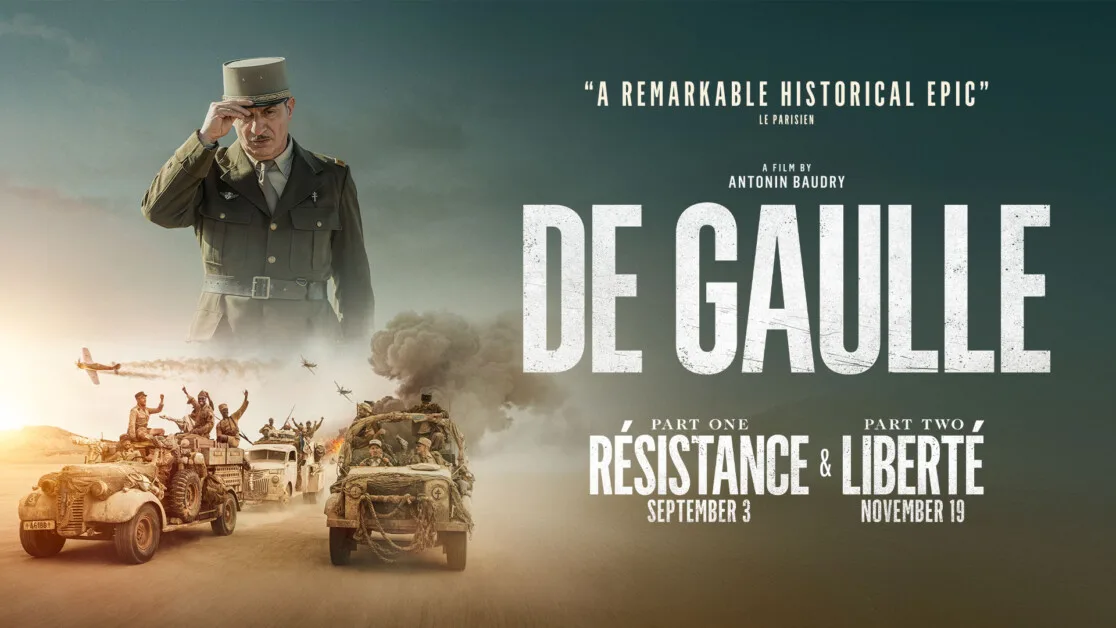
I am a keen amateur student of the history of World War Two. I have long felt that the commercial behemoth which is Holllywood and the artistic excellene of British cinema have combined to offer an incomplete record of the conflict
This wonderful two parter, of which this is the second half rightly reappraises the French role, retracing the battle of Free France .It is a film brave enough to make Roosevelt the antagonist, not the hero.-
Baudry does something cinema rarely risks: he puts Washington, and the Americans in the villain’s chair. Campbell Scott’s Roosevelt treats France as a defeated country to be administered rather than an ally to be consulted, and behaves accordingly. He embodies the pragmatic, almost colonial ambitions of Washington. American viewers will find this uncomfortable, and the film’s reception outside France will turn on how much of it they are willing to accept.
What makes the film stand out is its willingness to cast the Americans as near-villains in the struggle for French sovereignty – an angle that feels both brave and genuinely refreshing. This version of events, with its clear-eyed view of Allied power politics and de Gaulle’s fierce defense of national independence, is rarely given such prominence in mainstream Western storytelling. Baudry leans into the political intrigue and diplomatic brinkmanship without soft-pedaling the tensions, resulting in a historical drama that feels purposeful rather than merely celebratory.
The occupation currency was printed, officers were trained to run French departments, and Roosevelt did float carving a state called Wallonia out of northern France. Jackson’s biography, which Baudry adapts records it all.
Abkarian carries both the awkwardness and the mystique of De Gaulle, without sliding into impersonation. The Churchill exchanges keep the dry needling from part one, still the most enjoyable double act in either film, and the score was beautifully cinematic. The liberation sequence, set against Éluard’s 1942 poem Liberté, was my personal high point of the whole diptych. The film is titled J’écris ton nom for a reason, and it delivers on it.
The African soldiers fighting under Leclerc across the entire film never get a line between them. For a picture that alert to those who get written out of history, it is a rather strange blind spot.
Baudry has admitted compressing and inventing at the level of individual scenes but the spine of the story is sound, and it is a spine most audiences have never been shown.Handsomely shot, well-acted, and driven by a clear-eyed sense of national destiny, De Gaulle: Liberté is a confident, intelligent war film that trusts its audience with a less sanitized chapter of the Allied victory. One scene in particular – a moving montage near the end of the movie that combines archival footage of the Paris insurrection with Paul Éluard’s iconic WWII resistance poem “Liberté” embodies the class and care that has been taken with the entire presentation of these two films.
Viva la liberation!

