
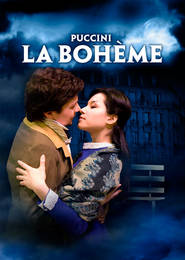
It is quite a couple of days for opera fans at the Grand, with La Boheme last night, and Aida tonight, both by Ellen Kent . Puccini’s La Boheme demands proper staging, and this production delivers that. It is a traditional show , with well choreographed crowd scenes and authentic, realistic sets that transform from the artists garret to the Café Momus, and from the Barriere d’Enfer back to the garret – the platform for music and drama is sumptuously set. Local talent is represented by children from stage schools, a local dog and a brass band. Spectacle abounds, snow falls and everything is a little larger than life.
The story is inspired by Henri Murger’s novel Scenes de la Vie de Boheme, although most of the libretto is original. It tells of the love affair between seamstress Mimi (Elena Dee) and penniless poet Rodolfo (Sorin Lupa) ,beautifully introduced by their first encounter with “Si, mi chiamano Mimi” in which soprano Dee excels, displaying her slight edge and fast vibrato .Rodolfo’s preceding “Che Gelida Manina” is nuanced and poignant. Baritone Petru Racovita, meanwhile, is the appealing Marcello, opposite Ecaterina Danu’s beautifully characterised Musetta, glamorous, commanding, and with a gleaming, lyric soprano that lifts the soul. There’s a nicely uptight Schaunard from Iurie Gisca, and an endearing Colline from Valeriu Cojocaru. Romance, tragedy and death, the staples of a good opera are all present and correct, played with respect and commitment by a fine ensemble.
La Bohème is awash with well known glorious arias and duets, particularly Mimì and Rodolfo’s arias and duet in Act I,culminating in O Soave Fanciulla . They set a fearsome pace and standard for the rest of the evening. In Act Two, Musetta’s waltz, Quando M’en vo,” glitters as she strains for Marcello’s attention stealing time with him by means of a ruse regarding a tight shoe. The dramatic closing quartet of the Third Act, Addio dolce svegliare alla mattina! ,is brilliantly played out as Rodolfo and Mimi are reconciled, and Marcello and Musetta quarrel in antithetical counterpoint. The closing Fourth Act is stolen by Colline’s Vecchia Zimarra as he pawns his overcoat to pay for medicine for the ailing Mimi.
Nicolae Dohotaru’s conducting oozes warm orchestral sonorities, and is at its best with the arias which have have the slow, grave beauty and cadence of symphonic adagios. La Boheme is remarkable for being a classic opera, first performed 117 years ago in 1896, for which a recording exists conducted by the original conductor.In 1946, fifty years after the opera’s premiere, Toscanini reprised his conducting a performance on radio, offering contemporary conductors, and musicians, an unique insight into how Puccini envisioned the original score.
A temporary hitch with the surtitles at the beginning was soon rectified with Ellen herself coming front of house between Acts to apologise, a perfect demonstration of how hands on she is with her productions. She presents Aida tomorrow at the Grand before continuing on tour with La Boheme and Nabucco, details of which are available on: http://www.ellenkent.com/how-to-book.htm

