I first saw Elvis on the Bunch of Stiffs tour in 1977, forty seven years ago. Forty seven years prior to 1977 lies 1930. A time before the establishment of the Weimar Republic and Adolf Hitler in Germany, George Vth was King, Hebert Hoover was American president, and the newly written hit songs of the day were Minnie the Moocher and Putting on the Ritz. 1977 is a long time ago.
Radio Costello are a Birmingham based tribute band to Elvis Costello, the first serious attempt that I am aware of. Certainly the first I have seen. There are pros and cons to such a venture. On the release of his debut album in 1977 he claimed to have written hundreds of songs, by 1986, nine years later he had released eleven albums. That is an extraordinary repertoire – with dozens to follow. Furthermore, each album came with diverse styles and arrangements, together with verbose, multi layered lyrics. There are easier artists to pay homage to.
The venue is extraordinary, a church has been on the site for over 900 years, the existing building is over 150 years old, revered English wordsmith Samuel Johnson was baptised there. The acoustics are superb. Outside, 475 years ago , is a plaque to those who were burned at the stake in the reign of Queen Mary.
There are some who are disdainful of tribute bands. They are wrong to be so. Tribute bands are a contemporary reinterpretation in the style of the original act. No-one goes to a Beethoven concert and complains : “ it was rubbish, Beethoven was neither playing nor conducting”.
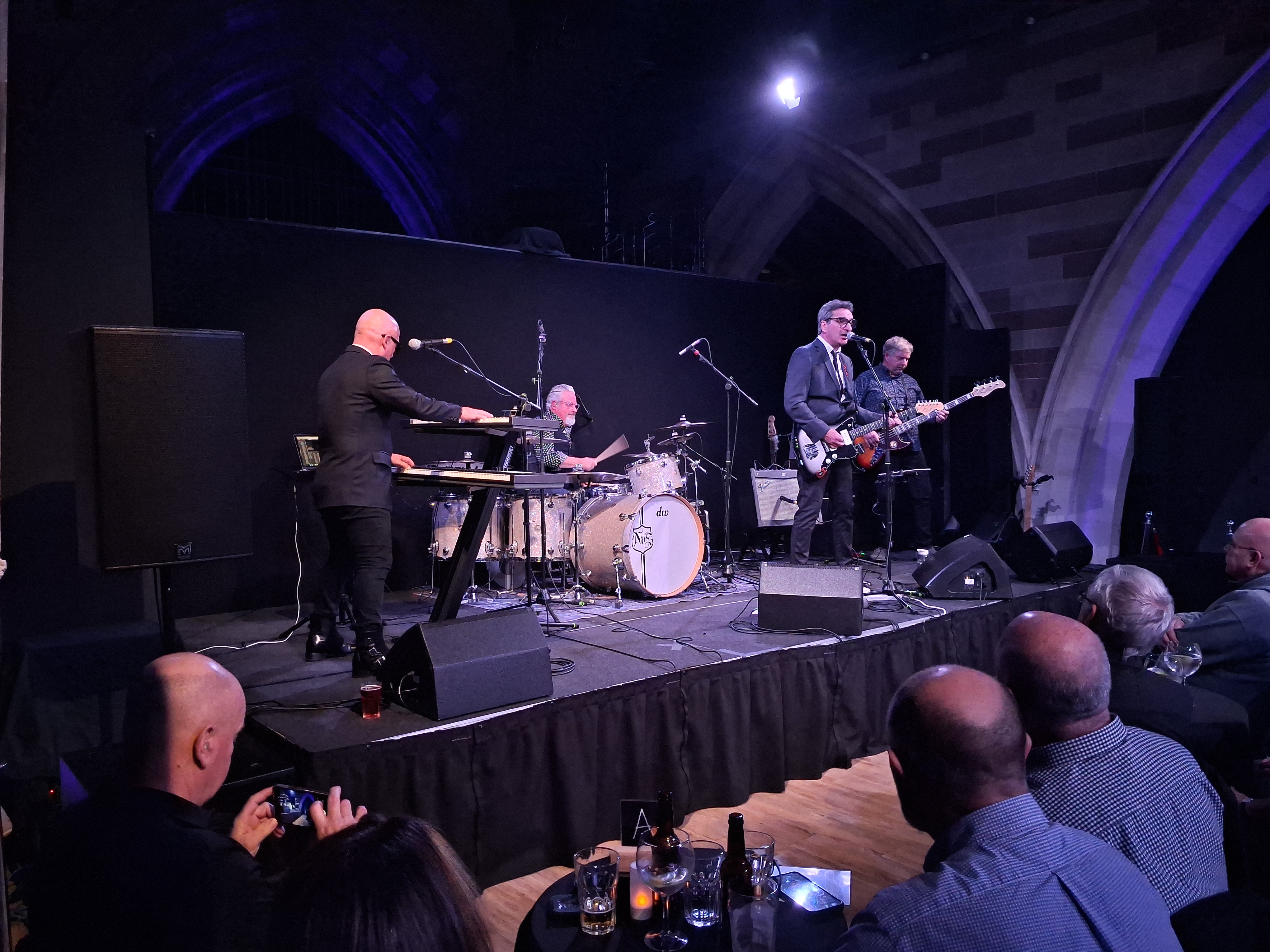
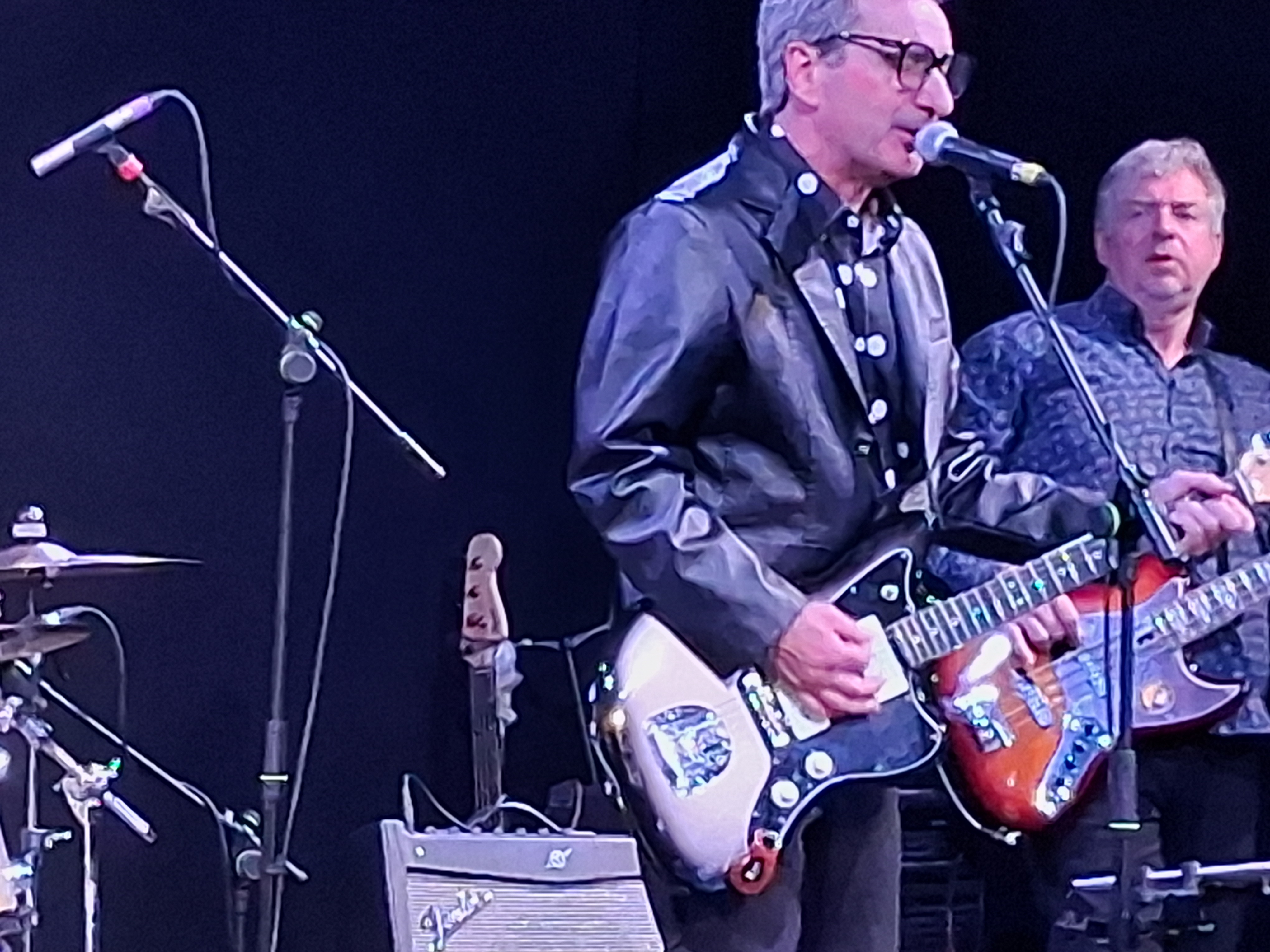
Tom Bradshaw features as Elvis, physically similar, but not slavishly so, Boris Brain delivers an astonishingly faithful keyboard sound. The drums and bass authentic and relentless and fluid respectively.
One of the challenges for an Elvis tribute is that only two songs were big mainstream hits, Olivers army” in the Uk, selling half a million, and Veronica in America, No 19 on Billboard. But there are numerous associated musical gems, amongst them his cover of “Good year for the Roses” and “Shipbuilding” covered by Robert Wyatt, and Alison covered by Linda Ronstadt, beyond that there are numerous cult classics which appear in the set.
Overall, including interval, they played for two and a quarter hours over two halves. My personal highlights were Clubland and King Horse, fan favourites included Watching the Detective and Whats so Funny About Peace Love and Understanding.
A rewarding night, from a superb accomplished band whom I not only unreservedly recommend ,but whom I will also be going to see again when I next have the opportunity.
I have always been a massive rats fan and was there for their first full UK tour in 77. Thy were the best live band around when punk broke – and that includes The Jam and the Clash.
Their star waned as the seventies closed, they were unable to keep producing high quality songs at a time when new bands were breaking who could do just that.
Ironically their musical high water mark- “Mondays” was also their nemesis. It was wholly atypical of their material. It alienated their die hard punk fans and set a benchmark for their new fan base which they could not possibly emulate.
Geldof is 74 years old now. Although there are peers who are older frontmen ( Iggy pop, Jagger) this tour will surely be his last hurrah
The unbilled support act London based “The Horn” offered ostensibly indy fare, but really harked back to Simple Minds and Duran Duran. They were politely received.
I love Bob, but he can border on the preposterous, and the documentary celebrating the Rats past fifty years was preposterous. It is fifty years since their inception, they have not had fifty years of success. The snippets from the early years merely serving to emphasise what is gone. A few bars of the magnificent Born to be Wild inspired Mary of the Fourth Form teased and tormented in equal measure, but is impossible to play live now in The Jeffry Epstein. Prine Andrew/ Jimmy Savile era.
Symphony Hall is acoustically one of the finest auditoria in the world- but the dialogue was muffled- no excuse for whoever was in charge of sound.
Those sound issue persisted. The chiming piano intro to the opening “Rat trap” was lost in a sludge of guitars. As the show unfolded matters did not improve.
Opening with Rat Trap was bold- sometimes Springsteen would open with Born to Run. When opening with your biggest song works, it sets a high water mark which does not recede. When it doesn’t- you have blown your best song.
Eva Braun, is a routine rocker, Like Clockwork, an irritating novelty song, the energy dipped.Never mind, next up was Neon Heart a great rocker, it fell flat.
Bob then decided that he would stretch out the routine rocker “She’s Gonna do you in” from four to ten minutes courtesy of a blues harmonica solo. Only three people are allowed harmonica solos, Neil young ( Heart of Gold), Bob Dylan ( Blowing in the Wind) and Stevie Wonder ( Isn’t she Lovely). And that is it. There is a reason for this. They are rubbish. Bob proved the point.
“Mondays” was good- with a poignant Gaza monlogue. Close as You’ll ever be was ruined by a poor arrangement. “f*** the world” was embarrassing, fine if you are 14 not when you are 74 and certainly not sing along material. Modern was very good- and the show should have ended there.
Rat Trap
(I Never Loved) Eva Braun
Like Clockwork
Neon Heart
(She’s Gonna) Do You In
Monster Monkeys
Someone’s Looking at You
I Don’t Like Mondays
Whole World
Close as You’ll Ever Be
When the Night Comes
She’s So Modern
Banana Republic
Diamond Smiles
The Boomtown Rats
The truth is that without Johnny Fingers and Gerry Cott who are both pursuing other musical projects the band is shorn of its original musical dynamism with Garry Roberts sadly now dead. It’s over- but thanks for some great memories Bob
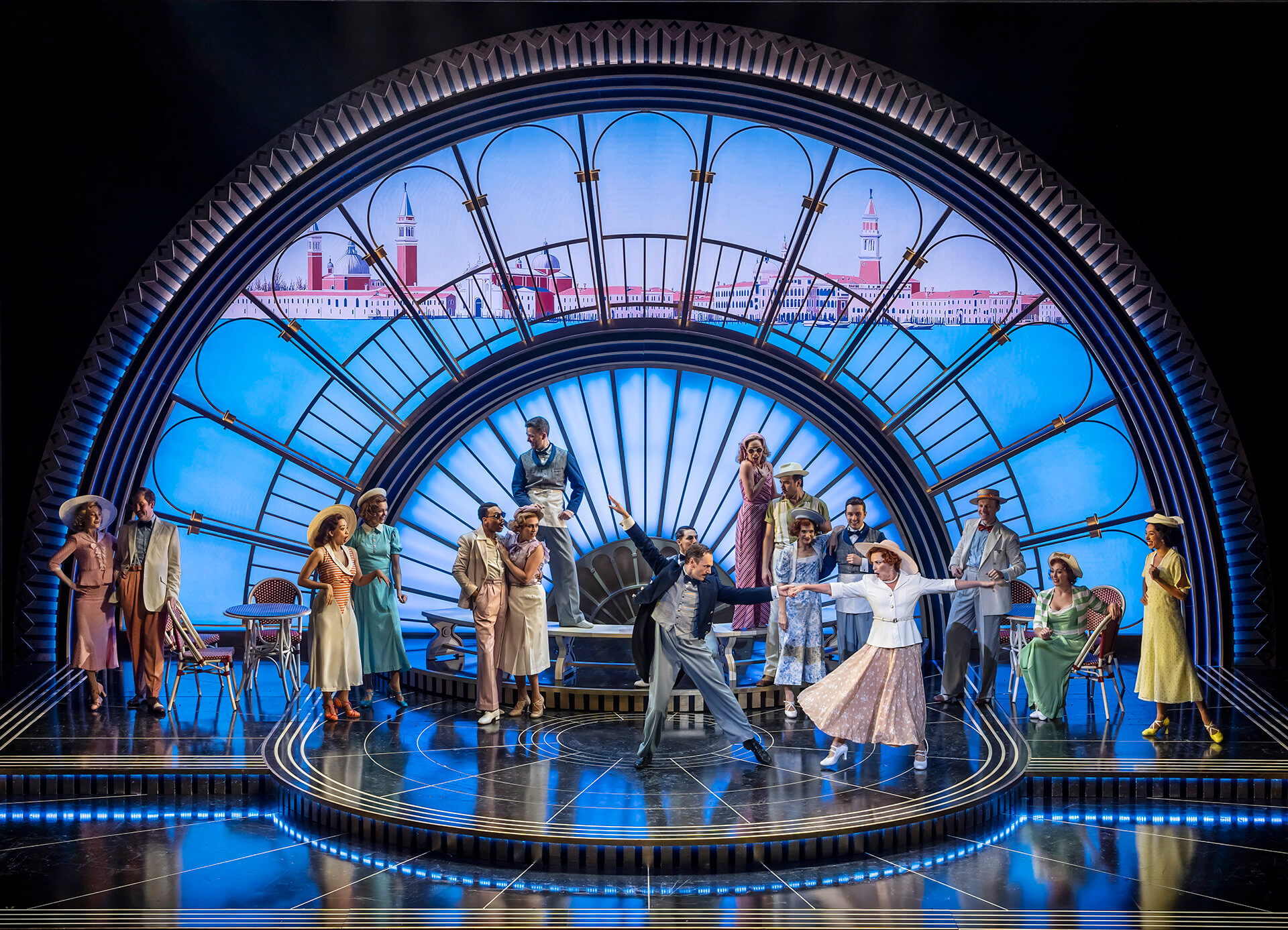
Autumn is here. Its becoming cold- surely a cue for some old style Hollywood glitz?
If you like song and dance, particularly tap dance, then this is your show. Visually it is a sparkling, frothy fizzy cocktail of mistaken identity and razzle dazzle.
The story is merely a loose framework for episodic spectacle, showcasing some of the best of Irving Berlin’s timeless melodies, namely: “Top Hat, White Tie and Tails,” “Cheek to Cheek,” “Puttin’ on the Ritz,” and “Let’s Face the Music and Dance”.
Stephen Ridley’s musical direction is impeccable
The choreography is immaculate, featuring dazzling solo dance and stunning unison tap dancing from this wonderfully talented cast.
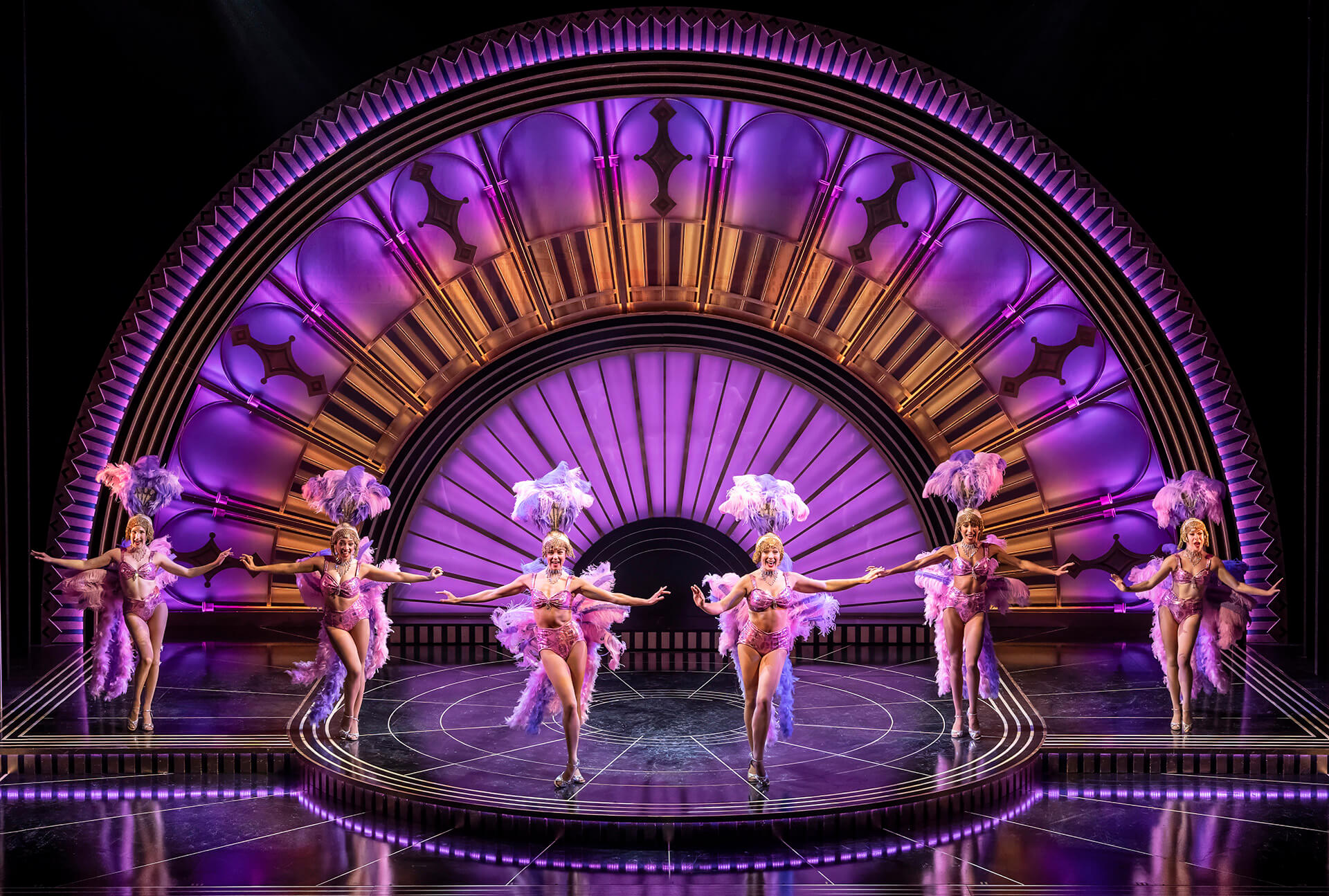
With great songs, you need great dance. The sparkling choreography and the syncopation in full cast tap dancing numbers is flawless, courtesy of Kathleen Marshall framed by a superb, memorable set, design by Peter McKintosh. It features revolving Art Deco clock-like motifs , incorporating frantic scene changes from bedrooms to bars then hotels to aircraft. Tim Mitchell’s Lighting adds a glamourous veneer. The band , complete with boisterous horns, is a delight. Costumes by Yvonne Milnes and Peter McKintosh are shimmering and sharp.
My recollection of the story is of the 1935 RKO motion picture where Astaire and Rogers set a defining standard with impossible precision and effortless chemistry, blurring the distinction between acting and dancing.
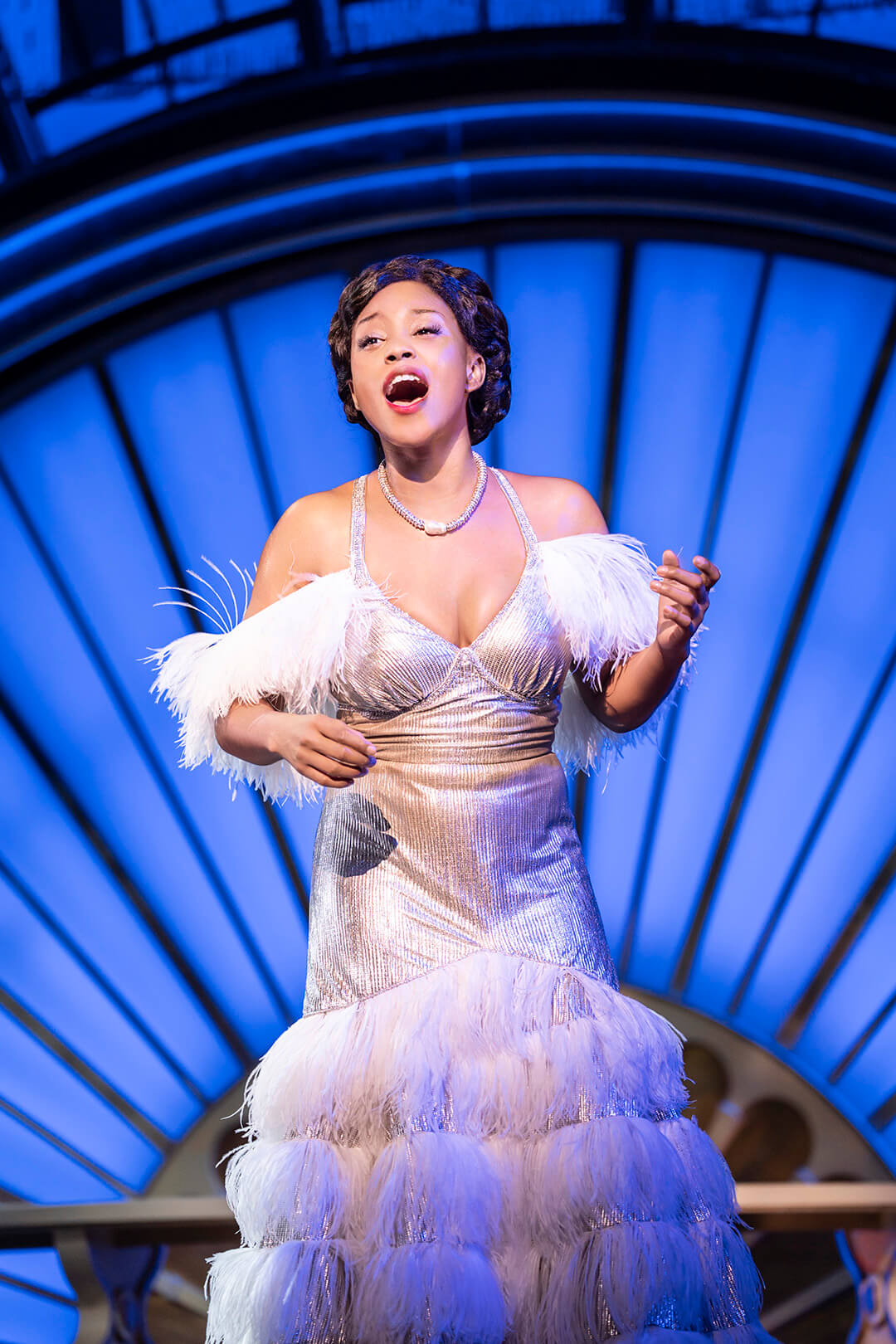
It would be unreasonable to ask for that to be replicated. It isn’t, instead we are offered something different. Phillip Attmore ( Jerry Travers) is a convincing tap dancer, supple but sharp, opposite him plays Dale Tremont (Amara Okereke). Okereke is visually great with strong vocals, however their romance plays second fiddle to the comic sub plot characters.
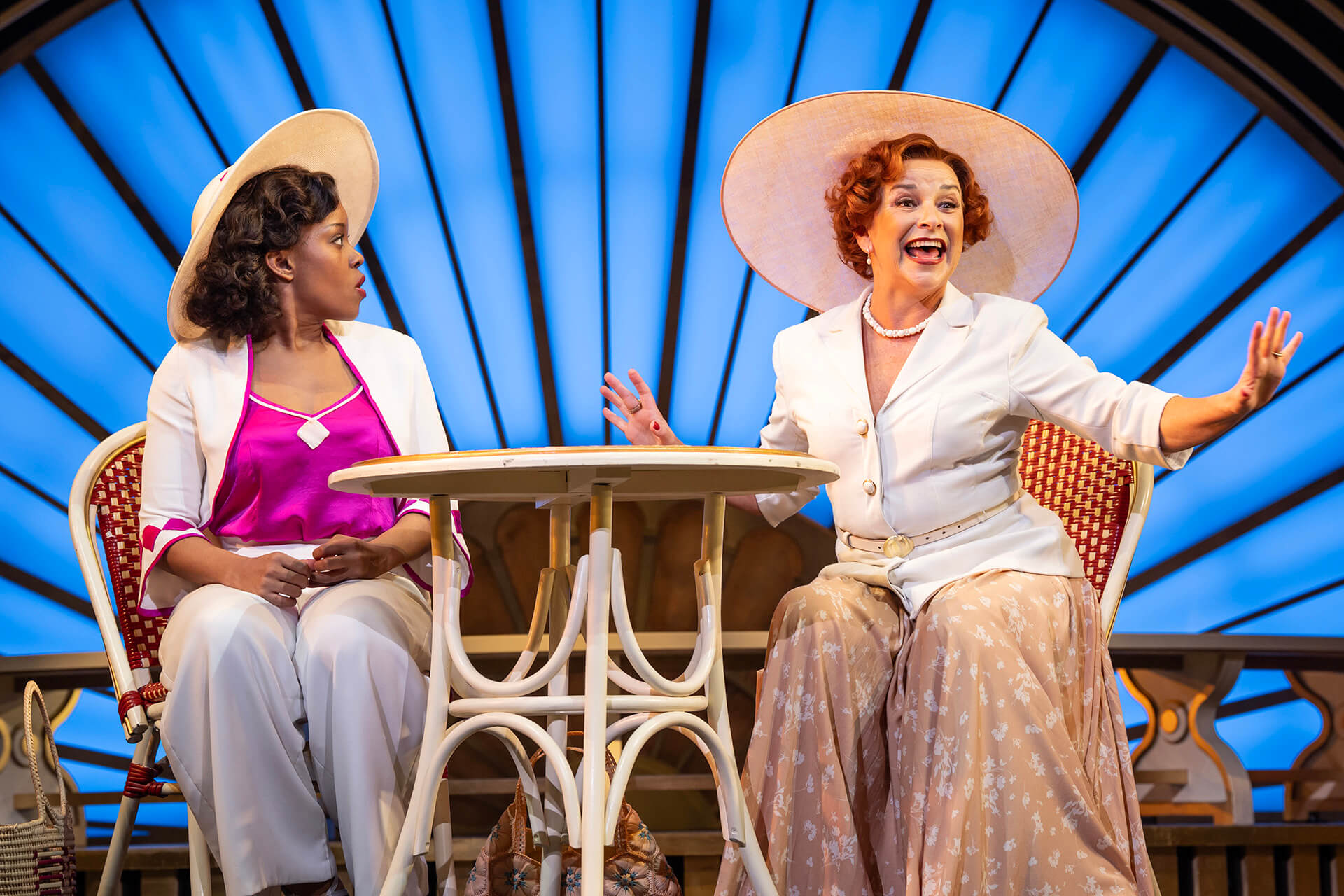
Producer Horace (James Hume) and his wife Madge (Sally Ann Triplett) are at the centre of the comedy, Triplett is brilliant as Madge, and dominates every time she appears on stage with Hume her hapless foil. Belly laughs on a mid week matinee are difficult to come by but Triplett succeeded time and time again channelling a combination of Lucille ball and Mrs Slocombe. Their partners in crime are almost as hilarious. Horace’s manservant, Bates (James Clyde) is witheringly dry, and a fine looking woman in drag. Alex Gibson-Giorgio’s gloriously outrageous chef Beddini is superb.
You cannot beat Astaire and Rodgers. This production does not aim to. The triumphant “Putting on the Ritz” is impossible to surpass, instead the ensemble deliver the remaining classics with enthusiasm and verve- and that is enough.
This show excels at farce and is hugely enjoyable for it, a celebration of the diversity and allure of musical theatre. Richard Pitts’ direction breathes life and humour into a libretto which is now ninety years old- and is still funny. Quite an achievement. Continues on nationwide tour.
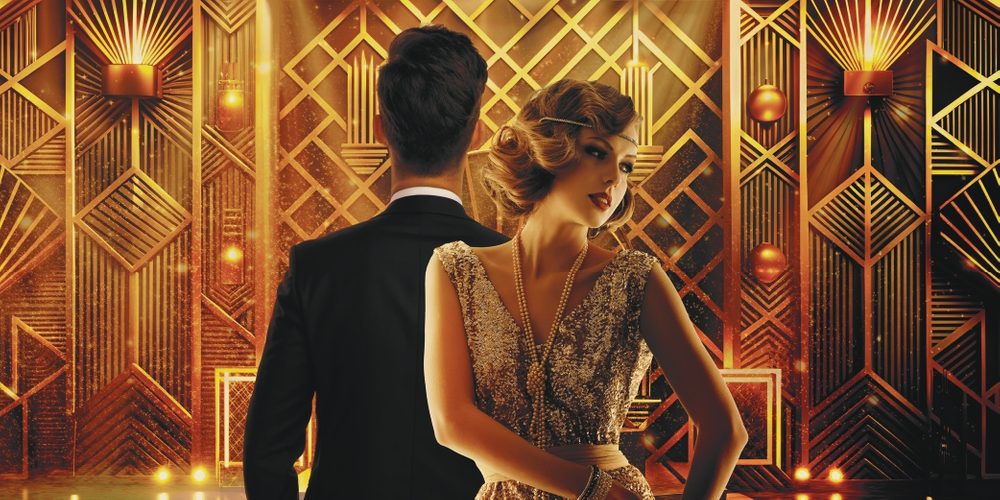
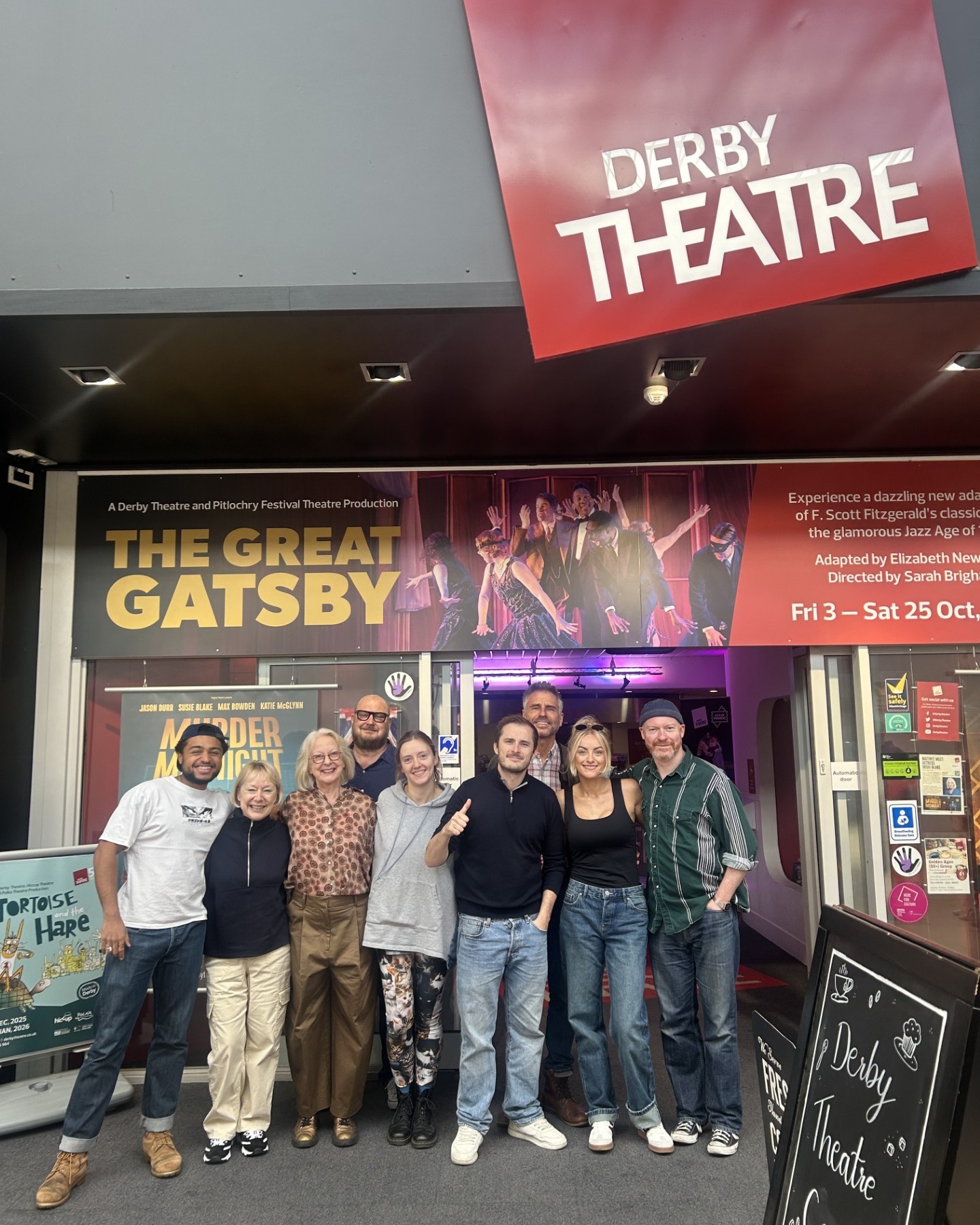
Hitherto The Great Gatsby has been defined by the original F Scott Fitzgerald novel and the 2013 Baz Luhrmann film. For this production which debuted earlier in the year at the Pitlochry Festival Theatre, Elizabeth Newman has adapted the original story for stage ,Sarah Brigham directs the results.
Director Brigham wrestles with the a story which shows how wonderful bring rich is, but interspersed with some sad and bad moments. Ivan Stott recreates Jazz Age music showtunes without the awkward bit of attempting to write lyrics to match Fitzgerald’s original prose. The Jazz Age ,with its gangsters and bootleggers , as presented here by Brigham , lacks the sinister edge of Weimar Berlin, whilst eschewing the glossy froth of Luhrmann its character dependent upon the quality of the lead performances
The story is set in 1922, the year that began with the publication of Ulysses and ended with The Waste Land. Its brevity and acuity is legendary, sensibly, those attributes are to be seen in this new script.
Scott Fitzgerald’s The Great Gatsby was first published exactly 100 years ago. Never at any point during the 1925 book’s near century in copyright did Fitzgerald or his Estate allow a musical adaptation .However the copyright expired in America two years ago and now there are two US musical adaptations : Florence Welch’s Gatsby and one directed by Marc Bruni and this.
The film is a blueprint for the portrayal of glamour, excess and Jazz Age opulence. Jen McGinley’s sumptuous set succeeds in shrinking that grand vision onto the Derby stage without losing any of the vibrancy of the period. The stage is split featuring two grand staircases with a connecting balcony from which the music is played.
The film is a blueprint for the portrayal of glamour, excess and Jazz Age opulence. Jen McGinley’s imposing set succeeds in shrinking that grand vision onto the Derby stage without losing any of the vibrancy of the period. The stage is split featuring two grand staircases with a connecting balcony from which the music is played.
Oraine Johnson swaggers and strolls as Jay Gatsby, dancing with style, panache and confidence, suspended between chasing the future and longing for the past: the present means nothing to him. His downfall movingly unfolds.
Fiona Wood and April Nerissa Hudson excel with their vocals. Wood is excellent as the long suffering upwardly mobile wife to lothario husband Tom (Tyler Collins). David Rankine as writer and narrator Nick is the vehicle through which events unfold, he does a seamless job drawing events together.
Although the rags to riches story is the nub of proceedings, contemporaneously we have the Epstein story omnipresent as a cautionary tale of entitled bacchanalian excess and the trial of Sean Diddy Combs’ decadence as an unspoken backdrop.
Wisely, Newman’s adaptation does not attempt to redraft Fitzgerald’s masterpiece as a musical rather than novel, nor does she seek to explore the dark underbelly of the source of all this wealth . Instead she offers a glittering musical romance underpinned by the Tragedy of careless people.
The finale elevates the production onto another level bringing together the holy trinity of Newman’s fluid words, Brigham’s sharp direction, and David Rankine’s outstanding performance as Nick. His closing soliloquys bring the pathos of Shakespearean Tragedy at its best into the auditorium.
A hugely enjoyable evening. Runs until October 25th
I have been a fan for many years and own many of her albums but this was my first opportunity to see her live
Sadly ,I was disappointed. I expected a Jazz, not MOR easy listening set. However we experienced a recital, not a concert performance which would have been better suited to several hundred at Ronnie Scott’s, not a couple of thousand at this prestigious venue.
Her audience interaction was minimal, she was largely obscured to the majority of the audience sitting parallel to the audience offering a profile shrouded by her long hair to some. I had come to hear her playing and singing, not extended double bass and drum solos, worthy as they were.
Of course we were treated to Krall’s exceptional piano dexterity “All or Nothing at All” featured Krall’s eclectic phrasing, “I’ve Got You Under My Skin” simmered slowly. “Do Nothin’ Till You Hear From Me,”, featured her dazzling cascading runs and melodic tension as did a glowing interpretation of “Fly Me to the Moon,”. “In the Wee Small Hours of the Morning and “They Can’t Take That Away from Me,” were melancholic class
But The mood was overwhelmingly sombre and downbeat. The set featured a few spotlights and no video screen and just two supporting musicians. That’s £150,000 box office less petty cash. Nice work if you can get it. Several left before the end.
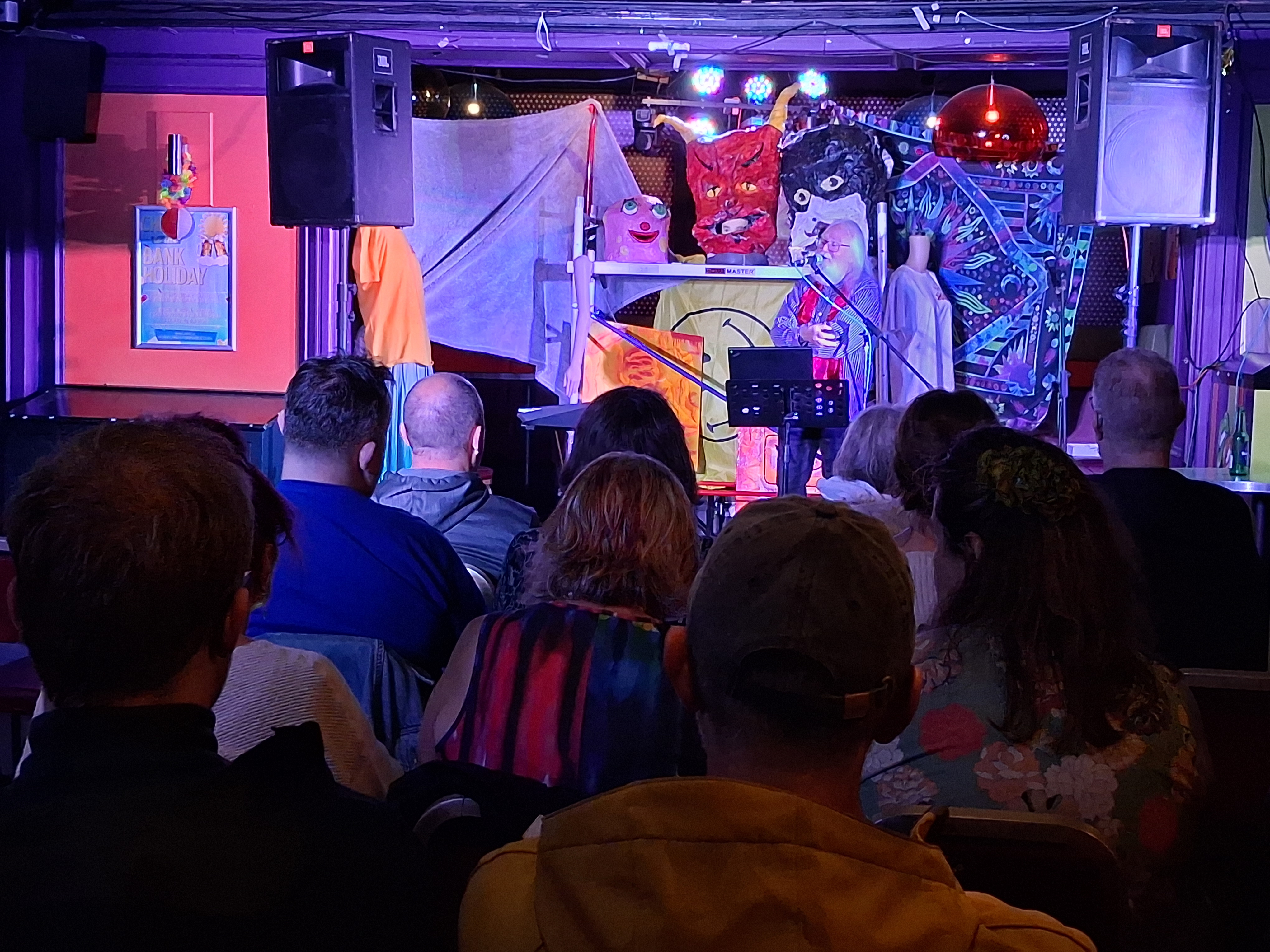
I have attended numerous music festivals, and some Mind Body Spirit festivals , but never a Poetry festival of over a days’ duration. I decided that Morecambe was the perfect opportunity to redress that omission. What follows is not a review, more a capricious record of some fond memories.
I had never been to Morecambe before. It was far enough away (120miles) to be an adventure but close enough to be a comfortable journey. And over four days there were bound to be some poets I liked. There were.
I travelled alone, but with the poetry community you are never alone, and I knew that I would soon find like minded souls. I was right.
Thursday night was an informal welcome night in the Bath pub. It was a large boozer with a small stage in the corner. I wondered how the locals would react to their boozer being occupied by poets. The pub slowly filled, and filled, any locals engulfed ,till around 250 people squeezed in. “Perhaps we should have poetry nights every night! quipped the landlord.
The totemic, charismatic, organiser Matt Panesh opened proceedings serving up – a course of tantalising poetic hors d’oeuvres. It was a bit like seeing Deep Purple open their set with “Smoke on the water” as the winner of last years local poetry competition and joint winner of this years’, Trystan Lewis, produced a scintillating start combining socially aware poetry with physics (you had to be there). Rosemary Drescher and Hannah Wood subsequently caught my ear before we decamped to the upstairs of the nearly next door pub, an old night club.
“We’re running a little late” joked Matt introducing the strapline for the event. ( who cares I was there for five days!). I had come for the event, not names and to be surprised, and delighted- which i was.
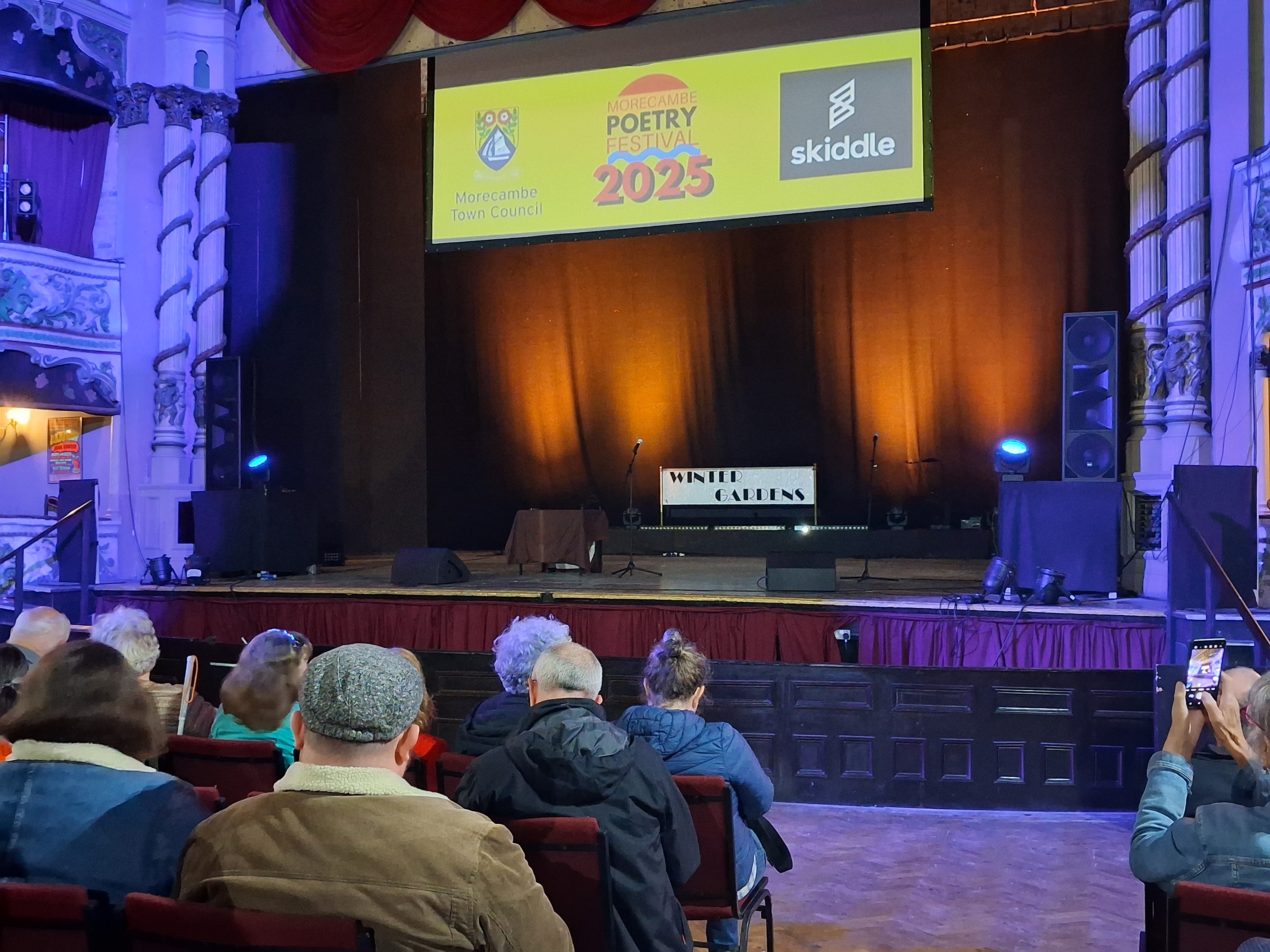
On Friday the event proper commenced including the first evening show at the magnificent, full, 800 seater Winter Gardens.
John Hegley topped the bill with a reliably assured set, but it was his support , Jan Brierton, from Ireland who shone , performing extensively from her book “Everybody is a poem”. Catch her while you can, a great poet and a thoroughly delightful person in person. She gave generously of her time to me.
We then decamped to the Kings Arms for Luke Wright who came on stage at around 10.45pm to a “lubricated” audience- he was in his element. Luke is an extraordinary performer and blazed through an incendiary set combining stand up comedy, poetry, and errr, Luke Wright! Unquestionably the performance of the weekend.
Which posed a problem for the fine Lisa Moore, a gifted poet of a more considered,cerebral style who had to come on stage at 11.45pm … she did well, but through no fault of her own, “The time was out of joint”. I felt for her, and told her as much after.
Graham Parker the pub rock great once declared that :“Saturday Night is dead.” Not in Morecambe it isn’t.
Henry Normal opened the Winter Gardens in the evening, urbane, loquacious and eloquent. Nigel Planer stole the evening. Very wittily he came on stage and informed us how much older we were all looking since he last saw us… he romped through a failed relationship with an older woman, two failed marriages and his return to the original woman in a wonderful, humble, self-deprecating performance that Neil would have been proud of.
At the Kings Arms, Geordie Rowan McAbe ripped it up, and my old friend Jonny Fluffypunk fluffed delightfully.
Sunday afternoon was an absurd smorgasbord of talent at the Kings Arms. Manchester’s Rowland Crowland triumphed alongside John Darwin. Heathers Moulson and Sullivan alongside Anna Somerset and Sharon Green performed as a quartet, “Into the Blue” was a deeply affecting poem about a walk in a bluebell wood to remember a deceased friend
In 2011 I attended “Hit the Ode” a poetry night in Birmingham. I started chatting with an extraordinary young woman who used to live in Cambridge, as I did, who then went on to perform an equally extraordinary set. Her name was Hollie McNish. I had an identical sense of impending greatness when I met Louise Fazackerly, who effortlessly combines personality, poetry, pith and pizzaz. Her dazzling set melded pathos, humour, incisive observation and fun. One of my favourite music albums is by the Verve- “Northern Soul”- it sums her, and her poetry up perfectly
Yet at the Winter gardens it was not over. Clare Ferguson Walker blitzed the opening slot, Michael Rosen offered more sedate reflective fare and inexplicably did not reference his outstanding new children’s book “Oh Dear, Look what I got” the natural successor to “Bear Hunt”, but to be graced with his presence was enough. Three of my grandchildren now have a signed dedicated copy each – thanks Michael!
What is the Morecambe poetry festival like? When buying a festival t shirt I discovered that they were out of stock of my size. “Don’t worry” said a volunteer who was the same size as me, you can have mine in an unopened packet…. A word of advice to newcomers. I arrived on the Thursday and left on the Monday morning, essential if you want the full experience and can afford the time.
It returns 18/20th sept 2026, I shall be there, will you?
A fan once said to legendary Liverpool football manager Bill Shankly:
‘To you football is a matter of life or death!’ , he replied: ‘Listen, it’s more important than that’.
The two great loves of my life are football and theatre. I approached this production with trepidation. Could it do justice to either? Football plays are thin on the ground. Peter Terson’s 1967, “Zigger Zagger”, and that is about it. There is a reason for this, it is a very difficult subject to realise convincingly on stage. That difficulty is compounded currently by the wave of nationalist political sentiment popularly expressed by England flag displays swathed in a myriad definitions of what England is about. The moment is both auspicious and dangerous. This production is rewritten from the 2023 original to incorporate subsequent events. This review offers no narrative as there are a number of surprise delights. Rupert Goold directs with vim and vigour, bringing playwright James Howard’s script alive, a local Nottingham boy made good.
Centre stage is David Sturzaker as Gareth. He is magnificent, from my front row seat every trademark eyelash flutter and facial nuance was apparent as he journeys from failed penalty taker to the most successful England Manager since Sir Alf Ramsey.
At his side is sports psychologist Pippa Grange ( Samantha Womack). Womack is a revelation on stage freed from the constraints of her television roles- most notably with East Enders.
The cast of twenty three is massive, how the production can make money is beyond me. The story of the cultural and psychological development of Southgate is interspersed by numerous hilarious comic character cameos ( Allardyce/ Taylor/ Capello/ Boris Johnson/ Theresa May) and a script with laugh out loud comedy.
Yet Howards’ script gently, and powerfully touches on racism, masculinity and national identity in a way which illuminates rather than shouts, and, unlike the England team itself, is consistently, entertaining. Multi- layered, it explores the national team, Southgate himself , our own collective sense of national identity , and how we deal with the past, and trauma, “Dear England is , in the theatrical sense, not the political sense, a populist play. with the audience encouraged to join with the songs “Sweet Caroline ” , “World in Motion ” and “Three Lions” . The terraces meet the stalls.
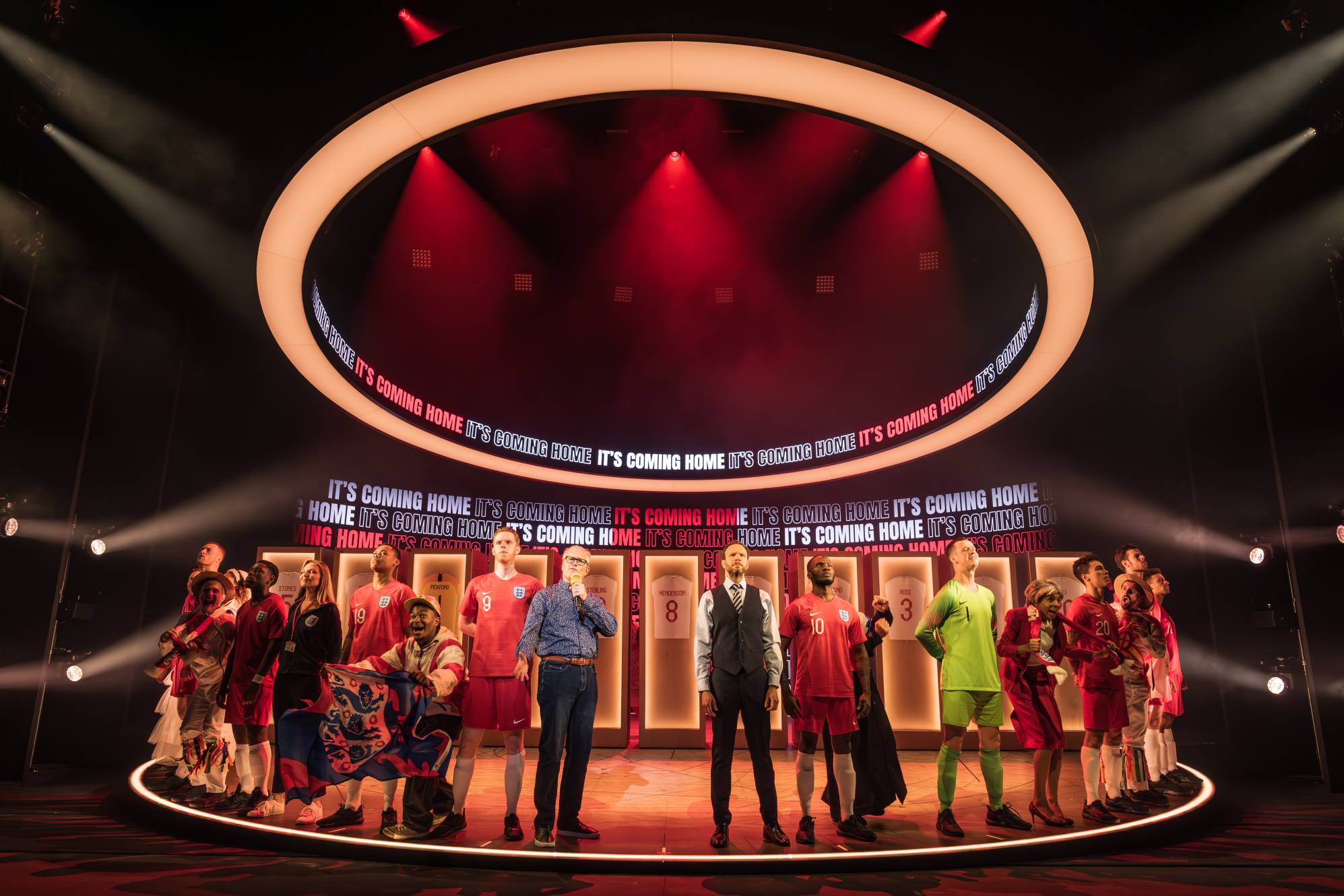
Director Rupert Goold, choreographer Ellen Kane, and designer Es Devlin combine to create a confident, bombastic feel to the production. A circular floor and ceiling lit circular surround put its characters literally in the spotlight.
If you love theatre, but hate football – or vice versa – I would heartily recommend you watch Dear England, which runs until Saturday, September 27 and continues on National tour
“I always think: ‘What if this is the first play someone ever sees?’ That’s always in my head, whatever the subject matter,” he comments that he didn’t grow up with the theatre, and saw his first play in London in his 20s: “I don’t have an arty family.”
Therefore, he was very aware that it was the football story that attracted thousands of people to see a straight play for the first time in the West End.
This made the opportunity to give the play a regional premiere and a tour even more vital: “I advocated very strongly for it… It’s the national game and it’s the National Theatre. It should go around the nation.”
I went to the same school as Gilmour ( Perse) and lived in the city ( Cambridge). We were not contemporaries at school, but I recall seeing Syd Barrett around Cherry Hinton, a Cambridge suburb and pink Floyd were very much the local boys made good with “Dark Side of the Moon” and “Meddle “ epoch defining records. I was, am, and will continue to be a fan of almost sixty years standing.
Gilmour’s guitar prowess is a given, but this is dreary stuff save for an inevitably majestic “Comfortably Numb” the hymn for the “Comfortably off” who can afford £400 a ticket prices.
The running time is almost 3 hours, and 2 hours in I was checking my watch. This was dreary fare which could have been livened up by some chariot racing. It felt like Dire Straits/ Mark Knopfler or Chris Rea, worthy, meticulously crafted, but dull.
It is September , the children are back at school, temperatures are falling and Derby Theatre has a scorching world premier tour from leading contemporary playwright Torben Betts to open the autumn season.
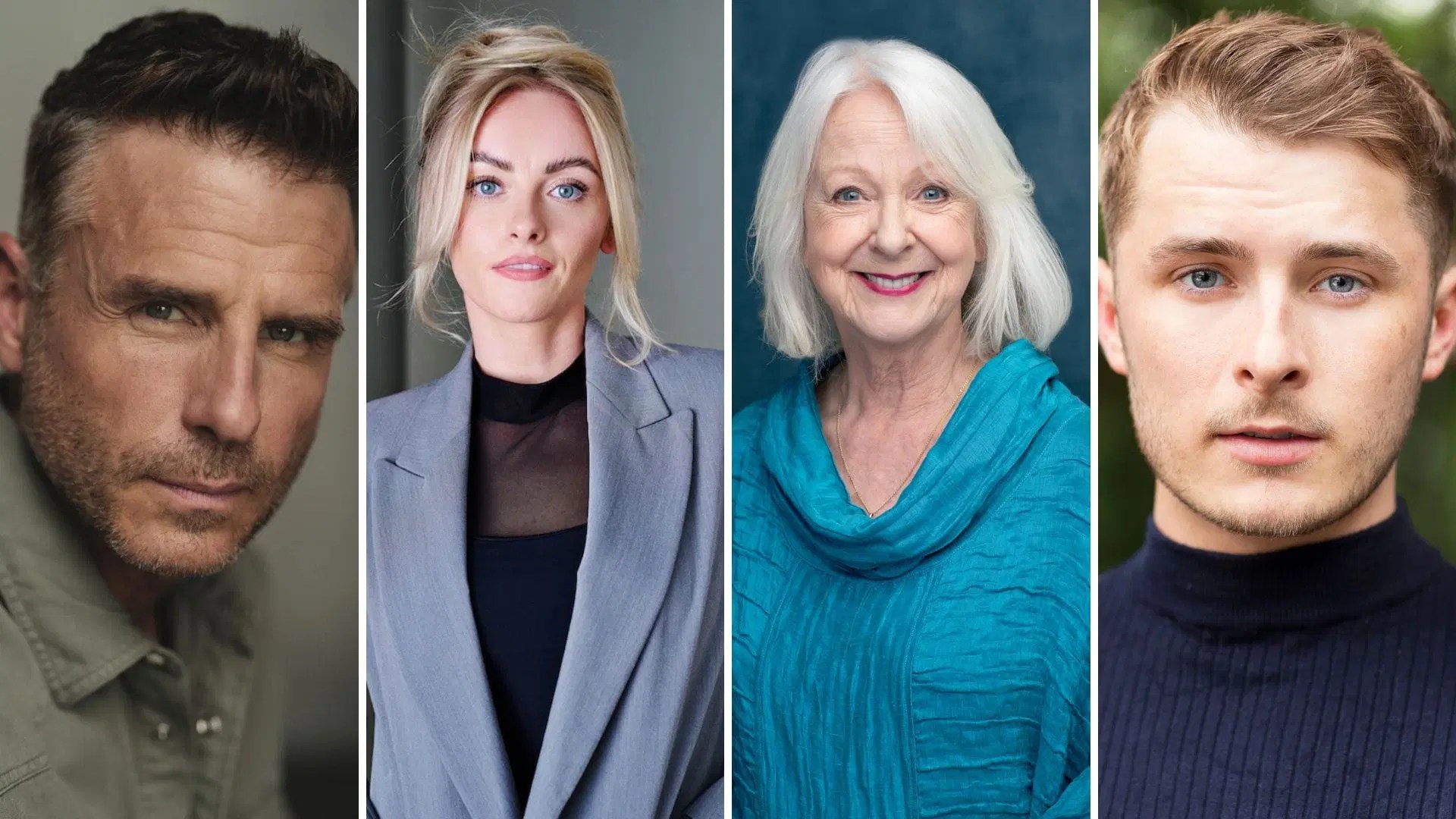
A strong cast of television veterans includes Jason Durr (Heartbeat, Casualty) as Jonny the Cyclpos, Susie Blake ( Coronation Street) as Shirley, Max Bowden, ( Ben Mitchell in EastEnders) as Paul , and Katie McGlynn (Waterloo Road, Coronation Street, Hollyoaks) as Lisa
Performed by the Original theatre company , Murder at Midnight is a cross-genre piece incorporating, crime, comedy, thriller, murder mystery and madcap farce set on New Year’s Eve in a quiet corner of Kent. There is a killer on the loose. Within are gangster Jonny ‘ Cyclops’, his glamorous girlfriend Lisa , his emotionally volatile sidekick Trainwreck, his clairvoyant mum—who’s seeing things, her very skittish foreign born carer, plus an undercover detective, – and a burglar dressed as a clown. That is quite some New Years Eve gathering.
A safe full of cash and drugs, a stash of deadly weapons, and one unsolved murder spice the evening up.
One house. Seven suspects and a Murder at Midnight…
Philip Franks’ direction is pacy, brisk and energetic. The two hour long halves never outstay their welcome. A split-level single set ( by Colin Falconer, lighting by Jason Taylor) incorporating an open plan lounge/kitchen, study, bedroom and back alley works well, Sound by Max Paapenheim majors on Jonny’s favourite artist Robbie Williams and mercifully eschews Coldplay, the latter of whom are the butt of a very funny series of running gags.
After the success of Invincible, Caroline’s Kitchen, and Murder in the Dark this is Betts’s fourth play at Derby. It is also his best. It borrows from Jacobean revenge drama in the mould of Webster or Middleton. Director Franks has described it as Feydeau meets Tarantino which is particularly apposite for a modern audience.
The dialogue is snappy . The one -liners are whiplash fast and laugh out loud funny. I dare you to wear a Coldplay t shirt to the show. The body count is high, the stage drenched in blood for the brilliant finale. It isn’t just people who meet their maker- Rocjk DJ tragically is despatched to the great kennels in the sky too, where hopefully he will be better fed.
The principal cast are terrific. Betts has created a classic villain in Cyclops for Jason Durr to inhabit. Lisa his girlfriend, sassily played by McGlynn is much more than a dumb blonde. Susie Blake plays the psychotic mother with a wicked gleam in her eye, sometime demotic villainess in a winceyette nightie, sometime forgetful granny.
Betts is a master at teasing wit the motivations for his character’s actions, sometimes we find out, sometimes we don’t. He never seeks to explain why some people like Coldplay.
Cast also includes Callum Balmforth, Peter Moreton, Iryna Poplavska, Bella Farr and Andy McLeod.
Murder at Midnight plays until Sat 13th before continuing on nationwide tour at Birmingham, Cheltenham, Guildford, Malvern, Southend, York, Eastbourne, Cardiff, Fareham, and Bromley and in 2026 Salford, Blackpool, Ipswich, Northampton, New Brighton, Coventry, Salisbury, Bath and Darlington, with further dates to be announced.
My fifth cruise, my third transatlantic repositioning cruise from the Caribbean to the mediterranean on Voyager, my first journey on her.
Once again we were starting from Barbados, a long haul flight from Birmingham Uk and finishing with a relatively short hop from Palma Majorca to home.
Bridgetown Barbados is a curious mix of the ramshackle old town with an obvious drive to reinvent the waterfront as a trendy modern area, basking in the late April summer sun. The only shame is that an afternoon was not nearly enough time to do it justice
Next up was the beautiful island of St Lucia,, my third visit and this time we partook of some whale and dolphin watching which was excellent
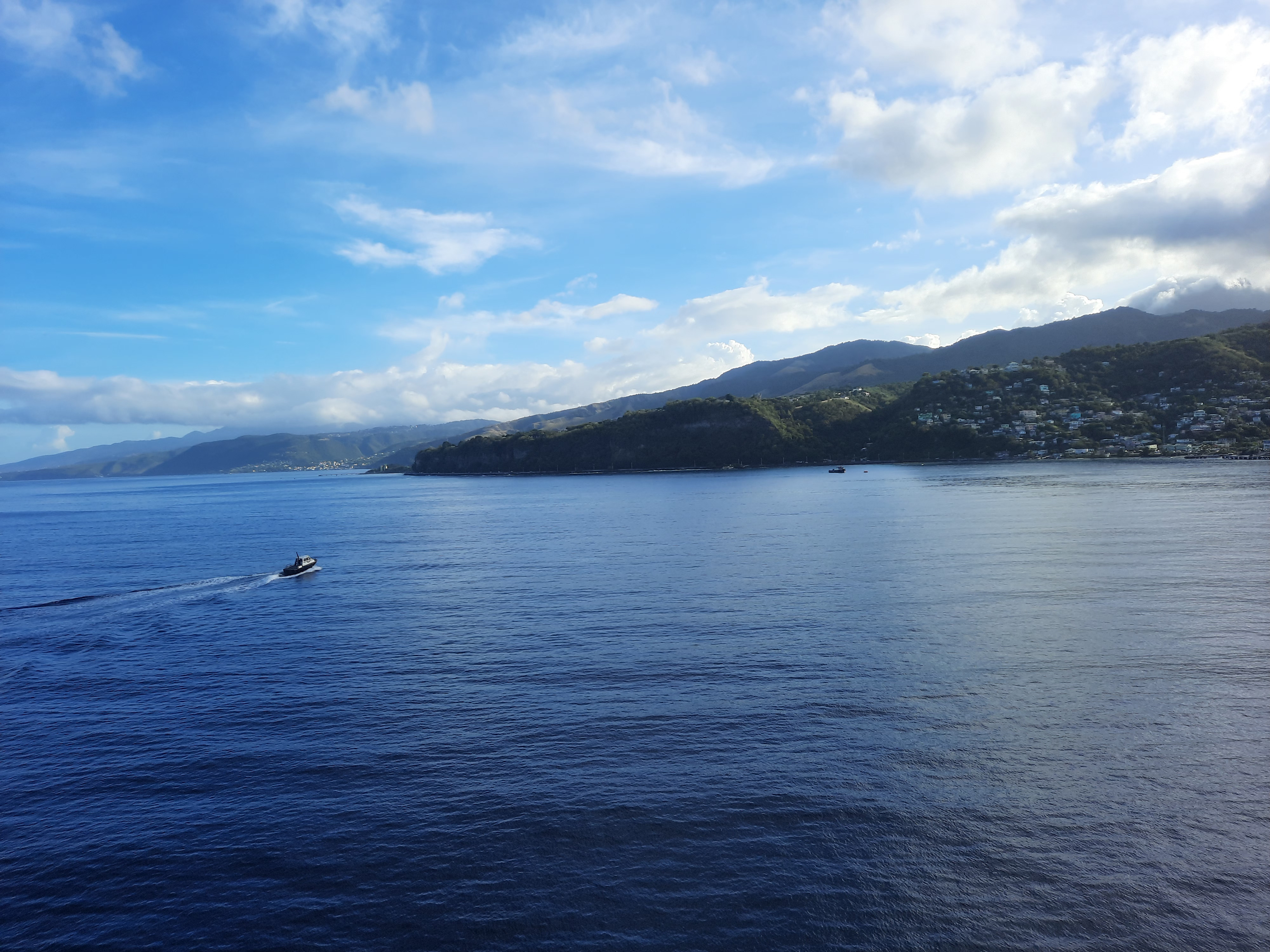
the following day was the island of Dominica, not to be confused with the much larger Dominican republic, small, underdeveloped poor and a set for the film “Pirates of the Caribbean”- there was no sign of Johhny Depp.
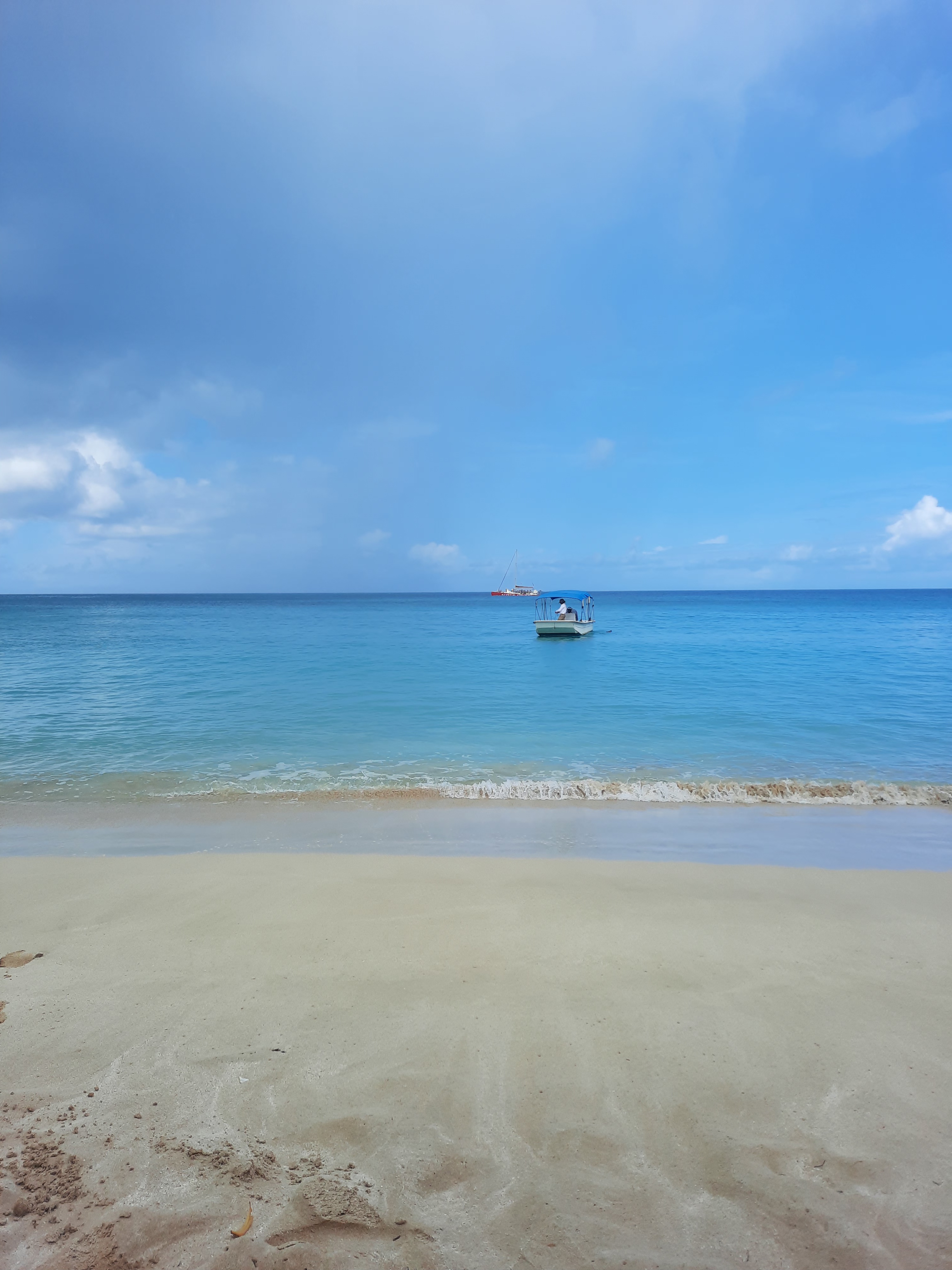
our final Caribbean stop was a favourite, Antigua at which we island hopped from beach to beautiful beach on a small boat
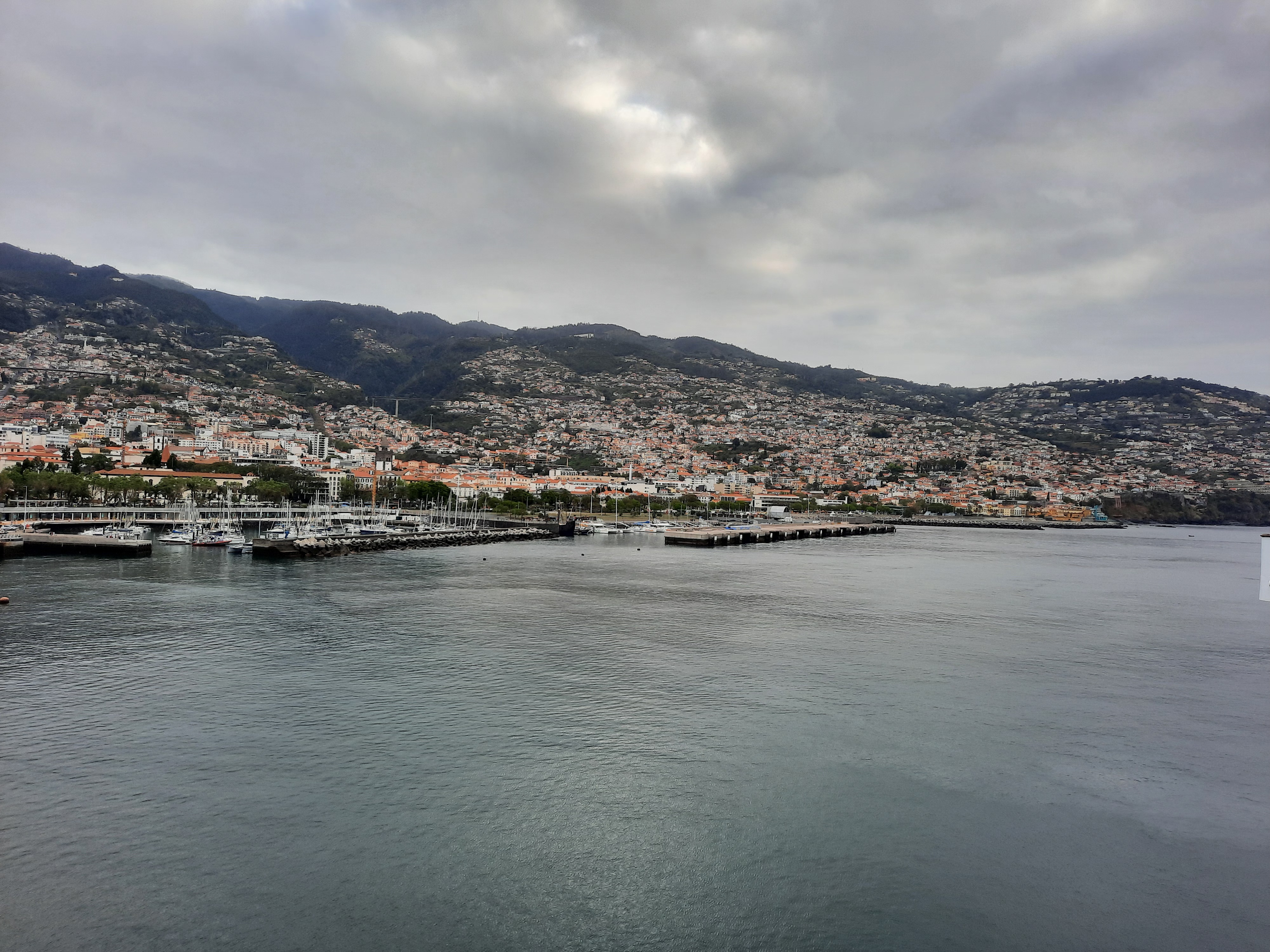
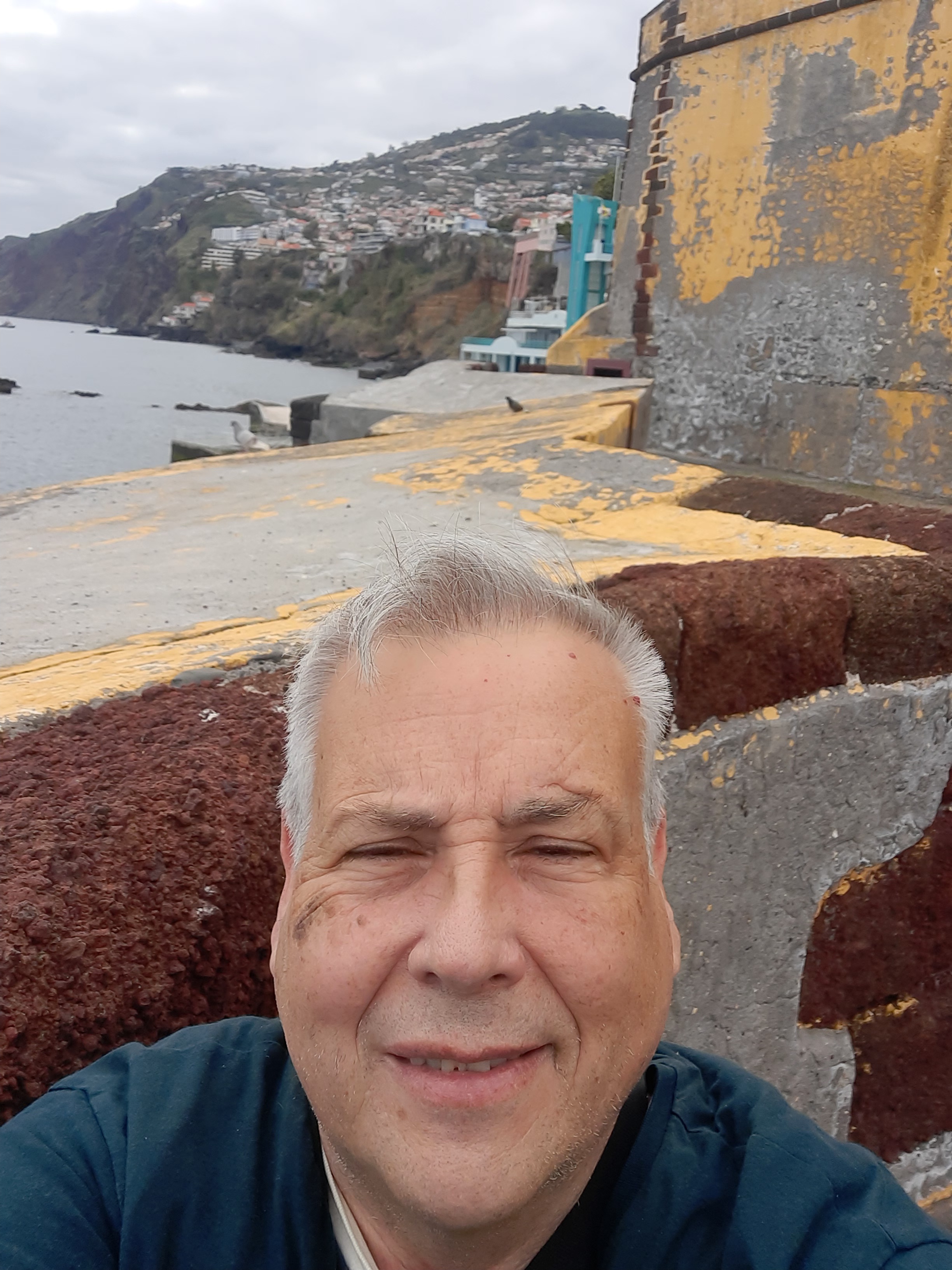
Seven full sea days then took us to the big surprise of the holiday for m, the glorious island of Maderira, great cake, great wined, great seafoof. Reids Hotel where Winston Churchill and Margaret Thatcher have stayed ( not at the same time) was superb
I had been to Cadiz before, it remains a wonderful city
Concluding in palma- it was a memorable cruise with madeira the highlight

















 Garyswordz