Flare Path- Derby Theatre


fp1

Anyone watching this play can be forgiven for a sense that it should be being performed in black and white as part of a double bill at the local Odeon cinema, such is the impact that the film version, The Way to the Stars” made.

Written, and first performed in 1942, by Terrence Rattigan, it tells the tale of a love triangle set in a hotel by a bomber base in World War Two. Rattigan’s contemporaneous wartime service in the RAF lends the writing an obvious sense of authenticity and immediacy.

The context in which it was written is an integral part of the piece. Remote air force bases in rural locations meant socialising was at a premium, which combined with an appalling death rate for bomber crew, resulted in romance being consummated fast, with tomorrow not necessarily a pressing concern. I have had the privilege of going inside a Lancaster bomber, although large on the outside, inside, it is cramped and claustrophobic. Spending several hours over enemy territory, freezing at 30,000 feet, being shot at, must have been terrifying.

Film and theatre were amongst the few sources of wartime entertainment. Inevitably a film about the war, in order to be successful, needed to be positive about the war effort and uplifting in its sentiment. Flare Path does just that. To modern eyes it may appear a little predictable and hackneyed, at the time it was just what the population needed, enjoying Winston Churchill’s endorsement.
Fp3

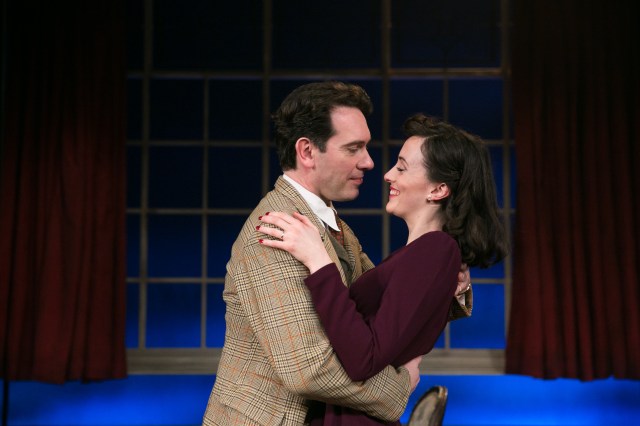
Kyle reacquaints himself with Patricia


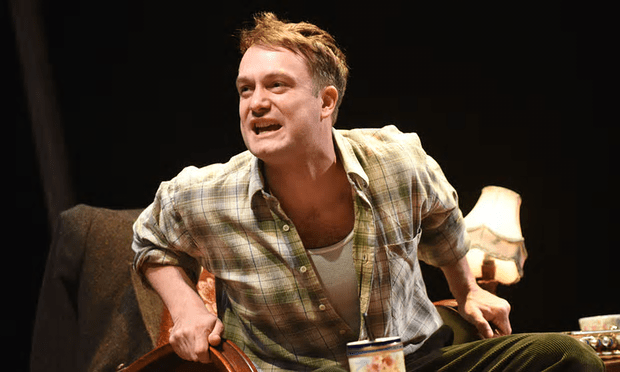
The love triangle takes in fading film star Peter Kyle, an old lover Patricia Warren, and her husband Teddy. Lynden Edwards is superb as Kyle, louche, smug and determined to win his girl back.  Daniel Fraser is outstanding opposite him as Teddy, brave, vulnerable and unaware of his wife’s past. Hedydd Dylan oozes forties glamour as officers’ wife Warren, tall, elegant and initially flighty, before events force her to reassess her relationship with her new husband.

Fp2

Teddy and Patricia


But this is no downbeat angst riven tearjerker. William Reay has the most fun as a Polish Flying Officer whose English is still basic, Audrey Palmer excels as Mrs Oakes, the formidable, colourful, Hotel Keeper .

Rattigan’s writing is a delight. The RAF slang is perfect, the comedy skilfully interwoven amongst the drama with several laugh out loud moments. The Pole provides not only much of the comedy, he also signally represents those from abroad fighting the Nazi’s, having suffered their own losses to the German war machine. The gunnery sergeant (Jamie Hogarth)  and his wife, enjoyably played by Polly Hughes, provide a slice of working class life in roles which hint at an upstairs/downstairs theme, but which are neatly counterbalanced by a stronger sense that everyone was in this together.

Particular mention should be made of Dominic Bilkey, the sound designer who has the vital role of introducing the distinctive sound of the passing aircraft, a sound which is unusually warm and reassuring. The incidental background music pre show, post- show and at the interval is similarly evocative.

Director Justin Audibert has done a fine job with this Original Theatre Company production which provides an accessible and rewarding entrée  into Rattigan’s work. Everything is understated. The valour of the airmen, the strength of the bonds between the protagonists, and the fortitude of the non- combatants, all pricked with self- effacing humour, or nonchalant asides.


Flare Path runs till  23/4 and continues on tour.

Gary Longden

This review first appeared in Behind the Arras, abridged, where a comprehensive collection of reviews from the best of Midlands Theatre, from a range of reviewers, is available.
http://www.behindthearras.com/

Posted in Behind the Arras Reviews | Tagged , , , , , , | Leave a comment

The Cat in the Hat – Lichfield Garrick Theatre


Cat2JPG

This poem has had pan- generational appeal since it was written in 1957 by Dr Theodore Seuss. Its combination of rhyme, rhythm, fun and mischief captivating children, and their parents.

Adapting the original poem has been a labour of love for Katie Mitchell, who road –tested the project on her four year old daughter, an idea guinea-pig, as the production is aimed at the three to six year old age group. Mitchell enjoys a controversial reputation as both the best director of her generation and cultural vandal, tearing up the works of Handel and Chekhov, then reconstructing them.

Cat3JPG

This new production is directed by Lillie Collier, designed by David Shields and produced by Paul Taylor-Mills Ltd. It is presented through special arrangement with Josef Weinberger Plays Ltd on behalf of Music Theatre International (MTI). Vicki Mortimer’s designs are faithful to the simple original illustrations, and the lively recorded score by Paul Clark adds much to the production.

Mitchell’s approach to the Cat in the Hat has been tempered by the forensically controlling rights holders, Dr Seuss’s Estate, ensuring that the story we all remember, and introduce to our children, is the story brought to the stage. Mitchell bravely produces each page as a self- contained scene. This has the advantage of fleshing out the story as each series of actions is acted out, but the disadvantage that the rhyming narrative rhythm of the story is broken up, occasionally feeling a little disjointed as a consequence

Cat4JPG

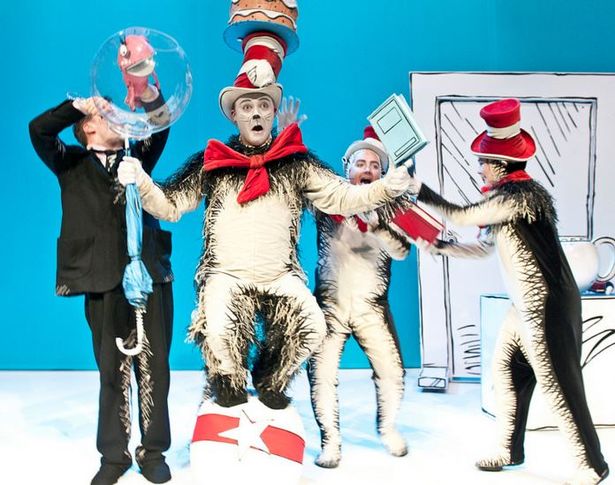
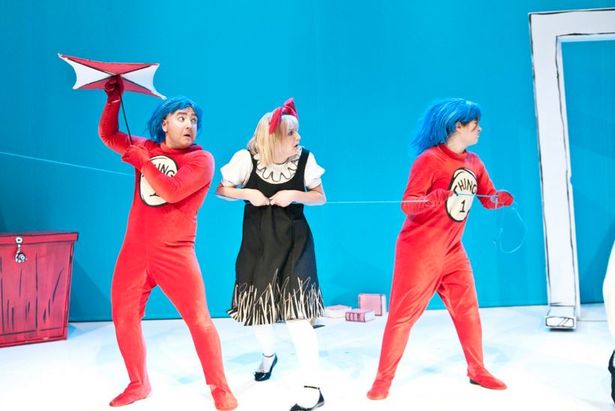
The joyful narrative is a delight, performed by six actors, amidst a riot of colour and physical excitement as giant balloons roll around the stage, and fly into the audience. When the Cat and Things 1 and 2 charge into, and in and out, of the audience, the children squealed with delight.

Naturally the Cat is the star, complete with towering, flipperty-flopperty hat, creating mayhem for home- alone Sally and her brother. Thing One and Thing two ably assist the Cat. All the children loved it, laughing along and maintaining concentration throughout a fairly brief show of around forty five  minutes with no interval.

Cat5JPG

The reply to the closing question asking the children whether they would tell their mother of the chaos that had unfolded with the Cats’ visit  if they had been Sally and her brother was a resounding “No!”

A first class, well-produced, and well –acted, children’s  theatre piece. The modest turn out, following a cancelled matinee was a shame. The Garrick now has many one and two- nighters. As a result, promotional space is slight to non-existent in a non-virtuous circle, and no programmes were made available to acknowledge the hard working production team on the day.


 The show runs till 19th April then continues on tour.

This review first appeared in Behind the Arras, abridged, where a comprehensive collection of reviews from the best of Midlands Theatre, from a range of reviewers, is available.

http://www.behindthearras.com/


Posted in Behind the Arras Reviews | Leave a comment

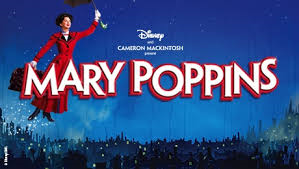
Mary Poppins, Hippodrome, Birmingham


mp4

One of my earliest memories of cinema going as a child is a trip to see Mary Poppins. It was a magical story then, and that magic has endured. The stage show is not a transposition of the film to stage, but instead from book to stage, offering quite marked differences in nuance.

This is a big show; big ticket prices, big set, big effects, big cast and big PR. sometimes these creations become a bloated mess. Not here though.

Lavish from start to finish, the roll call of supporting creatives is pretty much a who’s who of Musical Theatre. All of them deliver. Producer Cameron Mackintosh is the undisputed King of contemporary musicals and his experience, and deft touch, grips the show from start to finish.

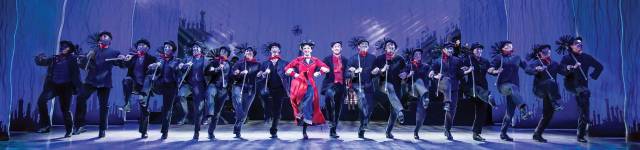
Sir Mathew Bourne is the best choreographer working today and the two key big production numbers, “ Supercalifragalisticexpealidotious”  and “Step in Time” are as good as anything that you will see on stage. Curiously, “Chim, chim, Cheroo” never moves to a big chorus, instead being used as a solo, and reprise with backing singing, rather than a full throttle ensemble piece.

Zizi Strallen delivers as the eponymous heroine. Aloof, mysterious, and  a little remote, but loveable and endearing too. She performs to the entire, large auditorium, drawing everyone into her magic, and sings beautifully.

Mp2

For this show, understudy Adam Rhys-Charles  took the part of Bert, and acquitted himself well with no sign of nerves putting to bed the eccentric performance, and accent, of Dick Van Dyke in the film, offering character, enthusiasm and vim.

The show, including interval, runs to two and three quarter hours, with the first half being an unusually long eighty five minutes. This has the advantage of leaving no-one with a sense of feeling short changed, but the disadvantage of being at the limits of the attention span of younger children.

Visually, not only are the set pieces a delight, but the special effects dazzle as well, as Mary Poppins glides over the heads of the audience and Bert scales the walls and ceiling of the auditorium Spiderman- style.

MP1

I found the narrative surrounding Mr Banks, Poppins’ employer, and his banking difficulties, a little clunky, despite hugely impressive banking hall  scenery .The pace slowed to a dawdle and there was little dramatic tension. But fortunately, in this show, you are never far away from a song leaving that reservation soon forgotten.

As a spectacular Mary Poppins delivers in pretty much every category. It may lack the intimacy and personal pull of Annie, but makes up for it in blousey front. It continues at the Hippodrome to 23rd

April and then stays on tour at Edinburgh ,Southampton, and beyond till January 2017.

Posted in Behind the Arras Reviews | Tagged , , , | Leave a comment

Rime of the Staffordshire Hoard

A somewhat belated posting of a commission which was performed last year at the New Vic Stoke.


The Rime of the Staffordshire Hoard


He sat quite quiet, in the Boat,

Supping his pint of beer,

His thread bare coat, dangling loose,

A finger beckoned us near.


Now lonely men are not that rare

In roadside hostelries,

But glimpsing the shape of his sunken eyes

He seemed to want to share


Something, maybe, that he knew

From a long and troubled past,

Of long lost love, intrigue and trysts,

Of vino veritas.


“Come here” he whispered loud but soft,

I have a tale to tell,

That has been handed down to me

From ancestors that fell.


It has never felt the pen,

Just kept to the spoken word,

For this is a tale you cannot read,

It only can be heard.


It has been passed down by mouth,

From father to son and daughter,

From the mothers breast, from fireside hearth,

Stories of wealth and slaughter,


In Mercian times, when war was waged,

With savagery and  steel,

The victors supped from hard won spoils

Stripped bodies in the fields.


Swords were prized above all else,

Their pommels and their hilts,

The metal, the gems, the plate the gold

Fine fashioned and carefully built.


And over time the war chest grew,

From battles far and wide,

The vanquished knelt, prizes seized,

Spoils for the winning side.


From the north , the Northumbrians crossed

The Trent intent on plunder,

But Eckgrith was routed, put to flight,

His army sliced asunder.


From the east King  Anna rose,

With armies wild and true,

Penda took the fight to him,

And at  Bulcamp, the Anglian he slew.


To the west the Welsh were tamed

“The Paradise of Powys” at Pengwern

Wroxeter bled and genuflected

Whilst all around them burned


To the South ,Wessex fell in thrall,

As Cenwealh was defeated.

Mercian land kissed by southern seas,

Success and wealth repeated.


Coelred ruled this mighty land,

But was quick to take.

Revelry and earthly things,

He just could not forsake.


From Tamworth castle edicts flowed,

Charters, and royal decree,

And little by little the people were lost

Defeat by degree.


For centuries Watling Street had borne

Traders, and legions  too.

A highway of wealth and fame and power

Retreat was something new.


As enemies circled, and dangers grew,

His treasure drew attention

Envious eyes and evil plots swirled

At the riches’ mention.


Coelred despatched his aide, Edward,

To find  a hiding place,

His anonymity assured,

By an unknown face.


So Edward rode to seek a spot,

West from the castles gaze,

Where silent ground could hold its tongue

In a quiet restful place.


Riding horseback is thirsty work

The road, uneven laid

Not since Roman Times had care,

Attention, and repair, been paid.


The wagons unmarked, creaked and groaned

On the journey there,

The trusty band of diggers moaned,

Heading out somewhere.


So ,with darkness closing in,

Letocetum came in view,

Very far from in its prime,

But with  a tavern or two.


Just beyond there lay a lea,

WIth trees and grasses lush,

Where a shallow trench, quickly filled,

Would not be noticed much.


So they set to work, with spades and trowels,

With sweat and furrowed brow,

Till the earth absorbed this fabulous hoard,

Disappeared from view for now.


And as reward they headed back

For an ale or four,

And when they had sank the fourth fine ale,

They all went back for more.


Night then spread her dusky wings,

The men consumed by excess,

All thoughts of maps just vanished,

Location would be a guess.


With heads that throbbed,

And hearts that sank,

They scoured all around.

But fruitless was their frantic search

For tell -tale broken ground.


But trees and bushes, stumps and lumps,

They all just look the same, (don’t you think?)

The buried don’t talk, just slumber on,

Like those consumed by drink.


Edward returned to Tamworth town,

Told Coelred the deed was done,

Coelred thanked them all for their pains

Then silenced them one by one.


All bar Edward, who was restrained,

In a castle garret, in solitary.

Kept in food and water,

But never in company.


As time passed and Edward pined

For human company,

He grew unhinged, and lost his mind

For  all around to see.


With great alarm Coelred despatched his man

To recover the buried gold

But his years alone, and hours at the  Inn

Had left his memory cold


Edward was ordered to continue his search

Until his dying day

Which he did, trowel in hand

Seeking where it lay


For many a year, there were reports

Around Hammerwich and of Wall

Of ghostly moans and shovel borne thuds

And desperation calls


He was condemned without respite

To continue his demanded quest

To search each clod of Mercian earth

In this world and the next


Now he rests, the hoard recovered

In the hands of a new protector

Thanks to Edwards guiding spirit

On a metal detector


Then the  stranger, whose eye was bright,


Whose beard with age was hoar,


Was gone: and now I cradled an empty glass


Turned from the lounge bar’s door.


I left  like one that had been stunned,


And is of sense forlorn:


A sadder and a wiser man,


I rose the morrow morn.


Gary Longden


Continue reading

Posted in Poems | 2 Comments

Poems 2016

Salvation

He always made doughnuts
Thousands of them
Alongside doughnut lassies

Sugar, lard, eggs, milk (evaporated)
Water flour, baking powder, salt
Ground nutmeg

Amongst mortars, mines, lead (assorted)
Wire, weapons, water and blood
Ground spirits

For bellies that lay flat on scorched earth
For mouths drained by oaths and fear
Watching as the Pain Cars inched by

While we mother hens and chicks
Wove in Nests, precious care parcels
With eager hands and keen intent

Shirts, pants, socks, chocolate,
Soap, paper, stationery
Home ground

Before exhausted souls staggered
Yellowed munition hands begging
For charity at home

But Beth never ate our doughnuts
She waited for one from the front
Made specially for her.

Abandonment

You deserted us, for You Tube illusions and an easy life
Made by others
You lined the pockets of our tormentors to make them strong
And us weak
You let others do the fighting for you
While you rest, and are fed.
The women who bore you, the old men who taught you
Look on, in despair
As our girls are preyed upon, and the fields lie unplanted
Those too sick to move plead for  our aggressors’ compassion
In the absence of yours
Our dignity, our beliefs are not worth your struggle
Leaving those least able, to do the most.
Our future disappears over the horizon
As you leave us condemned to live the past.
If you had built fences rather than try to scale them
If you had bravely faced the enemy – as you faced the sea
We would be together now, pride intact.
Instead you beg for yourselves there
While the old, the sick, young mothers and children
Lie abandoned here.

The Journey

Uttoxeter

Stoke

Manchester

Liverpool

Bolton

Blackburn

Blackpool

Preston

Lancaster

Kendal

Penrith

Carlisle

Gretna Green

Lockerbie

Hamilton

Glasgow

Cumbernauld

Stirling

Bannochburn

Dunblane

Auchterarder

Perth

Pitlochry

Aviemore

Culloden

Inverness

Cromarty Firth

Cairngorms

Braemar

Ullapool

Stornoway


The Blue Men of the Minch 

Gliding, their lithe forms wait silently

For the foolish and the hapless

Sentinels, guardians of the deep, they be,


When calm, as male mermaids they rest and play

Shadowy shapes, just out of reach, jostling

Jousting, watching, benign and fey.

Some say they were Picts, daubed in that hue

Others that they were Viking slaves in costume blue

But wherever was their place, whatever was their station

They now patrol in eternal damnation.


For their quarry to leave Loch Broom

And the Westerlies to arrive drawn by the Moon

So they can leap from feisty foam

Storm Kelpies rising in the spray

To hunt their prey to have their say

Their price for mercy from the brine

Is , when challenged, for Captains to respond in rhyme

And if  Blue Men do not catch

A couplet whose words just do not match

As the sea horses rear, and the wind doth blow

So their captives, they drag below

From their duty they never flinch

The dreaded Blue Men of the Minch.


For Sheila


You will walk with me no more on these streets which held so much promise

Once. Long ago.

I want to tell you about Stephen, and James

I want you to smile at what I did not appreciate, but do now

I want you to tell me that it is okay to buy that coat- and that you like it.

I want you to say that Portobello has become good again- and aren’t the  garlic breads big?

How I wish you were irritating Sarah by advising her on Stanley’s child care. He’s a bonny boy.

How I wish that fate had not dealt you such a cruel hand

Things are going on as if nothing had happened- it’s the way, isn’t it?

You would have liked Paphos.

I have changed the hall and bedroom

You wouldn’t like it

The Potteries

Made here

Pots and porc’lain

Fashioned by nimble hands

Wedgewood found fame amongst the smoke

In Stoke


Bright glare blazed outside

Patio bricks oozing heat

Our Saturday treat

Dan Yr Coed


Where Red Kites soar

No strings attached

And the Severn turns about face

A place, between


Where earthly things are ruined

In rubble and dry locks

And the hills hover,

Watching, and waiting


Where time is measured in rising falling light

Not the sweep of a second hand

And the rain hesitates

For a moment.


Dave


A politicians peccadilloes  are a wonder to behold

Particularly those from the privileged, Eton and oxford fold

On a night out

Those from the compo’s , might play with a traffic cone or two

Placed on the head, thrown over the hedge, or used as a temporary loo

But the Galveston club, is somewhat more refined

It is where the toffs, and the young gentry, dine

And although Dave likes sleek Sam in high heels, how she totters!

He’s also quite partial to a set of hairy pink trotters

Those big luscious  lips, the fetching curly tail

Makes something in Dave’s libido, start to whine and wail

And if it grunts nicely making him feel the special one

He’ll whip his own sausage out for a bit of porcine tongue

When this was reported it was dismissed as porky pies

But the great British public knows its swine and how to take the rise

He hogged the headlines, all else stopped, even Jeremy became a boar

Whilst facebook and twitter put their snouts in the trough, foraging for more and more

Now his actions may have been ham fisted, but his intentions I am sure were pure

Let us just hope that as PM that his thoughts have now been cured


Le Pen


All that it takes is a brush, rushed


A choice, to find a voice


Or a silencer


At a stroke, a line, bullet straight


Poised, for the noise


Of confusion


Expression and repression


Pouring automatically from the muzzle


Escaping, leaking ink, distorting


Born free, yet chained


This is my truth, tell me yours


Of what you can do instead of what you do do


Arms linked, fingers crossed


Friday Saturday Sunday and Monday Morning


I did not hear of it until Sunday morning

Instead slumbering while explosives murmured and air frame metal  snorted

Tuning in, mid-story, is confusing

Who what where when and why?

A bit like being there

Fragments travelling to the nearest body

Yet reaching far beyond

Moments in motion


I did not hear of it until Saturday morning

Instead slumbering while Kalashnikovs, murmured and bombs snorted

Tuning in, mid-story, is confusing

Who what where when and why?

A bit like being there

Fragments travelling to the nearest body

Yet reaching far beyond

Moments in motion


I did not hear of it until Monday morning

Instead slumbering while Mirages murmured and bombs snorted

Tuning in, mid-story, is confusing

Who what where when and why?

A bit like being there

Fragments travelling to the nearest body

Yet reaching far beyond

Moments in motion


I did not hear of it until Friday afternoon morning

Instead working while Kalashnikovs murmured and bombs snorted

Tuning in, mid-story, is confusing

Who what where when and why?

A bit like being there

Fragments travelling to the nearest body

Yet reaching far beyond

Moments in motion


And I wondered how often this would be repeated


You try your best, but despite it all

Yearning for the time before your fall

When a day could be lived without sharp pain

When a night was measured in hours, not minutes

Again and again

Neighbours come and go, with a wave and a cursory smile

“I like your coat they trill- unaware of your guile

But when the front door closes, when the walls come tumbling in

That is when the fear starts of what the day will bring


Church


I don’t care much for Church

Our Christening Party outnumbered

The congregation many times over

And I wondered who was joining who


His robes older than the pews

The vicar conjured bonhomie and boredom

Unfamiliar hymns blared amplified

As if volume was enough to disguise bland dirge


There were no notices

Perhaps no-one cared anymore


Posted in Poems | Leave a comment

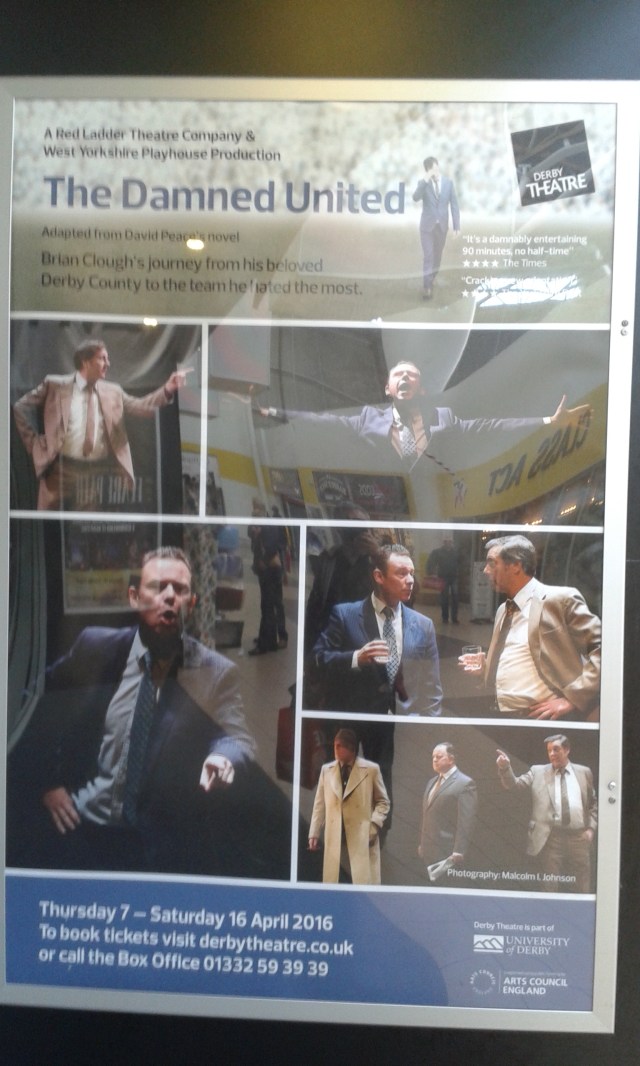
The Damned United – Derby Theatre

20160406_154602
I did not attend this production as a neutral observer. As a teenager I watched Clough manage his great Derby side at the Baseball Ground, then later admired his triumphs with Nottingham Forest, found his television appearances as a pundit unmissable, and was at Portman Road for his final game as a manager. I found David Peace’s book to be amongst the best ever written about football, and the film a very good effort at bringing him to cinema. So it would be fair to say that my expectations were high, my critical faculties sharply tuned. Could the play seal a treble?

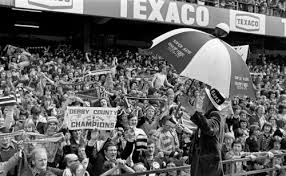
This run opened at the West Yorkshire Playhouse, which was brave. Leeds was hostile on his appointment as manager of their club, and it went downhill from there. By contrast, here at Derby, he was on home turf, the tiered seating of the theatre doubling for the Popside. In Derby they named a road after him, in Leeds the players and fans would have liked to have buried him under one.

Clough as a character has all the ingredients of great drama. A promising playing career cut short by injury leaving him with a burning desire to prove himself. Rags to riches success with Derby and Forest. “The Fall” at Leeds. The bromance with Peter Taylor, and the personal demons which both drove, and haunted him.

It is difficult , over forty years on, for those who were not around at the time, to grasp the grip that Clough had on the then contemporary football psyche. “Big ‘Ead”, along with Malcolm Allison, paved the way for the modern celebrity manager of whom Mourinho is the most obvious heir.

popside

The Glory Days


The now levelled Baseball Ground was a cauldron of emotion and noise, the Popside the cheerleaders from the terraces, the upper seated tiers stamping their approbation, Cloughie the conductor to the faithful’s chorus. It was a working class theatre where triumph and failure unfolded, and heroes and villains played their parts. From the age of those in the opening night audience, many had come to relive their long lapsed roles. The ghosts of those now far off football battles returned as Mackay, Nish, Davies, and Hector once more confronted Giles, Bremner, Hunter and Charlton on the pitch, while Sam Longson and Manny Cussins watched from the Directors box, and Don Revie pored over his dossiers. The love of the Ossie Road End, and the disdain of the Gelderd End, was nostalgically evoked.

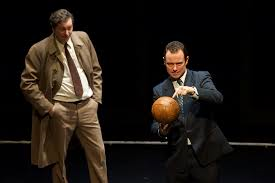
Anders Lustgarten’s new stage adaptation attempts to convert what has previously worked so well on page and screen, to stage, in this Red Ladder production. As with the book, the drama is of Clough’s fateful 44 days at Leeds and his essential, but flawed working and personal relationship with his assistant, Peter Taylor, played with laconic fortitude by Tony Bell.

Andrew Lancel’s Clough is troubled, brash and vulnerable, slave to his passion for footballing success, and his dependence upon alcohol. Derby County’s players are balletic masked figurines. Leeds United’s are anonymous mannequins. Lustgarten’s production aspires to Shakespearean tragedy for this production, and largely delivers it. Lancel has to carry numerous soliloquy’s, only briefly interspersed by scenes with Peter Taylor, and the Derby and Leeds Boards, in a performance of energy, commitment and intelligence.

The set, comprising four white lines and a table, supported by video backdrop, with soundscapes by Isobel Waller-Bridge and Nina Dunn, is brilliantly realised by designer Signe Beckmann, and lighting director Tim Skelly. A strong multi- role cast provides a fine squad with John Graham Davies as Derby County Chairman Sam Longson/ Syd Owen/ Bolton, Tom Lorcan as McKenzie, and Tony Turner as Manny Cousins/Jack Kirkland. Davies portrayal of Leeds’ Syd Owen is a comic delight and an essential counterpoint to his new manager’s bombast.

Lustgarten’s script is far closer to Peace’s novel than Tom Hooper’s film version, jumping back and forth between the Derby glory days and the black ones at Leeds. To those unfamiliar with the story, this could be occasionally confusing, but so long as you remember that when Taylor is on stage they are in Derby, and when Clough is on his own they are in Leeds, the narrative works.

20160406_154538

The Clough family, most notably represented by locally resident son Nigel, currently managing promotion chasing Burton Albion to join Leeds and Derby in the second tier, has been steadfastly hostile both to Peace’s book, and Hooper’s film. I doubt whether they will be found in the audience for this production. Which is a shame, as the play celebrates Clough’s achievements and portrays his flaws and temporary downfall (he was to spectacularly rise again at Nottingham Forest) in an Everyman sense, not as personal spite. An omnipresent bottle of scotch whiskey is a reminder of his alcoholism, the language is often crude male machismo, but the story is skewed more in favour of his glory days at the Baseball Ground than his Leeds agony. This is no hatchet job.

Clough was an intensely private man behind a brash façade with more front than Buckingham Palace. The latter trait was consummately exploited by Lancel, in a portrayal which eschewed any attempt at mimicry or imitation, in favour of getting to grips with the essence of a man, bereft at the sudden loss of his mother, and obsessed with money, even at the expense of his right hand man Taylor.

Rod Dixon’s lively production falls just short of extra time at 85 minutes, with no half time interval, and is an authentic and compelling sketch of one of football’s greatest characters. In parts, the statistics heavy dialogue, whilst mirroring Peace’s method and intent, is at the expense of the drama. The cognoscenti know the detail, the non-football fan doesn’t care. And the finale is a little awkward. But the passion of the man prevails culminating in the finest moment of the play when Clough and Taylor part for Leeds and Brighton. The unspoken cry from the audience is; “ Don’t!”

Clough leads out a less than enthusiastic Leeds team

Clough leads out a less than enthusiastic Leeds team

As the cast took their bows the applause rolled down the aisles with an intensity more commonly associated with a vital league win, than an opening night. Derby people know their theatre as well as they know their football, as the heightened response to Tony Bell’s bow as Peter Taylor bore testament to. Of course Lancel took the plaudits, not only for his performance but on behalf of a bona fide local legend.
DU cnt

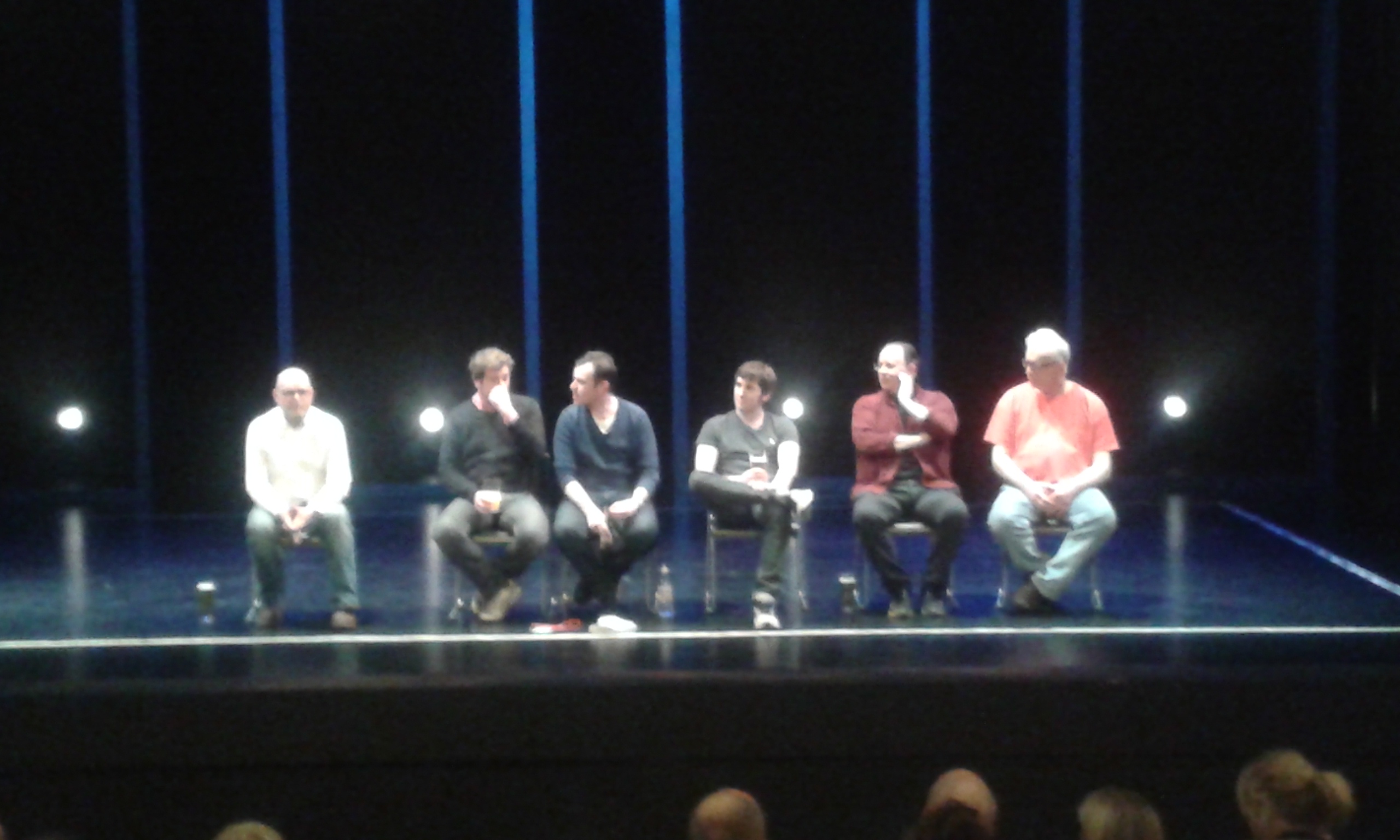
After the curtain calls and an interval, the cast and director took an impromptu question and answer session which was very well attended and provided numerous gossipy titbits. Some Leeds players had attended the West Yorkshire Playhouse performances, including Peter Lorimer and Norman Hunter, at which Don Revie’s name was called out and Clough was  (playfully) booed by some, and Tony Bell had met with Peter Taylor’s daughter who had provided several insights into her father and confirmed that it was Clough’s attitude towards Taylor’s remuneration which had irreparably breached their relationship. The Clough family are still hostile to the project.

Andrew Lancel was particularly interesting and honest during this session, emphasising the scale of learning and performing the part and demonstrating a depth of talent far beyond his enjoyable “Bad boy” role in Coronation Street as Frank Foster. He is also fleet of foot in handling questions. When I asked him to what extent the play was about football, and to what extent it was about personal tragedy, he replied;” What do you think?”

This is a fine attempt to bring the drama of football to the stage, and it is to the credit of both Red Ladder Theatre and Derby Theatre and Sarah Brigham that they have succeeded so admirably in doing so.

The Damned United runs till Saturday 16th April.

Director and cast take questions after the performance

Director and cast take questions after the performance

This review first appeared in Behind the Arras, abridged, where a comprehensive collection of reviews from the best of Midlands Theatre, from a range of reviewers, is available.

http://www.behindthearras.com/

Posted in Behind the Arras Reviews | Tagged , , , , , , | Leave a comment

Annie, Wolverhampton Grand Theatre

annie

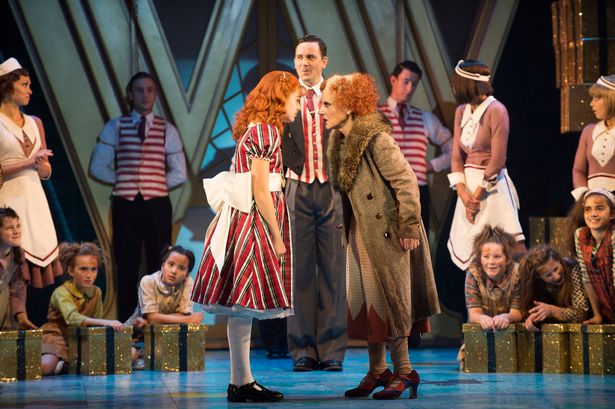
“Annie” seems to have been around forever, but in fact premiered on Broadway in 1977 making it a more modern musical than most imagine. Based upon the Harold Gray comic strip “Little Orphan Annie”, with music by Charles Strouse, lyrics by Martin Charnin, and book by Thomas Meehan, its libretto is well supported by a strong score of which “Tomorrow” , “It’s the Hard Knock Life” and “Easy Street” have become standards.

Any production pivots on the success of the roles of Miss Hannigan and Annie. Taking up the challenge are Lesley Joseph, whom I have seen tackle this role some years ago, and is a safe pair of hands, and Elise Blake, who is suitably cute and endearing.

The plot is saccharine sweet American schmaltz. A loveable little red-haired orphan escapes the clutches of comic book evil orphanage keeper Miss Hannigan to win the affections of hard- nosed wealthy businessman Oliver “Daddy” Warbucks. His granite exterior soon cracks for the little girl- yet her desire to discover her roots cannot be thwarted. The dialogue zips along with a number of good jokes, often at the Democrats expense, Donald Trump would approve. We are also never far away from a song or a dance to recharge our batteries in a show whose energy levels are impressively high.

Events unfold in 1930’s New York against a backdrop of the Great Depression, stage designer Colin Richmond has produced a versatile, colourful set which impresses, without being over elaborate. The set changes with stage furniture are slick, morphing from orphanage, to back streets ,to billionaires mansion, in a blink of an eye.

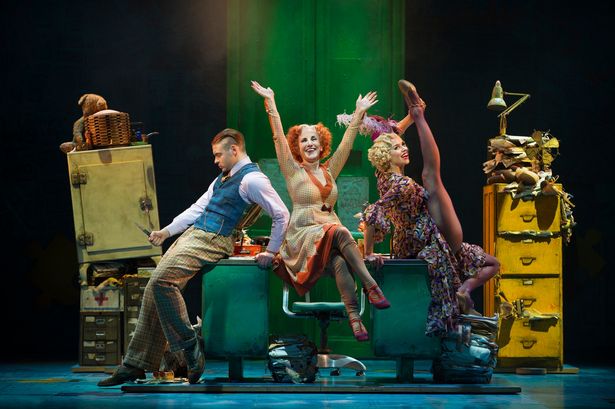
Lesley Joseph is the star turn, and in this characterisation, tunes down the malevolence, turns up the drunkenness, and allows Johnny Fines, playing her partner in crime brother Rooster, to take the crown as chief baddie. Rooster is ably assisted by Djalenga Scott as his girlfriend Lily, who is funny, scheming and ekes the maximum both out of her supporting role, and legs which seem to go on forever..

Elise Blake is all that you could want from an Annie. Her relationship with Daddy Warbucks is convincing, her performance confident, but vulnerable, and her naïve joie de vivre neatly counterpoints Miss Hannigan’s increasing frustration as Annie enjoys the good fortune which has eluded her, and yes, she and all the orphans hit those top F #’s in “Hard Knock Life”!  “Tomorrow” is beautifully sung, a song of hope for the young, a lament for the old, and is to the show what “Somewhere Over the Rainbow” is to “The Wizard of Oz”.

annie 2

For some legs of this tour Craig Revel Harwood has taken the part of Miss Hannigan. Unsurprisingly the production delivers choreography of the highest standard driven by choreographer Nick Winston . Four teams perform the child parts, the Rockerfeller Team were present on this opening night, and Winston produces several memorable set pieces, the highlight of which is the Broadway pizzazz of “NYC” towards the end of the first half.

Not only is the choreography sharp, inventive, and performed with gusto and brio, the singing is also unusually strong too, both individually, and collectively. I should make special mention of understudy Callum McArdle’s Daddy Warbucks, whose vocal performance was mellifluous and an absolute delight. Opposite him, Holly Dale Spencer shines as his PA, and love interest, Grace Farrell, singing and dancing with aplomb, and carrying the best dress of the evening, an emerald evening gown, with some style.

This is wholesome, accessible, entertainment for the whole family and a revival far superior to the last tour I saw with Joseph in it. The dance has been ramped up significantly, and the score is beautifully arranged by Musical Director George Dyer who slips from Vaudeville to New Orleans Dixie effortlessly, besides the big Broadway production numbers which boom with New York style.

Justly evoking a standing ovation for the curtain call, catch this show on its run till Saturday 9th April, it will make you feel good.

This review first appeared in Behind the Arras, abridged, where a comprehensive collection of reviews from the best of Midlands Theatre, from a range of reviewers, is available.
http://www.behindthearras.com/


Posted in Behind the Arras Reviews | Tagged , | Leave a comment

Look Back in Anger – Derby Theatre


lbia.jpg

This is a very special presentation . Not only is it a 60th anniversary production, but John Osborne also worked at Derby Theatre, lived locally, and set the play in the locality. Legend has it that it was written in 17 days in a deck chair on Morecambe Pier. It was certainly inspired by Osborne’s ill-fated marriage to local actress Pamela Lane and the death of his father, Thomas.

Director Sarah Brigham’s production is neither a period piece, nor a modern interpretation. The striking set by Neil Irish reproduces a faithful facsimile of 50’s living space disappearing into doorways which gape into a black void into which the cast disappear and reappear as a header tank and piping hovers overhead.

LBia2

The beating heart of this play is the Angry Young Man, Jimmy Porter, whose soliloquys and philosophy dominate proceedings. Patrick Knowles inhabits the character admirably delivering his trademark tirades with aplomb and conviction. His ambiguous relationship to his father in law, Army Officer of Empire Colonel Redfern (Ivan Stott) is pivotal. Does he hate him- or want to be him?

Porter’s wife, Alison, is the face of a disintegrating marriage, as boredom, angst, pregnancy, miscarriage and infidelity overwhelm her. Augustina Seymour imbues the character with dignity and poise, her post miscarriage visit to Jimmy is particularly harrowing, her drab clothes and drab countenance perfectly matched. Opposite her Daisy Badger is the perfect femme fatale as friend and love rival, her cut-glass accent as sharp as her red pencil skirt and jacket. Amidst the conflict, flat mate Cliff (Jimmy Fairhurst) metaphorically, and physically, wrestles for Jimmy’s attention.

LBia1

Some of the impact of its original performances is inevitably lost on modern audiences. The kitchen sink set, vibrant language, and anti-authoritarian tone are now familiar, even if the off- stage trumpet lament is not. Colonel Redfern bemoans the good old days which he has experienced, and lost, Jimmy bemoans the good days which he has never had, mirroring the post war uncertainty and crisis of identity experienced by the country.

Porter’s misogyny, and his wife’s response, feel anachronistic to a contemporary audience. Is Porter the disenfranchised voice of a generation, or just a spoiled, grieving young man, lacking empathy? To what extent does Alison stay with him because culturally that is what women did in unhappy marriages at the time, or was it just that emotionally Osborne could not write his female characters in more rounded fashion?

Brigham’s production neatly offers the questions without seeking to provide answers in a fulfilling and rewarding revival. My only criticism was that the diction and volume of Fairhurst and Knowles occasionally dipped making it difficult to hear. Nevertheless, this is a powerful and worthy revival of a fine work with a defining place in theatrical history- runs to Saturday 26th March.


Gary Longden


This review first appeared in Behind the Arras, abridged, where a comprehensive collection of reviews from the best of Midlands Theatre, from a range of reviewers, is available.
http://www.behindthearras.com/

Posted in Behind the Arras Reviews | Leave a comment

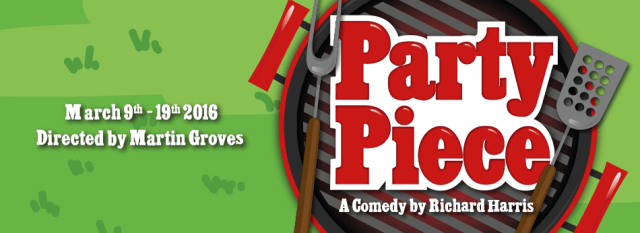
Party Piece- Grange Players, Grange Playhouse, Walsall

pp2

****

Although author Richard Harris is relatively unknown to the general public, his writing has figured in numerous hit television series and stage shows. For television, he was a regular contributor for forty years, from 1960 to 2000, writing for shows like The Saint, The Avengers, The Sweeney, A Touch of Frost, and Darling Buds of May. Some forty of his plays have been performed for stage. Thus his grasp of drama, and comedy, is a given. The only variable is the production. Harris fans will see similarities with one of his earlier plays, Local Affairs.

Events unfold in the back gardens of two adjacent neighbours, as Doctor Michael and his wife Roma’s fancy dress house-warming party descends into disaster and chaos, incorporating a notable shortage of guests, a shed engulfed by smoke, and an aerodynamic Zimmer frame. Grange Players have located the action in Walsall. Martin Groves and his team have done a marvellous job creating a back gardens set with full rear elevations, incorporating all manner of associated horticultural paraphernalia, and a mural of a Walsall church.

Next door, an elderly woman is being persuaded to sell up by her son, David. Mrs Hinson is curmudgeonly, scheming, duplicitous and has a Zimmer frame which her long suffering daughter in law suspects is for cosmetic sympathy purposes only. Her downtrodden, over-mothered only son David,  (Christopher Waters) stoically battles with his mothers’ foibles, not least of which is her refusal to accept his wife Jennifer (Liz Webster), while trying to improve his mother’s (bad) humour. Jennifer does not like being ignored, or being compared to David’s previous consorts, resulting in regular mutual sniping, culminating in her launching her mother in law’s Zimmer frame into the distance with considerable enthusiasm.

Rod Bissett as Dr Michael portrays a neurotic, fastidious man with an excessive estimation of his own talents, which sadly do not include an ability to procure defrosted food for a barbecue. His wife Roma,(Jill Simkin), struggles to help him to rectify this omission, and his serial other shortcomings, to repeated comic effect. She ends up as deflated as her squashed top hat. He ends up as a man on the edge.

Only two invited guests actually turn up to the barbecue, Toby (Andy Jones) and man-hunting Sandy, (Louise Farmer). Both milk the most from their supporting roles, the former, in a kilt, after free food and booze. The latter, after “up –for- it” men, sporting tight white shorts which are somewhat hotter than the barbecue, a rather good Welsh accent, and some good jokes. Both inject vital energy into the second half script.

However it is the abrasive and formidable long standing resident Mrs Hinson, wonderfully played by Sheila Grew, who steals the limelight. Initially she neither appreciates her upwardly mobile new neighbours, nor the gentrification of the area, until the benefits of having a doctor next door for her numerous ailments dawn on her. Her own property and her persona are perfectly matched- frayed around the edges.

Liz Webster, Christopher Waters and Sheila combine formidably in the first half to garnish a slight script with amusing bickering, and acid asides. The plot is enlivened overall by two unseen figures; David’s first wife Rosemary, who stalks Jennifer through Mrs Hinson’s rose tinted memory, and burly Gareth, husband of randy Sandy, who stalks the party as his arrival, and the consequences, are anticipated.

This is escapist fun, with improbable, implausible plot twists, cross-dressing, and a big fat smile on its face. Director Martin Groves and producer David Stone have realised a fast-paced farce that depends upon rapid exits and entrances, timeous sound effects, and perfect verbal and physical timing. It delivers in spades, and with plenty of laughs. Party Piece runs to 19-03-16, returns only for this sold out show.

Gary Longden

Posted in Behind the Arras Reviews | Leave a comment

Visitors, Sutton Arts Theatre


 visitors

 Sutton Arts company is as inspired in its sourcing of new work to perform as it is in producing it. Having unearthed the little known gem “Mind Games” by Anthony Horrowitz last year, this year they have found Visitors, the debut play by Barney Norris, first performed in 2014 for which he won the Critics’ Circle Award and Offie Award for Most Promising Playwright. Only twenty nine years old, Oxford graduate Norris is also a published poet and novelist.


Remarkably his youth has not stopped him from tackling a story which is ostensibly about dementia and old age, but is underpinned by an examination of love.


Set in a farmhouse on the edge of Salisbury Plain, Wiltshire, we are introduced to pensioner couple, farmer Arthur, and Edie, in the home they have lived in throughout their long marriage. They are to enjoy no balmy sunset to their lives, as Edie’s memory, and health, deteriorate. Carer Kate, with problems of her own, tries to make things better, awkward son Stephen makes things worse, as he pushes his parents to sell up and put his mother into a care home.


But this is no depressing two hours watching the misery of others.  It is much harder to write interestingly about happiness than it is about misery, and it is the former task that Norris undertakes, and succeeds in.


Norris was inspired by two themes when writing this play, the love  his grandparents had for each other, and the moral questions raised by the financial collapse of 2008.  What do we value? What really matters? His lyrical prose subtly juxtaposes with the jarring dislocation of dementia, drawing humour and wit, as well as evoking poignancy and lament. The beautiful Wiltshire countryside is an ever present and tranquil backdrop to Edie’s developing dementia. A holiday on the Dorset coast is meticulously and fondly recreated, a memory of love, happiness and moment, the image of a white wedding dress cascading like champagne over a waterfall quite exquisite. Things which cannot be bought, and can never be lost. Individualism is eschewed in favour of self-sacrifice, and sharing.


Edie and Arthur’s generation preceded the “greed is good” era with Arthur working the land, and material possessions secondary to their lives. As such their story is, in part, a snapshot of a time almost gone, of rural life, and of distances. The distances between birthplace bound parents and upwardly mobile offspring, and the distances and silence that dementia can create. It is also about the value, and joy, of sharing, and of marriage and of love. As Edie starts to ebb away those virtues are thrown into only greater relief. Norris boldly examines love beyond   lust, infatuation, longing, meeting, and parting, into the experience of what loving someone looks like, what it means. Although the temporal virtues of belonging and permanence fade, a sense of the glory of love takes its place.


Director Barrie Atchison is associated by numbers with his skill at producing farce. Here he demonstrates his grasp of pace in quite different ways. Silence, gaps, pauses, and distance are all used to profound effect. His task was not made easy by an absence of stage directions, props and set scheme by the author, the script being presented to him almost as a radio play. However this has afforded him maximum leeway in putting his own stamp on a production which could be subject to quite different interpretations. He delivers a drama of beauty, part funny, part tender, part lament for loss of people and a way of life. A life in which we are all just “visitors”.


Dexter Whitehead plays Stephen with great sensitivity taking him from thoughtless grasping offspring to a denouement which garners our sympathy as his fortunes shift. Carer Kate (Kira Mack) injects youthful vitality into her role, countering Arthur’s experience of working on the land with her own “woofing” ( working on organic farms!). But it is Len Schofield as Arthur, and Dorothy Goodwin as Edie who are the beating heart of this production, and as Edie’s physical and mental faculties fade, so her insight increases, culminating in a beautiful, laconic, elegiac closing soliloquy, faultlessly and tenderly delivered as the stage spotlight fell, then dimmed on her.


Visitors is a hymn to love, and  a plea for us to reassess and recalibrate our lives. It runs till Saturday 19th March.

This review first appeared in Behind the Arras, abridged, where a comprehensive collection of reviews from the best of Midlands Theatre, from a range of reviewers, is available.

http://www.behindthearras.com/

Posted in Behind the Arras Reviews | Leave a comment