****
Written by David Almond, and staged by Theatre Alibi, this is a one set, one hour, production. The opinion of adults is irrelevant to a children’s production. Jacob, aged five years, and Harry, aged seven, both theatre veterans, accompanied us to tell us how they saw it.
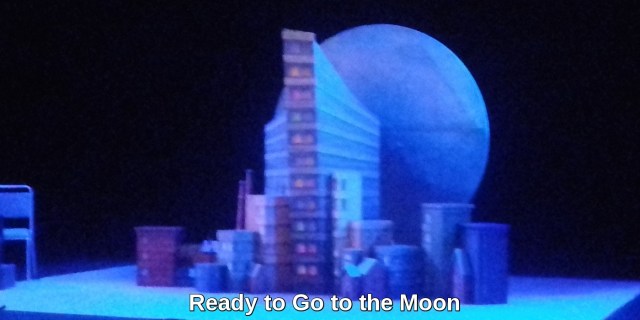
A simple, but striking and colourful, set, designed by Trinna Bramman, turns out to be more versatile than it at first appears, seamlessly morphing from a block of flats to the moon. A cast of three manipulate puppets to tell the story, Lisa Lee- Leslie plays accordion and hang drum, the latter to considerable effect, as musical accompaniment. Having live music brought an immediacy and vibrancy to the morning. The performing style is more one of animated storytelling, than conventional play.
The plot itself is dreamy, laconic and ambles, rather than races, along. This is a cerebral, not visceral experience, one which encourages children, and adults, to dream, and wonder, “What if ?”
The target audience is ostensibly six to twelve years old, but the late morning performance was solidly in the five to nine years age range. They were captivated by the idea of a young boy, Paul, who thinks that the moon is a hole in the sky and that he is going to climb into it. And who could not warm to Clarence the poodle who thinks he can fly? Harry liked the bit where, “everyone had to heave to pull Paul to the moon”, and gave it twenty out of ten. Jacob gave it 100/100, and liked the bit best where Paul is climbing the ladder to the moon. They liked it.
The story did not outstay its welcome, all the children in the audience were kept engaged, by a lovely, wistful show which is a credit to Daniel Jamieson’s adaptation of David Almond’s story, and Director Nikki Sved’s vision for how it should appear on stage. It continues on national tour.
“Are you reviewing it?” she asked. “No, I feel awkward” I replied.
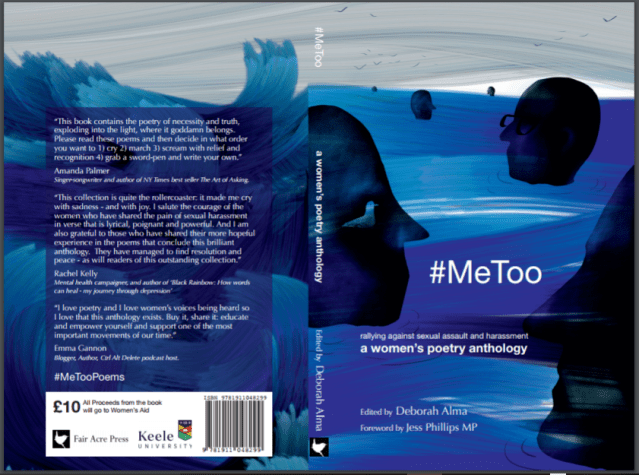
#MeToo is a collection of poems written by women, about women’s experiences with men, carrying a powerful foreword by MP Jess Phillips. It is not an easy read. It is, however, a rewarding and essential read. Although the theme is constant, the experiences are disparate and diverse, a crystal ball of innocence shattered into a myriad jagged, angular, irregular pieces.
Editor Deborah Alma, whose original facebook posts were the unplanned genesis of this project, has assembled them into seven chapters as loose groupings. In so doing, she has succeeded in creating a pleasing narrative flow . I was struck by how little polemic there was in these poems. That is their strength. Dozens of little stories telling a big story. The collection could have evolved into a literary companion to Gloria Gaynor’s torch song, “I Will Survive”. Alma wisely eschews that option. The power lies not in a unified entity, but in the rough, brittle, sharp, edges of each one of those shattered shards.
The stories, worthy though they are, are not enough. This is a poetry collection. The key question is, “Are the poems any good?” The answer is yes. Readers will recognise some contributions from amongst the most eminent of contemporary female poets, they will also be struck by the cogency and veritas of writers whose names may not be known, but whose writing on the subject deserves to be heard.
Rhyme is almost entirely absent, it is as though the content has stripped the songs from their heart. Sally Jenkinson’s contributions are written in staccato couplets. Their bone lean framework carrying a potent punch. “Nervous”, with its, “That’s how you win the game/ You just have to tolerate it” a witheringly effective tour de force.
There are some lines, and poems to make you smile too. Natalie Whittaker’s, “To the Giant Ground Sloth in the Natural History Museum” is amongst the pick of them, inspired in its allegory.
The contributions from the heavyweights do not disappoint. Jane Commane’s “Bitch” is a masterclass in control, Helen Ivory’s “Scolds Bridal “ savage in its brevity, Helen Mort’s “My Fault” is my favourite, cinematically zooming in at the start, before pulling back to reveal the big picture.
Initially I did feel awkward about the prospect of commenting on this work, wary about what to say. Yet if this collection ends up being a collection by women, for women only, that would be a shame. It deserves a fifty per cent larger audience. It is effective in numerous respects. It is an authentic, first person, contribution to the #metoo debate. It serves as both a lightning rod, and rallying flag, for those touched by it. It has literary merit, and substance, in its own right. It reaches out by means of its humanity to a male audience who should not feel alienated by the subject matter.
This fine collection, published by Fairacre Press necessarily compiled in short time, is a valuable extension , and exploration of, a movement which has come of age.
A hugely inventive but simple story by David Almond, but produced by Theatre Alibi. Behind the Arras will be there on Friday morning to review it. The plot? Some pretty odd ideas are floating around Paul’s street. There’s Mabel, whose brother hides under a brown paper bag. And Clarence the poodle who thinks he can fly. But Paul has the oddest idea of all. He thinks that the moon is a big hole in the sky and he’s going to climb into it… Anything’s possible in this warm and very funny story by David Almond, award-winning writer of Skellig and My Dad’s A Birdman. Its target audience is 6-12 year olds and is touring nationwide in Spring 2018. Theatre Alibi’s excellent website offers the following background information:
The production team comprises:
Cast: Kirsty Cox, Sian Kidd, Jordan Whyte
Accordion and hang drum: Lisa-Lee Leslie
Writer: David Almond
Adaptor: Daniel Jamieson
Director: Nikki Sved
Designer: Trina Bramman
Composer & Musical Director: Thomas Johnson
Lighting Designer & Technical Stage Manager: Marcus Bartlett
Production Manager: Rachael Duthie
Design Assistants: Sarah Vigars & Ruth Webb
Production Electrician: Will Tippett
Set Construction: David Elliot
Set Painting: Charlotte Hillman
Thanks to the R&D performers who helped develop the show:
Charlotte Dubery & Simon Palmer
Theatre Alibi are contemporary storytellers, creating work for all ages that moves freely between the intimate and the epic and aspires to be inventive, joyful, moving, vivid, intricate and ambitious. Our productions are marked by a passion for the live event – actors as storytellers absolutely present with their audience, live music, a delight in revealing acts of transformation that would often be confined to the wings and a level of inventiveness that allows us to embrace action that might seem to be unstageable. The company integrates a wide variety of art forms into its work and recent productions have featured animation, film, puppetry, photography and music both live and recorded.
Past productions include Falling, Hammer & Tongs, I Believe in Unicorns, Olive & the Dream Train, Curiosity Shop, The Crowstarver, Cabbage Heart, Goucher’s War, A Flying Visit, Ministry of Fear, Cobbo, Spies, Teapot, Lost & Found, Why the Whales Came, One in a Million, You Can’t Catch Me and Shelf Life.
Theatre Alibi tours to large and small venues nationally and regularly co-produces with other theatres, including Oxford Playhouse, Exeter Northcott Theatre, The Lowry, Exeter Phoenix and Polka Theatre in recent years. The company also performs its work for around 11,000 children in primary and special schools in the South West, providing a first experience of theatre to many. Click here for more information about where we tour to and when.
Based at Emmanuel Hall in Exeter the company offers rehearsal, workshop and office space to other arts organisations.
Artistic Director: Nikki Sved
Associate Writer: Daniel Jamieson
Executive Producer: Ruth Weyman
Administrative & Financial Director: Mary Attewell
Marketing Manager: Debbie Bucella
Production Manager: Rachael Duthie
Administrator: Annie Chave
Caretaker and Cleaner: Graeme Drew
Theatre Alibi Board Members: Melita Armitage, John Bunting, Roz Duffin, Pete Goodwin, Jonathan Gower, Jonny Ison, Tony Lidington, Dulcie Oliver & Erin Walcon
Theatre Alibi is one of Arts Council England’s National Portfolio Organisations and is also grateful for support from Exeter City Council.
The author, David Almond, also has an excellent website from which this information is gleaned: http://davidalmond.com
“I grew up in Felling on Tyne, close to the city of Newcastle and not far from the icy but beautiful North Sea. I had four sisters and a brother. My dad worked in the office of an engineering firm. My mam was shorthand typist. We lived on a council estate until I was 13.
I think I was a happy kid, but there was also a good deal of sadness – one of my little sisters died when I was seven and my dad died when I was fifteen. We were Catholics, and I was an altar boy, so I spent a lot of time in church. I loved roaming the streets and fields, playing football with my mates, camping, heading off to beautiful Northumbrian beaches. I liked primary school but disliked grammar school. I loved our little local library. I knew I wanted to be a writer and I dreamed that I’d see my books on its shelves one day.
To the astonishment of some of my teachers, I went to UEA and studied English and American Literature. Over the years, I’ve been a labourer on building sites, a tank cleaner in a shipyard, a brush salesman, a postman, a hotel porter. I became a primary school teacher, which I loved. I wrote short stories at the weekends and during the holidays, and started to get my work published in little magazines. As I approached thirty, I gave it all up, resigned from my job, sold my house and lived in a Norfolk commune for a year and kept on writing, writing, writing.
My first novel took me five years to write, and was rejected by every UK publisher. I shrugged, spat and kept on writing. I wrote stories, poems, plays. I travelled. I worked in Adult Literacy and as a part-time special needs teacher. I edited a literary magazine, Panurge, for a few years. My first two story collections were published in tiny editions by the heroic Iron Press. Then I was ambushed by a story that turned out to be called Skellig, and everything changed.
Skellig has been published in 40 languages. It has sold over a million copies in the English language. It has become a stage play, a radio play, a movie and an opera. Skellig opened up a whole new creative world for me and I’ve written many more novels, stories, plays, opera librettos and songs. I’ve won some of the world’s major literary prizes.
I live in Newcastle. I have one amazing daughter. I’m Professor of Creative Writing at Bath Spa University. I’m fascinated by the nature of creativity, by the writing process, by education. I work with artists, musicians, actors, teachers, directors, dancers. I work with, and write for, children and adults. I’m astounded by this amazing world, by the universe in which we live. I love beaches, light, music, Italy, skylarks, garlic, pasta, theatre, sardines, chilli, cinema, books. Every story that we write or read or act or sing or dance is an act of optimism, a move against the destructive forces that want to stifle us. I keep on writing.”
Almond’s publisher describes “The Boy Who Climbed into the Moon”, thus:
A magnificent tale of crackpot notions and sky-high courage – from David Almond, the master of magical realism, with illustrations by the award-winning Polly Dunbar.
Paul believes that the moon is not the moon, but is a great hole in the sky.
It’s one of many strange ideas that he’s never told anyone (at school he was told that he had no ideas at all), until he meets Molly, his irrepressible neighbour, who begins to convince him that his theory might just change the world.
Helped by a very long ladder, some highly irregular characters, two rather worried parents and a great deal of community spirit, Paul takes to the sky.
But his astonishing discovery there can’t keep him away for long – what is waiting for him back at home is turning out to be better than he’d ever imagined…
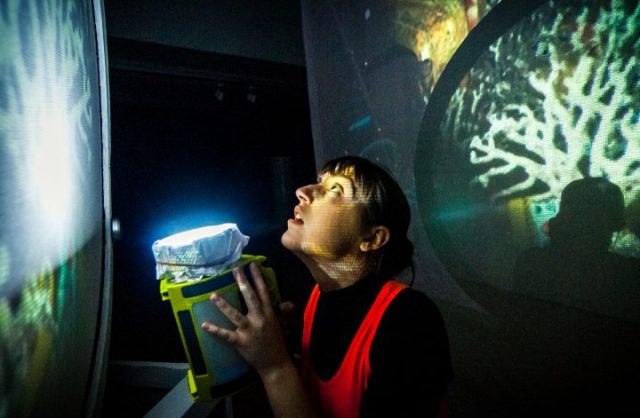
This weekend, actor, playwright and Theatrician, Louise White brings her one woman environmental show to Derby Theatre as part of a nationwide tour. What should we expect? In her website, Louise explains a little bit more about herself: http://www.louisewhitetheatrician.com/about
Louise White
I make devised theatre with participation at its heart. Passionate about theatre without a forth-wall, I look to immerse my audiences in my work and create a sense of community. With a mix of autobiography, social and environmental messages, and repeated references to David Attenborough, I conjure up fun experiences that are all about breaking down social boundaries and inclusivity.
What I’m up to now… I am an associate artist with the In Good Company artist development (Derby Theatre), and the Leicester Curve Breakthrough Artist programmes. Being a part of In Good Company has been invaluable. I’ve learnt a ridiculous amount and have been offered opportunities that have led to so many wonderful things!
I started 2017 year working towards my arts council grant for The Dead Sea and I’m very pleased to say that I was awarded the funding to develop it. Since then I’ve been beavering away in the rehearsal room with a great team around me. I presented works-in-progress at both Departure Lounge festival and at the Attenborough Arts Centre in July, as well as taking the show to Camden People’s Theatre in November. 2018 see the start of my Preview Tour for the show, taking it across the East Midlands. For more information on tour dates please click here.
I am also very excited to announce my new job working with Hubbub Theatre, co-facilitating drama sessions with their adult and youth learning disabilities groups. This has quickly become the best part of my working week and I can’t put into words how much I’m learning, but am also benefitting massively as a practitioner and a person from being a part of what Hubbub are doing to improve access to the arts.
Training and what got me here… I graduated from Dartington College of Arts with a degree in devised theatre. The focus of which was to create contemporary performances through democratic collaboration with peers and performance makers. Much of this work was interdisciplinary, working with fine artists, musicians, choreographers and writers as well as theatre makers. The work produced was varied, in the form of theatre shows, site-specific performances, performance art, and installation art. In my professional practice since then I have continued this approach to my work and have actively championed making work through the ethos of skill sharing through collaboration.
Upon graduating I was awarded a grant from Falmouth University to develop my own theatre company. The grant support-period lasted a year, within which myself, and the others in my company, further developed our performances and arranged a regional tour of this work. We also worked closely with the Curriculum Outreach Programme at Falmouth University to deliver workshops in schools and sixth forms throughout Cornwall, focusing on team building skills and performance making through autobiographical material and collaboration. I now work on a solo basis in much the same way.
Since returning to the east-midlands, I have developed my professional practice by working with several Nottingham-based arts organisations, such as the Lakeside Arts Centre, the Nottingham Contemporary, New Perspectives, The Malt Cross, Notts TV, the Actors’ Workshop Nottingham, The Actors Studio and the National Student Drama Festival.
Work is always ongoing! There are always new shows to make, new people to teach, new places and people with whom to share my knowledge and expertise!
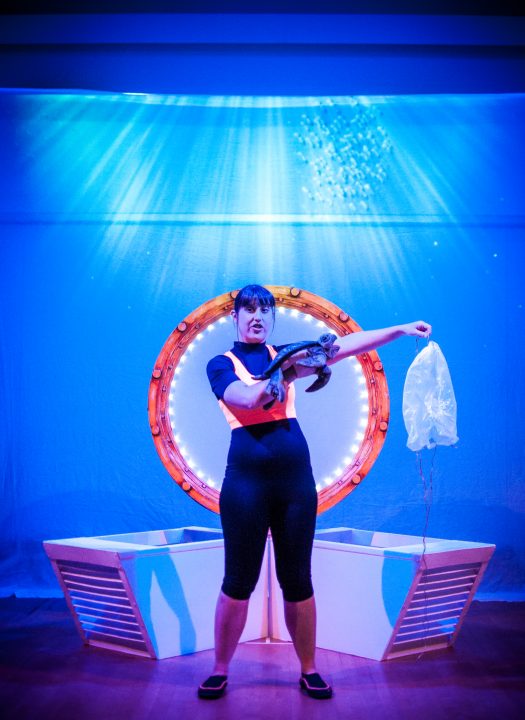
Louise has lost her sense of adventure. Her days consist of observing sponges… which is pretty boring. She would love to journey to the deep ocean, if only she wasn’t so afraid of the water!
As a child she wanted to be a great ocean explorer and liked nothing more than to play her toy turtle and inflatable killer whale!
Louise embarks on a mission to the deep ocean, but on the way tragedy strikes and her life and childhood dreams hang in the balance. Will she make her way back to the surface? Will she conquer her fear of the sea? Join Louise on her journey as she explores the ocean depths. With a mix of light humour, adventure and tragedy; Louise faces plenty of challenges as she pursues her dreams below the waves.
The Dead Sea is a performance suitable for all, looking to get all ages excited about saving our planet and looking towards the future. It is made with support from the Lincolnshire Wildlife Trust.
What do you do when you lose your sense of adventure? When you lose your passion? That’s where we find Louise at the start of the show, painstakingly measuring an unapologetically budget-shop-bought sponge every hour in the hope that it grows. She finds herself trapped in her situation – both hating the sponge and the monotony it represents, but also treating the sponge as a safety blanket – a convenient excuse to hide away from her fear. As she stares vacantly into space while waiting for the next hour to tick round, Louise daydreams of being a child in the bath tub. As a child, Louise wanted nothing more to be the world’s greatest deep sea explorer and go on all sorts of adventures with her friend Reggie, a dare-devil turtle!
We also find Louise on occasion dreaming of gliding through the ocean, free and powerful as an orca, going wherever her curiosity takes her. But these dreams have a sinister undertone and her fear of the ocean is never too far away, battling against her longing to adventure again.
Now, as a marine biologist you may think that a fear of the ocean would be quite problematic… and it is. She is constantly having to make excuses as to why she can’t join the team on field missions out in the open ocean and her anxiety starts to rear it’s head in the form of plastics spilling out from cupboards, pockets, and any other places in her lab that they can hide! As the story unfolds we find out the reason for Louise’s fear of the ocean and what she tries to do to overcome it.
Of course, as you might have guess by now, this show is about Louise conquering her fear of the ocean and rekindling her sense of adventure. It also has an important conservation message. I wanted to specifically deal with plastics as that is the most pressing problem facing our oceans. The conservation elements are craftily included in dream sequences, flashbacks, in the materials used to create the set and props, as well as the slightly absurd moments in Louise’s lab where plastics start to bulge out of the woodwork. I’ve been working alongside the Lincolnshire Wildlife Trust to inform the show and, if it proves to be a success, the LWT will roll out the show as part of their Living Seas programme to raise awareness of conservation aims on our local shores.
I enjoy making autobiographical shows, some more loosely based than others! The Dead Sea is a bit of fun looking at what life might have been like in an alternate reality had I pursued wanting to be a marine biologist when I was 13. As it happens when I was 14 I fell in love with theatre and the rest, as they say, is history. There are also a lot of my own experiences that go into my work, particularly surrounding mental health. I previously created a show called Debris that dealt with my experience of depression. The Dead Sea deals with the ideas of anxiety, and loss of purpose and passion. What is it to become disillusioned? In the making of the show, mindfulness has played a big part, and meditation music has been integral to the making process and getting that feeling of ‘under the sea’. This calming and gentle atmosphere the show creates has been praised by parents looking for something different to the usual family show, which tends to be very excitable.
A few things I’ve been playing around with while creating The Dead Sea as I develop my practice have been object play and puppetry. This is something that I’m developing a real taste for and would love to keep working with puppetry to make it a staple of my practice. This will also be the first time I’ve worked with animation and projection mapping as part of my work, and what I’ve learned has been incredible! I plan to build more on this next year as I experiment with creating a more immersive environment and develop the set so it doubles as an interactive sensory installation tailored for people with learning disabilities. Watch this space! I’m so pleased to be bringing The Dead Sea to Camden People’s Theatre, and show what I have been working on during my time as an In Good Company associate artist. IGC is an artist development scheme based in the east midlands, which helps to progress artists in their practice and enhance their artistic profile within and beyond the east-midlands, forming new working relationships and getting the work out to new audiences. I’m really excited to show my work to the lovely CPT audiences! If you would like to know more about myself, and the show, please visit my website: http://www.louisewhitetheatrician.com And so there you have it. Before you started this preview you knoew nothing about Louise and the Dead Sea, now there is little you do not know! Come down and see the show on Saturday. Behind the Arras will have a review up on Sunday.
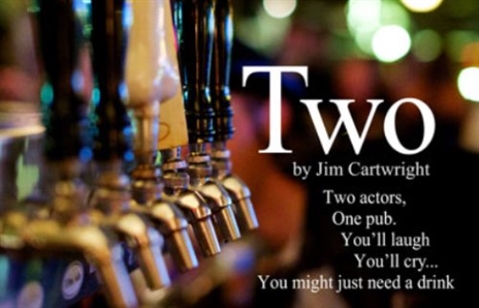
Derby Theatre is putting on “Two”, by Jim Cartwright, between 2nd- 24th March. It is a play beloved of drama students and teachers, one play, two actors, fourteen characters. It is also a difficult show to pull of convincingly. As a rite of passage for an actor it is fine, but if the two actors fall short of their Herculean task, the results can be patchy and disappointing.
Director Sarah Brigham
Fortunately, Derby Theatre do not tend to do “patchy and disappointing”.Firstly, Sarah Brigham, one of the finest Directors in the country, is in the chair, devising the production, Julia Thomas Directs. Secondly, even in advance of the show, she is experimenting and innovating. A limited number of audience seats will be on the stage in the pub, and the pub will not only be serving beer, but a specially brewed beer by local brewer Dancing Duck, called “Dramatic Duck” a 4.1% hoppy pale ale.
1 pub. 2 actors. 14 characters. Pull up a stool and order a pint – it's time to meet the locals. 🍻 #TWO Fri 2 – Sat 24 Mar #JimCartwright#ExperienceSeats
The two actors charged with bringing the fourteen characters to life have been shrewdly chosen.
Jo Mousely is best known for her TV work on Coronation St and Emmerdale, her stage work includes performing in “Brassed Off” which was widely hailed as one of the finest productions ever to grace the Derby stage.
Sean McKenzie and Jo Mousley
Sean McKenzie lives in Derbyshire. On TV he has appeared in Emmerdale and Downton Abbey, on the stage he has performed with the National theatre in “The Curious Incident of the Dog in the Night” and “War Horse”
The play itself is described as; “ hilarious, yet heart-breaking, and presents a slice of working-class life in a Northern local pub in the 1980s through a constantly quarrelling husband and wife landlord and landlady team, and the dozen regulars who pass through their pub in an evening; a place of failed aspirations and unfulfilled lives. All life is present in this pub, and through this range of colourful characters, the rich tapestry of their interconnecting lives is revealed; it is the heart of communities, it is where people laugh, share stories, celebrate and mourn. With the fragile relationship of our less than cordial hosts at breaking point, a rollercoaster of emotions unfolds. ”
Jim Cartwright
Multi-award winning playwright Jim Cartwright has written extensively for stage, television and radio, with some fifteen plays and eight films to his credit. Born in Farnworth, Lancashire. Cartwright’s first play, Road, won a number of awards before being adapted for TV and broadcast by the BBC. His work has been translated into more than 35 languages.
****
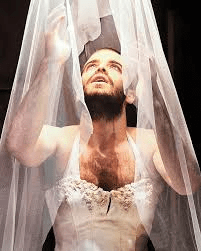
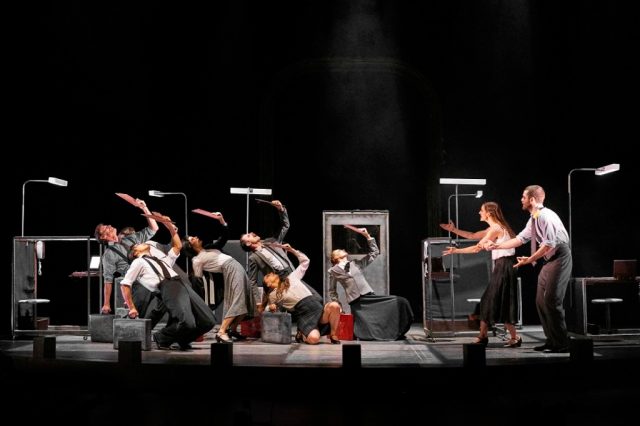
This show is produced by the Gecko theatre company who specialise in physical theatre and whose director, Amit Lahav, has an international reputation in the form. I had tried to do some research beforehand, but uncovered precious little. Now, I understand why. It is a production that defies conventional theatrical norms, but draws upon all of them, and has been some three years in the making. What inspired Lahav in 2015, has taken some unexpected twists in the intervening years, resulting in the script constantly evolving. It examines The Wedding as a contract, formal and informal, spoken and unspoken between two individuals. It also explores the same between the citizen and the state. It is not an altogether optimistic vision.
The opening scene reveals players plummeting down a rubbish chute, circumnavigating the auditorium in aural surround sound before being dumped on stage amidst a heap of teddy bears, witnesses to betrayed childhood dreams. A wedding ceremony, cut and pasted from dozens of different traditions unfolds in many different languages. It is impossible to understand what the words are, save for a few snatched English phrases, and half understood foreign ones. But what is being said doesn’t matter. It is the way it is being said. There are barriers, the audience does have to work, just as happens within a marriage, or a citizen’s relationship with the state. The physical element assumes increasingly greater prominence, as a sense of isolation, mistrust and part understanding grows.
The wedding house physically collapses part way through proceedings to reveal an inner circle, and an outer circle, across which some players may not travel. Are you in, or out? Do you want to be in or out? Refugee’s emerge from a suitcase begging for alms, from the audience, the players, from anyone.
To the rear of the stage lies a grand proscenium arch with elevated top table at which the rich feast, and the rest literally scramble to scale. Later this is exposed as an illusion, as the front cloth is stripped to reveal a mortal on stilts in a scene which visually, and metaphorically, echoes the same scene in the Wizard of Oz film when the Wizard is exposed as being not quite so mighty after all.
A tumultuous finale finds all the players, centre stage, sat in a line of chairs, lamp lit, singing a ( wedding?) chant, rhythmically clapping their hands, and stamping their feet in a visceral close, seemingly hell bent on reminding us that this is what physical theatre feels like.
A linear narrative scarcely exists, instead Lahav and his players invite us to explore ourselves, our own senses of estrangement, alienation and isolation, our own sense of shattered childhood dreams. The sceptre of Trump and Brexit hangs. At around seventy -five minutes without interval, the playing time is about right, but it is not an easy watch. There is precious little personal characterisation to latch onto, just faceless bureaucrats and ensemble joie de vivre.
The well attended first night was pleasingly heavily skewed in favour of young people who hopefully will be inspired to explore further, and develop themselves, some of the idea and themes realised in this show. A spontaneous standing ovation was well deserved. On a cold February Thursday night ovations have to be earned, and well- earned it was.
Runs till Sat 10/2/18 and continues on nationwide tour.
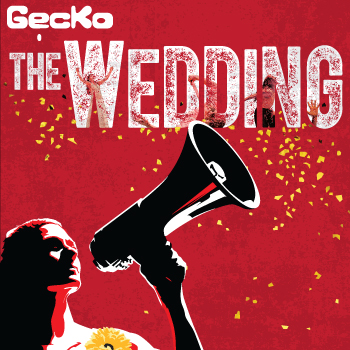
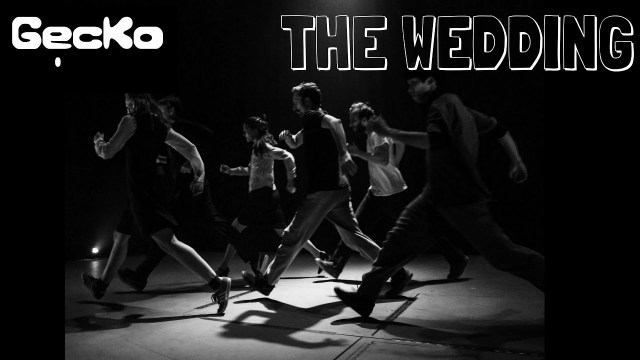
“The Wedding” , a physical theatre piece,by Gecko theatre, who are based in Ipswich is touring nationwide, and this week comes to Derby Theatre. Highly acclaimed, I am not entirely sure what to expect, which is probably a good thing. I will be reviewing it on Thursday night, why not come along and check it out with me?
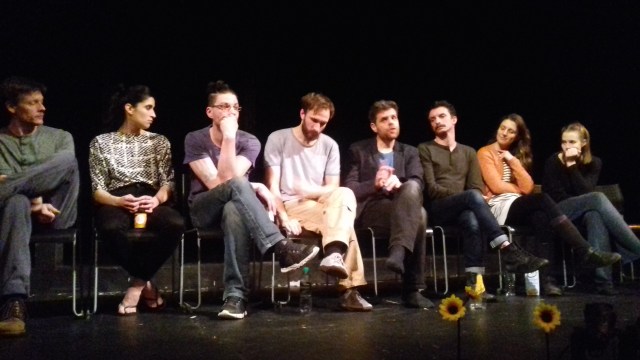
Derby Theatre have run a useful Q&A with Director Amit Lahav which gives us a taste of what is to come: The Wedding Q&A with Gecko’s Artistic Director Amit Lahav
Amit Lahav
Internationally acclaimed Ipswich based physical theatre company Gecko is currently touring their seventh touring production, The Wedding, which arrives at Derby Theatre for three performances from 8 – 10 February. The show is set in a dystopian world in which we are all brides, wedded to society and bound by a contract. But what are the terms of this relationship, and can we consider a divorce? Led by Artistic Director Amit Lahav, Gecko’s latest creation has been inspired by the complexities of human nature: the struggle between love and anger, creation and destruction, community and isolation. Q. For someone who has never seen Gecko’s work, how would you describe what the audience will see?
When you come and see a Gecko show, you sort of fall into a dream – or a nightmare, depending on your point of view! Each moment is crafted very carefully so you never know what’s going to happen next; there are always tricks and things will emerge from unexpected places. The shows are both a reflection, and a comment, on life, which can sometimes be a dark place. All the different elements are there to take the audience to another dimension, and as an invitation to re-imagine the world. Q. How would you define physical theatre?
Physical theatre usually involves more of a focus on movement, imagery and diversity in performance styles. We use very little text to make our work but the show is ‘written’ and ‘storyboarded’ like any other piece. For me, the main language for the audience is not words. Movement comes from the same place as language – both are emotional vehicles of communication by which the audiences understand the storyline. This is why I love working with an international ensemble of performers who can use their own languages in all of Gecko’s shows – it is movement and emotion that tell the story. Q. What is Gecko’s trademark style of performance?
We perform very physical, epic pieces that highlight the complexity of human nature in modern life. I have now spent fifteen years making shows and developing Gecko’s style of physicality. It’s a style that’s both athletic and emotionally honest. We use breath as the anchor for exploring all movement and emotion. Q. Where do you get your inspiration?
Inspiration for creating work is all around us. It’s in our personal lives, in the news, politics, and in the relationships that we have with our friends, families and colleagues. A personal emotion, reaction or situation is always the starting point for me.
My initial feelings about The Wedding came from a sense that we are bound by a contract with our state. Watching the world around me, I became aware that state dominance has slowly become more elusive and underhand, which gives us the impression that our marriage with the state is transparent and democratic, but in fact is more aggressive and controlling. Surveillance and Privacy, The Transatlantic Trade Agreement and our Human Rights are all huge areas where control and power are being carefully manipulated. These are very worrying times. Yet somehow, despite it all, I remain an optimist. I faithfully believe that through the will of the people and the power of community, we will make it through. Q. How do you then realise these ideas for the stage?
The process for all the shows I have made start by allowing these initial thoughts to develop into themes, scenes and characters. This can take a long time and requires patience to allow the ideas to grow, whilst constantly looking for further inspiration to inform the ideas. For this show, I studied wedding ceremonies from around the world, attempting to understand how even across languages and cultures, people join together with a supreme belief in their unity. Once the main concept has come together we start creating and designing the physical and technical elements associated with all Gecko shows. It’s not like a conventional theatre process where somebody is in a rehearsal room with a script and then they add the lights. All the various elements have to happen together, so those things are being thought about from the very first day. It’s a very collaborative process with everyone inputting and working together: director, designer, composer, performers, etc. Q.At what point is the show seen by an audience for the first time?
We always share a work in progress version of a new show with an audience after the first period of development. For The Wedding, we performed at Pulse Festival in June 2016 in Ipswich. This first performance can take the show on a new trajectory as I find it almost impossible to truly know a show until audiences interact with it. I’ll then take the show into a second development phase, in which the piece is re-written and re-worked.
How different will The Wedding be now to the performance at Pulse last year?
Very! Only a very few scenes, characters and visual elements from the first sharing will be in the final product. The process of making a version of the show for touring takes months of reflection and creation of a brand new storyboard and design. As a company, we will spend a lot of time creating the new version of the show. We start to reimagine the choreography, build the physical aspects and work on the technical elements in a fully equipped theatre. This process takes us right up to opening night, and further adaptations will still continue to emerge as the show begins its first tour!
The company itself promotes The Wedding as follows:
We are all married, bound by a contract.
But what are the terms of this relationship? And can we consider a divorce?
Led by Amit Lahav, Gecko’s latest creation is inspired by the complexities of human nature: the struggle between love and anger, creation and destruction, community and isolation. In a blur of wedding dresses and contractual obligations, our extraordinary ensemble of international performers will guide audiences through a dystopian world in which we are all brides, wedded to society.
Combining movement, imagery and provocative narratives in Gecko’s trademark style, our seventh touring production brings these contracts into question with an emotionally charged and spectacular performance.
We all want to believe in our journey, but where are we heading? Is it too late to stop, to go back, to fall in love, to start again?
*****
Over a decade ago I was a balletphobic theatre goer. Traditional ballet and dance simply did not connect with me. I had tried, and failed, or maybe the shows had failed? Then I went to see Sir Mathew Bourne’s “Swan Lake” and everything changed. Bourne, and his New Adventures Dance Company, showed me what was possible with the form. I have devoured his productions ever since, although this was my first “Cinderella”, which was premiered some twenty years ago.
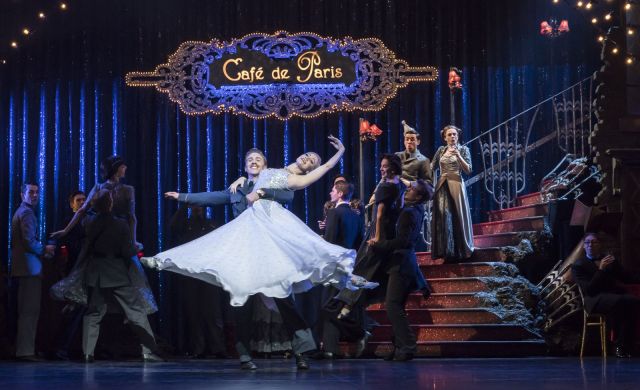
Bourne’s sets invariably impress, this is no exception. We are taken inside a monochrome domestic interior, dazzled by the Café de Paris, whisked down into the London Underground, along the Thames Embankment, before saying farewell at Paddington Station, complete with train. Wartime in 1940’s London is atmospherically conjured, a triumph for designer and costumier Lez Brotherston. The lighting is astonishing, and hugely demanding. Searchlights, flames and bomb bursts are demanded for the action scenes, show lighting for the Café de Paris, then there are the underground and over ground station scenes, lighting designer Neil Austin is equal to every challenge.
Prokofiev’s score never fails to bewitch and beguile, yet somehow, along with the ballet, we are offered swing, jive and a conga. It was written during the Second World War, premiered in 1945.Thus a setting during the War is absolutely in sympathy with its genesis. The music is rich and sweeping, tender and poignant. You could be listening to a soundtrack of a period film, a sensation encouraged by the use of contemporary projected Pathe News clips. Everyone is dancing, with each other, to each other, and to survive.
Most of the men are in uniform. The women wear flowing skirts and dresses of the 1940’s era and offer a perfect stylistic fit for ballet, elegantly flourishing to each ballerina’s movement.
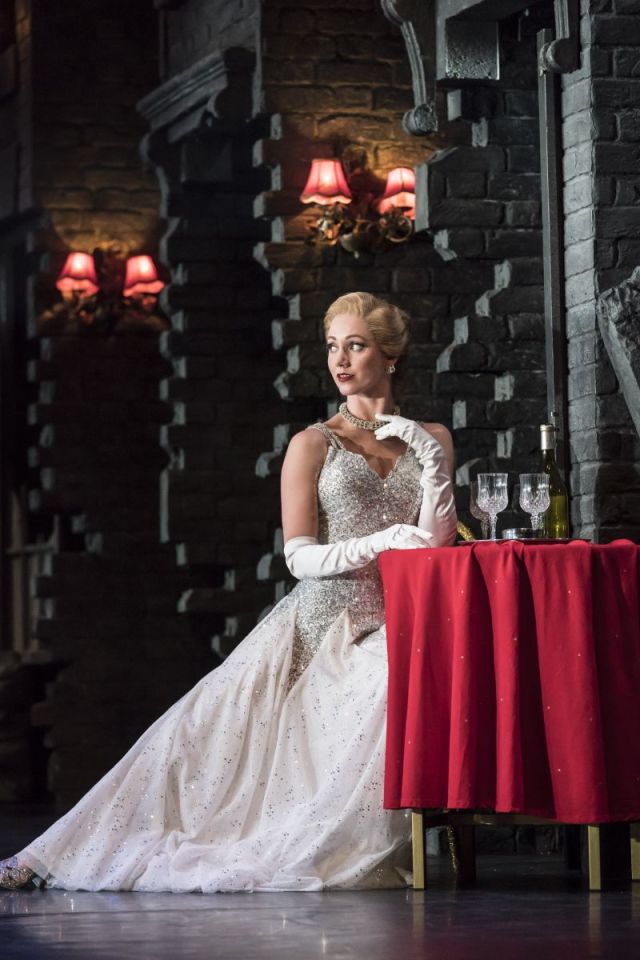
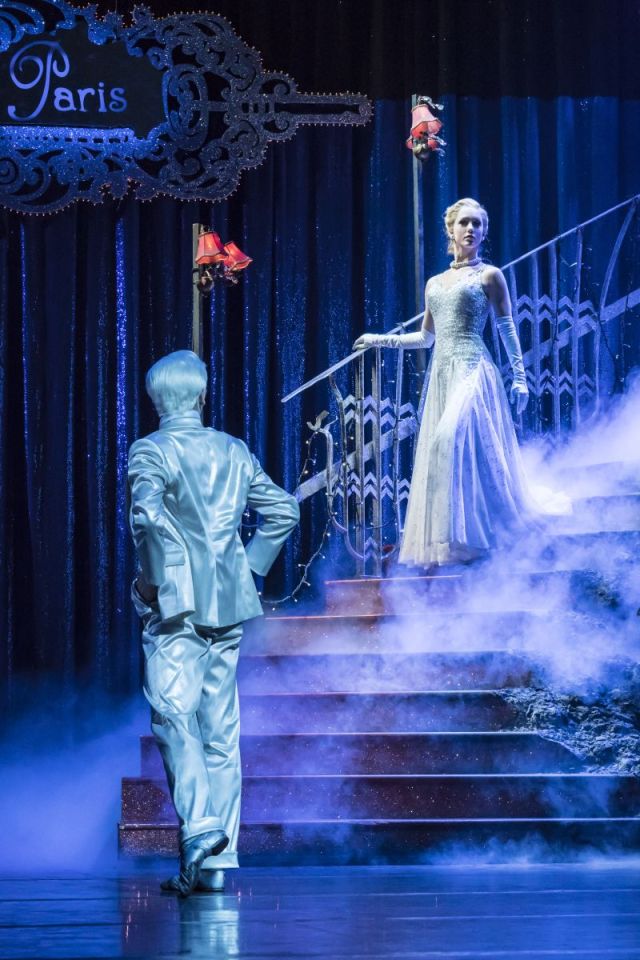
The pivotal pairing is Cinderella and the evil Stepmother. The latter is played by Madelaine Brennan, who is satisfyingly sassy and evil, the former by Ashley Shaw, in turns mousey, sexy and vulnerable. Her entrance in the Second Act, introduced by the fairy godfather before she tiptoes down the staircase of the Cafe de Paris is pure Hollywood kitsch, her solo dances in a beautiful white ballgown were exquisite perfection. They were danced with the assurance of someone who knows that they are a star, but executed with the panache and chutzpah of someone who enjoys showing why.
The Café itself is wonderfully recreated, destroyed, then recreated again in spectacular fashion. Local boy Andrew Monaghan excels as raffish RAF pilot Harry, dashing, daring and wholly believable as Cinderella’s love interest. Stephanie Billers and Nicole Kabera play the step-sisters as fairly straight forwards bitches, the comedy element falling to step- brothers Dan Wright and Stephen Murray. That one has a foot fetish, is a neat idea for a story about a lost shoe.
The production is lavish in every department, not least in the cast, with over twenty named dancers, and many supporting players too. Ballet involves telling a story without words, great dance evokes such emotion that words become superfluous. This production easily falls into the latter category. The set, costumes, production values, dancing and realisation of the narrative are all of the highest order. Sir Mathew Bourne was present for this opening night, his attendance a measure of his attention to detail and commitment to his productions. I spoke to him briefly, his concern that I, and everyone else, should enjoy the show. We did.The standing ovation at the shows close was richly deserved.
Runs until Sat 10th and continues on nationwide tour. http://new-adventures.net/
****
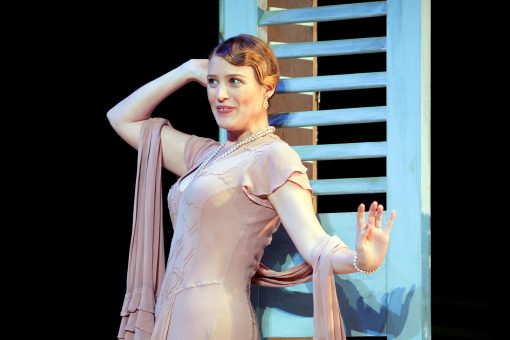
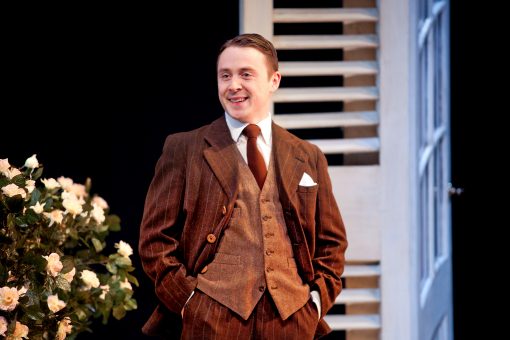
Written by Noel Coward some 88 years ago in 1930, “Private Lives” is a comedy of manners showcasing his trademark wordplay, badinage and wit. Performed by the London Classic Theatre Co, this is Director Michael Cabot’s first foray into Coward. The prospective downside of this is inexperience, the upside, that he would not have tackled it if he did not feel that he had something to offer the play.
The action unfolds on the balconies of a hotel in Deauville in the first act, and in a swanky Parisian apartment in the second. Set and Costume designer Frankie Bradshaw excels with the former. Bright, art-deco and stylish, it features two rooms with balcony, side by side, cocooned centre stage, symmetrical, and resembling a television studio. It perfectly meets the demands of the dialogue.
A tight cast of five demonstrably enjoy themselves. Newlyweds Sibyl ( Olivia Beardsley) and Elyot (Gareth Bennett- Ryan) open as the ill-matched couple, Bennett- Ryan exuding exasperated ennui, Beardsley combining an irritating personality and irritating voice with commitment and conviction. But it is their neighbouring room guests who ignite the fun. Victor (Paul Sandys) combines pomposity and vacuity in equal measure. Amanda ( Helen Keeley), ex -wife to Elyot, speaks at breakneck speed , revels in her role as feisty femme fatale, and shows off a beautiful backless antique gold dress with panache and vim.
Cabot has the production, which lasts less than two hours including interval, charging along at some pace, being to theatre, what the Ramones were to pop music. This leaves no space for the audience to become bored, whilst occasionally racing through some lines which may have been better appreciated if the audience had been given more time to savour them.
Coward’s script does not feel dated, although the impact and nuances of divorce will be less keenly felt by a modern audience than would have been the case with a contemporary one. Elyot’s second half punch to Amanda’s face brought gasps from the audience, as did his line “certain women should be struck regularly, like gongs”. Yet Amanda gives as good as she gets, a more palatable outcome for twenty first century consumption. Their passionate chemistry largely convinced, their bickering convinced absolutely, at one point they seemed to be reprising an argument I had engaged in with my partner earlier in the day!
The highlight of the evening is the awkward breakfast scene as Elyot and Amanda park passion and poison to down pastries, while Victor and Sybil go to war. Coward described Victor and Sybil , as “little more than ninepins, set up to be knocked down” but Beardsley’s Sybil shows she can do a bit of knocking down herself in the surprise denouement.
A well-attended opening night gave the players rousing, generous, and deserved applause for a production which runs till 3rd February at Derby, and continues on nationwide tour until the end of April.
Gary Longden
****
The Perfect Murder is a recent stage adaption by award – winning writer Shaun McKenna of the book by internationally- renowned, best-selling crime novelist Peter James. A comic thriller, it drew a full house for the opening night, reflecting both James’ reputation as a story teller , and the strong reputation which Sutton Arts rightly enjoys for this type of production. Stuart Goodwin directs, one of an unusually strong stable of Directors which the company uses. He can be relied upon to manage twists and turns, as well as shocks and laughs, in a suburban noir thriller certain to keep murder/mystery fans happy.
John Islip and his team have done a fine job with a busy set, which on a relatively small stage, manages to incorporate a marital bedroom, a prostitute’s bedroom, a kitchen, a lounge , a utility room with freezer, and enough doors to keep a farce fan content.
The plot is far simpler than the book. Victor and Joan are unhappily married and are planning to murder each other. Victor is seeing a Croatian prostitute Kamila whom he plans to run away with. Joan is having an affair with handyman Don , who has brought back the spark to her love life. Detective Constable Roy Grace is on hand to ensure that wrongdoers are caught and punished.
Jayne Lunn, as Joan, is the star of the show, a drudge in the lounge with her husband, a sexy minx with her lover under the duvet. Yet her performance would be less effective without the wonderfully dour Richard Cogzell as Victor opposite her. His lofty position as IT manager with the country’s ninth largest manufacturer of egg cartons fails to impress her now. She fills her day by watching crime dramas, mainly to ascertain the best way to commit the perfect murder, and by bedding her lover. Joan’s younger lover, swaggering Don, is always quick to impress with a bare chest, and a comic line in rhyming slang, a curious trait for someone who is revealed on stage to come from Birmingham. Giles Whorton enjoys himself enormously in the role, keeping the running gag of his rhyming slang just the right funny side of tedious. Kate Lowe handles her part as hooker Kamilla well. Looking sassily convincing in the role, she combines overt sex appeal with the laboured ennui of a whore, and apparent psychic powers. The immensely talented Chris Commander makes the best of the fairly underwritten part of detective.
Clockwise: Chris Commander does not believe a word as Detective Roy Grace, Giles Whorton forgets to take his shirt off, Jayne Lunn and Richard Cogzell plan to kill each other, Kate Lowe ready for action.
The sex scenes are racy, but not coarse, the humour often as black as a moonless night, and it is the comedy which carries the show. The lesson that all should take is that when acquiring bin bags to dispose of a murder victim, never economise and settle for thin value bags.
Mckenna’s adapted dialogue is strong, the plot development a little clunky, a common issue with book to stage transfers. But it is the sparkling cast who illuminate the show, their enthusiasm, vim and brio, easily smoothing over any plot cracks, ably and confidently led by Stuart Goodwin.
As is common in many murder mysteries, the exact historical setting for the action is opaque, the dress contemporary. However the soundtrack is gloriously eclectic, veering from Take That, to Sting, and the Sex Pistols, often with considerable comic effect. The evening flies by and holds the attention from start to finish, the perfect pick-me-up on a cold January evening for what turns out to be, inevitably, an imperfect murder.