It has been a considerable length of time since I last went to a gig to see a headline artist whose material I had never heard. But my friend Gary, who had seen Chantel four times before, highly recommended her, and because it is a given that anyone called Gary has impeccable taste, I thought that I would go along with him to check her out.
The Flowerpot is a great pub gig venue. Standing for several hundred, a modest, but decent stage, bar in the auditorium, and a knowledgeable rock crowd. I would guess there were somewhere between three and four hundred there, very creditable for a cold mid-week Thursday December night in the run up to Christmas, an occasion that merited a Christmas song from the band.
Support acts are often dispensed with these days for a variety of reasons but tonight we had a man with a beard and a guitar, James Manners, to entertain us. Playing a short melodious set of originals, nonetheless it was his cover of Joe Cocker’s Box Tops “The Letter” which stood out.
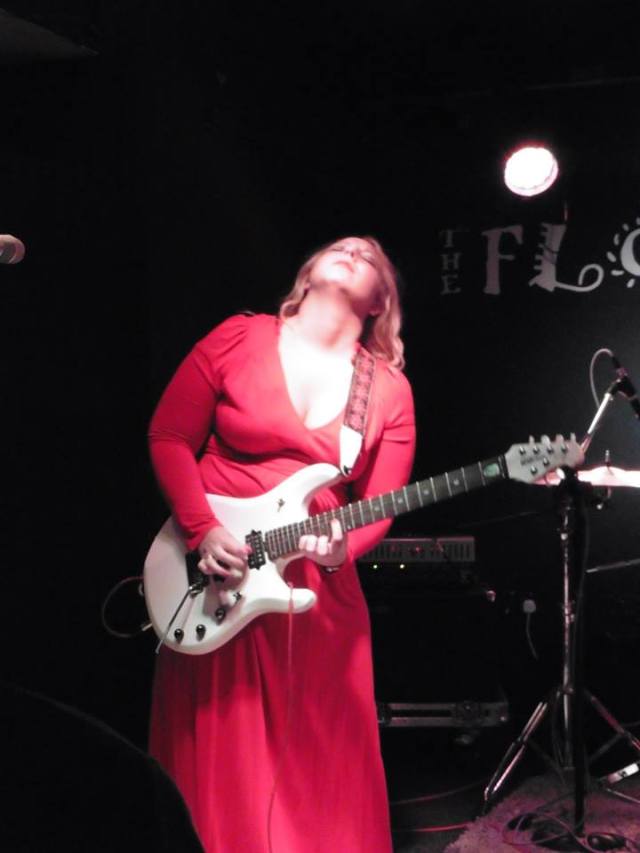
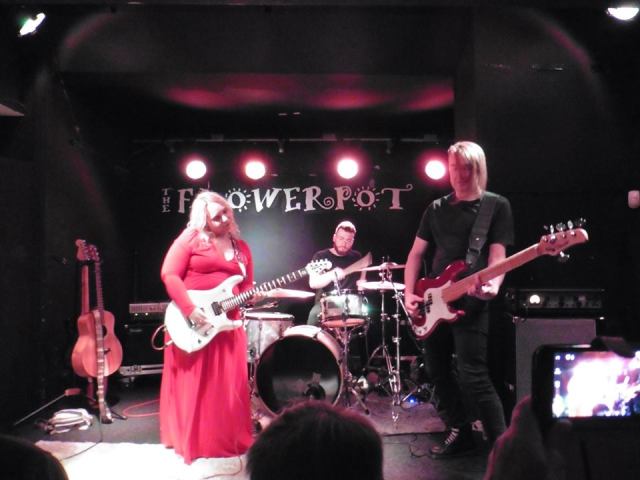
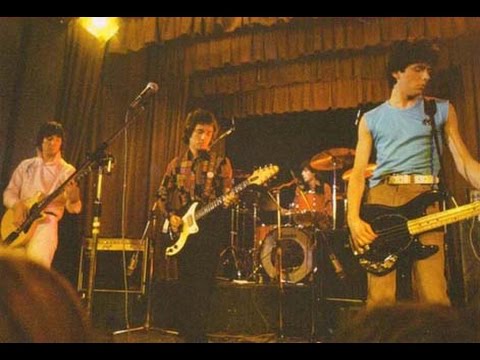
As the house lights went down, first impressions were drawn. The band are a three piece, Chantel on guitar, drums and bass, the classic Hendrix / Johnny Winter line up. Chantel appeared in a Christmassy red long dress, and although of modest stature, no heels, preferring socks on a stage carpet for comfort. Attractive, and not at all sporting the rock/biker chick chic, I as still not sure what to expect. Then she launched into her guitar. My first reaction was “where on earth is that sound coming from”- then I realised, “from her” And there was no going back, two hours of originals, and I didn’t look at my watch once.
Her voice is very distinctive. I spent the entire evening trying to think who she sounded like before I realised that she doesn’t, she sounds like herself. Capable of a Chrissie Hynde rasp, she also boasts the phrasing, looks, enunciation and softness of Candice Knight. Her guitar work was also similarly eclectic, a dash of Hendrix and Joe Walsh (think “Turn to Stone”) with phrases and licks that Tony Iommi, Brian Robertson and Jimmy Page would be proud of.
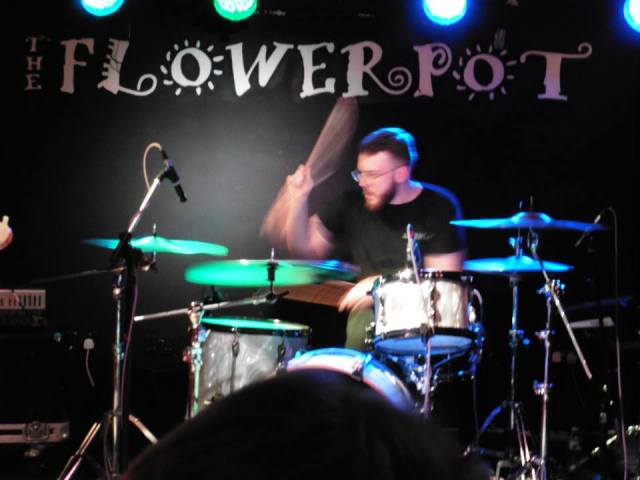
A three piece (White Stripes aside) is pretty much the minimum rock combination. Each player is glaringly exposed in this format, McGregor has chosen her sidekicks well. Drummer Ollie Goss is impossibly cheerful all the time, and consistently demonstrates an awareness of how his drumming fits into the overall sound. Apart from the essential job of keeping time his drumming offers variety, and a preparedness to offer a tempo of its own, effectively taking the lead in a song sometimes, something you rarely see.
Ollie Goss
Fop haired bassist Colin Sutton strikes poses straight out of Paul Simonon’s “London Calling” cover but offers textures similar to that which John Entwhistle offered the Who, with the difference that during Chantel’s extended improvisational work outs his bass runs are far more prominent, pleasingly so.
Colin Sutton
Although the Blues roots are self-evident, this is a rock show, whose instrumentals and improvisational pieces hark back to 1970’s prog rock. Musically, she reminded me of Johnny Winter in his prime. It is to her credit that she performed as a peer, not an apprentice. Yet there are limitations to a three piece. McGregor’s song writing and musicianship are a given, and I did occasionally wonder what a keyboard might bring to both the stage sound, and her song writing. As focal point, sole guitarist and sole singer, she carries the show on her own shoulders might be liberating. Not that there was any sign of stress from her as she enthusiastically chatted to the crowd about her Bradford roots, her mum and rubbish Christmas cards.
The audience was predominantly male, and aged fifty plus, which reflects the established market for this type of music. But such is her talent, energy and vim, that I do hope that she also draws a younger fan to her shows, producing a next generation of aficionados for music which she plays so well, and a genre which she re-energises.
****
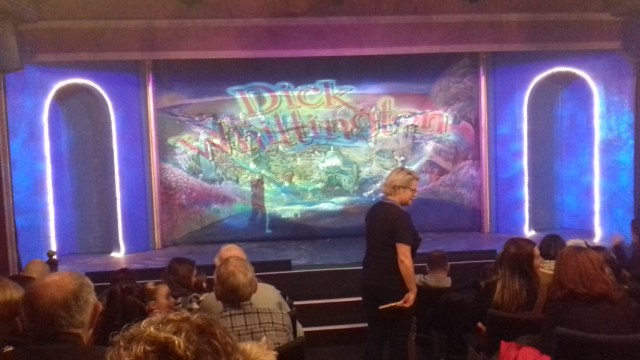
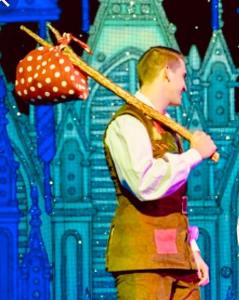
Dick Whittington is one of the better pantomimes with a well known and coherent narrative. The show is written, and directed, by Dexter and Emily Whitehead who know a thing or two about pantomimes. They understand the formula, and deliver it. Pantomime is a special theatrical form, and a vital one. It is the gateway through which children are introduced to theatre. Done well, it produces converts for life. I brought along Harry aged seven, and Jacob aged five, as my expert reviewing team.
The show is dominated by two outstanding performances. Phebe Jackson flutters and glows whenever she appears as Fairy Bowbells, her affected cockney accent and scraped back black hair remind me of Martine McCutcheon, whose voice she compares with very favourably. Her singing is fabulous, her Fairyness faultless. In pantomime good has to be countered with evil which brings me to the other outstanding performance, that of Robbie Newton as King Rat. His physical moves are always rodentesque, he spits and snarls his lines, and revels in his role as anti-hero. He had the good fortune to be playing to a Brownie Pack at the front on his side of the stage for this performance. I am not sure who enjoyed the experience more, but I would advise a check on the roof as it was raised several times by the intensity of the girls’ jeers and boos. Whenever Fairy Bowbells or King Rat appear on stage, the energy levels of everyone soared to maximum.
Paul Atkins plays the dame straight, neither camp, nor overtly feminine, but with a great range of costumes and wigs, the latter of which may need a few extra hair pins for forthcoming shows. Comedy duo Billy Bottle ( Mark Natrass) and Sammy Sack ( James Hutt), and Amelia Farrelly as Sally Slack provide the slapstick which the children enjoyed.
The supporting cast is large, filling the modest Sutton Arts stage. Sophie McCoy is fragrant and comely, as Alice, opposite love interest Dick (Tim Benjamin) who seems more surprised that he has become Mayor of London than Sadiq Khan was. Izzy Beardsmore commits to her feline persona as Tommy with enthusiasm and skill, Paul Dent is pleasingly paternal as Alderman Fitzwarren and forms a nice double act with Sarah the cook. Th hugely talented Suzy Donnelly makes the most of her cameo as the Sultana of Morocco, who is displeased to intruders, and men at that, on her land without good raisin.
Having saved on licensing fees with an in-house writing team, money is available for a decent stage and quality costuming. It shows. Mark Natrass’s set is versatile and always convinces, the on- stage structural deterioration of the Saucy Sal being particularly impressive, and the costumes are lavish. The latter is particularly noticeable for the full cast song and dance numbers, the best of which was “In the Navy” – well done to the choreographing team.
The children loved it, all the traditional call and response sequences are present, the standard of production was consistently high. The show runs until 22/12/18, catch some of the few remaining tickets if you can.
Gary Longden
I am not enamoured by the grief fests which sometimes surround the deaths of figures in the public eye. The overwhelming majority of people will never have met or known the individual, their perception distorted through the prism of media, vested and self interest. Yet undeniably the odd celebrity death does catch you off guard, prompting a pang of sadness which was not anticipated. I felt thus for the news of the death of Pete Shelley.
Pete Shelley 1977
I never met him. I never knew him. My first connection with him was sitting on the floor at the house of my friend Pete Kerr listening to the Buzzcock’s debut album , “Another Music in a Different Kitchen”. The cover was striking, silver with a picture of the band, the music fast and loud. Yet it was the melodies and sharp lyrics which impressed . They fused the energy and enthusiasm of punk with memorable tunes, some great one liners, and above average lyrics. Shelley, and the Buzzcocks were not the “best” or the “greatest”, but as an entity they were satisfying and fun.
The Buzzcocks 1978
I saw them live at Leeds Uni in 78, supported by John Cooper Clarke. Punk was in full tilt with gobbing and missile throwing de rigeur. Memorably, Shelley was hit full in the face by a half full beer can during “What Do I Get?”, which I found funny and ironic, although he probably didn’t share the sentiment. It was a great show, brim full with excitement and joie de vivre. I followed them thereafter with admiration and enjoyment.
Live in their heyday
Subsequently I saw them twice. First at the Market Tavern in 93. A dreadful dive, a music room in a run down pub. The place was sold out and throbbed with the collective bonding of fans and band, a memorable night. Lastly I saw them at the Civic Hall in Wolverhampton in 2010. Physically, Shelley did not look good, overweight and with a large beard, he looked like Papa Smurf, but the songs endured.
“Ever Fallen in Love (with someone you shouldn’t have fallen in love with)” is a classic three minute pop song, bright, breezy with a memorable lyrical hook. “Sixteen Again” a nostalgic retrospective written when he wasn’t much older a splenetic explosion. “What Do I Get” epitomised the condensed musical excellence he specialised in.
He died only three years older than me. His passing evoking fond memories from both my distant youth, and the recent past. A friend described him, and the band, as “great fun” – he would have liked that.
This fable is probably the most well-known fairy tale written by the German Brothers Grimm, first published in 1812. Hansel and Gretel are a young brother and sister kidnapped by a crafty cannibalistic witch living in the forest in a house of cake, confectionery, and candy. The two children of course escape by outwitting her in a manner which will delight all aficionados of the modern story, and film, “Home Alone”.
Mike Kenny is responsible for this adaptation, before him the tale was adapted into the now famous opera of the same name, in 1893, by Engelbert Humperdinck.
The original has an indisputably dark edge. However, rest easy parents. This production is light, child friendly, with plenty of song , dance, and laughter. I had a five and seven year old with me to ensure I had someone’s hand to hold if things became a little scary! We were fine.
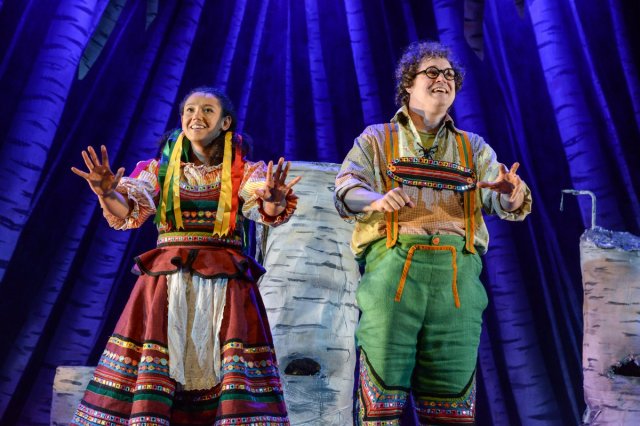
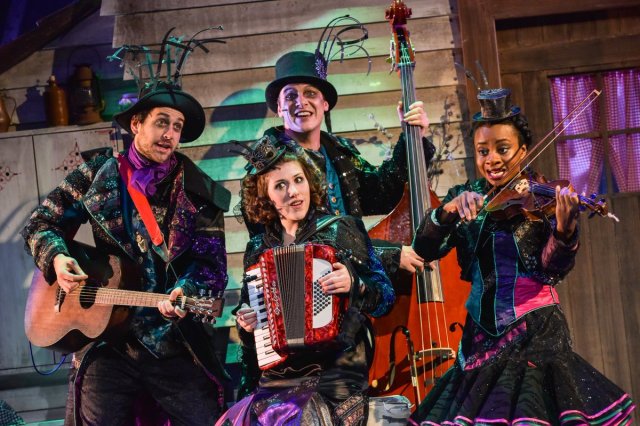
At showtime, the set designed by Neil Irish immediately impresses, but as the company arrive on stage, it is the work of Tim Heywood, Costume Designer and Head of Wardrobe which enchants and beguiles. There are Rooks. Lots of them. They combine an other worldly Gothic appearance, the males wearing large Georgian coats, with that of nomadic troubadours, replete with colour, sparkle, movement, fantasy and sheer joie-de- vivre. Always ready with a song to move the narrative along.
The children, Hansel, played by the ebullient Craig Anderson, and Gretel, played by the coquettish Yana Penrose, start off spoiled, then become lured and trapped by the evil witch, before tricking her, resulting in ingredients not to be found in Mary Berry’s recipe book in the oven! It is a classic morality tale with a song and dance never far away.
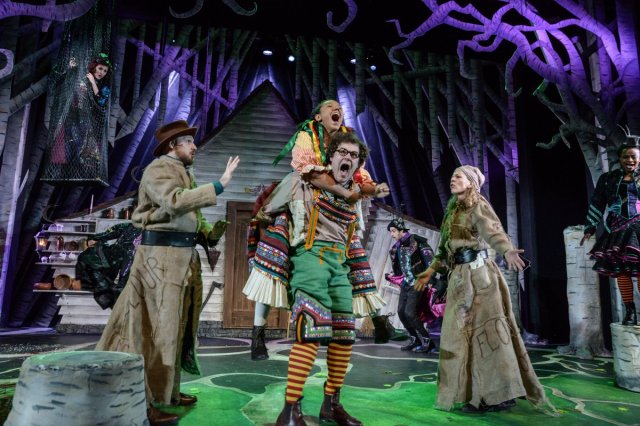
Physically, the most impressive moment is the transformation of the deceptive candy house into the malevolent witch’s kitchen with its infamous oven…
Christopher Price excels, as Ginger the Witch. It is a very difficult part to play, but he offers the right amount of specious allure to draw the children in, before morphing into evil, but not so much evil that it disturbs the children in the audience. He succeeds spectacularly with his song ‘Oh Boy’ the musical highlight of the evening. Five years old audience member Jacob muttered, “I hate you”, as the Witch tricked the children – Christopher Price will take that as the compliment it is intended to be!
Director Sarah Brigham has once again demonstrated her ability to mould a classic story for a modern audience, combining entertainment with jeopardy, to forge a hugely satisfying production.
Fabulous family Christmas entertainment with a proper narrative, edge, humour, colour and fun. Runs until Saturday 5th January.
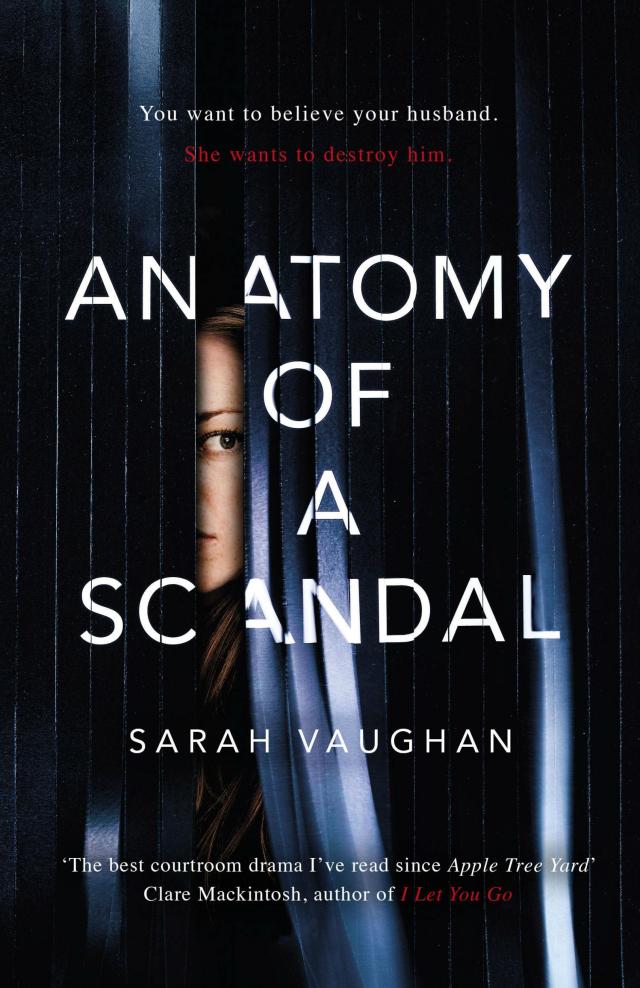
I had not read a novel for a while. This book had been heavily promoted and came with enviable review copy. The plot line involving Parliamentary scandal interested me, the author’s credentials as a political journalist were persuasive. Bought.
Just recently I have read several autobiographies which have been poorly written, with Roger Daltrey’s top ( or bottom) of the list, several novels before that equally so, with Andrew Marr similarly high or low on the roll of dishonour. What struck me immediately as the first chapter unfolded was that this book is well written. Her studies as an Oxford English Graduate come through not only in the calibre of her prose, but also in the authentic depiction of Oxford collegiate life.
Similarly, her description of politicians and the judiciary, and their home and private lives is colourful, authentic and engaging.
Her tale starts well, each chapter headed with a first name, usually that of a woman, opening with barrister Kate whose task it will be to prosecute an MP and government Minister charged with rape. Written by a woman, female characters predominate, the perspective is female and the #metoo landscape is firmly embraced.
The meat of the book is the Court Case, always rich, fertile, dramatic stuff for a writer. However, I found that it was here that the narrative ran out of steam. The opening chapter describing the barrister in chambers is superb, atmospheric, intriguing and compelling. Wife Sophie is beautifully and sympathetically introduced to us, brash James, her husband is clearly a bounder from the start. Dark insinuations about his relationship with fellow Oxfordian Tom the PM are introduced. The exposing of James’ affair comes early, the rap allegation comes quickly. The assumption is that the trial will be drawn out with twists and turns aplenty. But the latter fails to transpire.
Only one twist comes from the trial itself. In the aftermath of the trial verdict, again the assumption is that another twist awaits. But it doesn’t. There is a turn, but it is so laboured, so badly laid out, that it fails to convince.
It is a statistical truth that women read male writers more than men read female writers. In “Anatomy of a Scandal” at times the narrative was so heavily loaded from a female perspective it loses its sense of balance. Yet I don’t think that balance is Vaughan’s objective, and that is fine.
In summary, a very well written book, that loses its way in the second half, which is saved by the writing, rather than the plot.
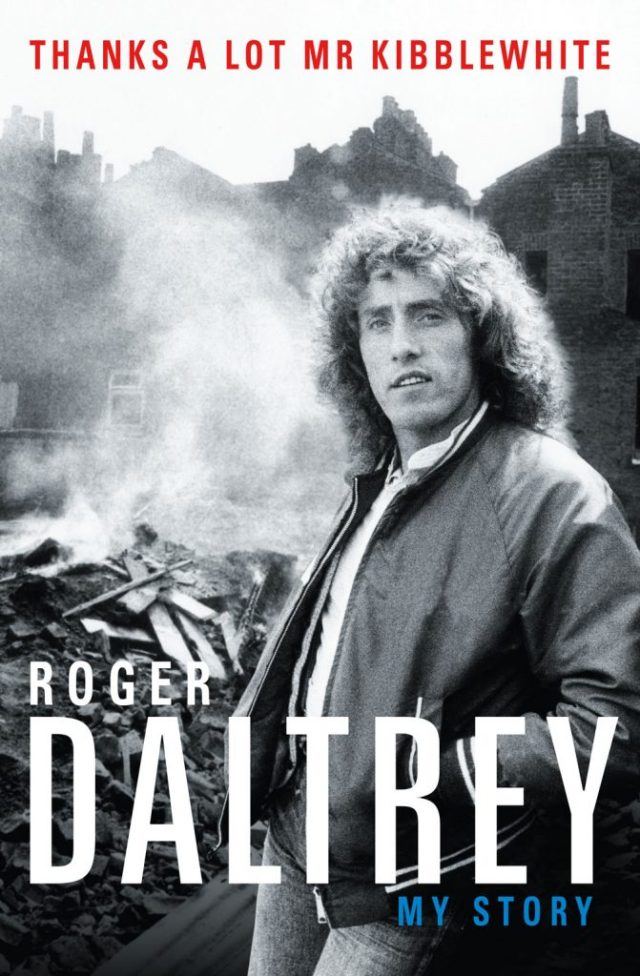
It is impossible to talk about the book, without talking about the band. It is impossible to talk about the band in isolation. The band, The Who, only mean anything in relation to those who experienced them, and their music. Thus, not only is this a book review, it is also about my experience of Daltrey and the band, first hand, and how that measures up to what I have read.
I was too young to catch the Who in their 1960’s heyday. My first remembered introduction was when I heard the single “5.15” from Quadrophenia in 1973. I was immediately struck by the powerful vocals, distinctive drumming, and energy of the songs. With so much music going on in the broad pop and rock scene back then they didn’t immediately force their way to the forefront of my consciousness . Bowie was breaking, Glam was in full swing, Deep Purple, Black Sabbath and Led Zeppelin were at the peak of their powers, amongst so much else fabulous talent.
The “Tommy” film was my first proper opportunity to consider them more fully. But although a quirky film with some memorable sequences, it wasn’t that good, nor did the music make a big impression on me, with the exception of Elton’s “Pinball Wizard” and “See Me Feel Me”. The latter prompted me to buy the album “Quadrophenia” and everything changed. My perception of the band was of one who could write four vinyl sides of narrative driven songs. It was a revelation. If I had been born ten years earlier, I would have seen them as a singles band, as it was, they were purveyors of the concept album.
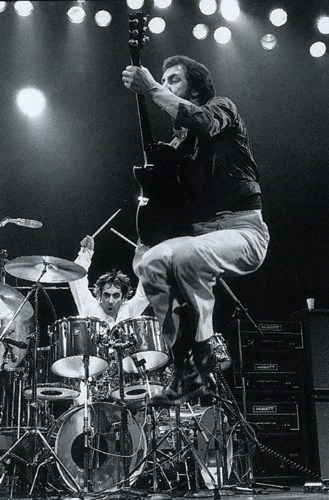
Townsend in trademark leap
Keith Moon died in 78. That could have been the end for the band. Kenny Jones ensured it was not. I was hugely fortunate to be able to catch the band for the first time at the Rainbow Theatre in London, third row, May 2nd 79. They were defiant, they were fired up, they were uncertain, they were magnificent. The “best gig ever” is such a subjective judgement subject to changeable variables, but this was up there. No support. Legendary DJ and TV presenter Annie Nightingale was sat next to me. The lights went down, and the volume turned up ay 8pm.
From the 2nd May comeback show
This was the setlist:
Substitute
I Can’t Explain
Baba O’Riley
The Punk and the Godfather
Boris the Spider
Sister Disco (Premiere: First performance)
Music Must Change (Premiere: First performance)
Behind Blue Eyes
Dreaming From the Waist
Pinball Wizard
See Me, Feel Me
Long Live Rock
Bargain
Who Are You
My Generation
Join Together
My Generation Blues
Magic Bus
Won’t Get Fooled Again
Encore:
The Real Me
————————–
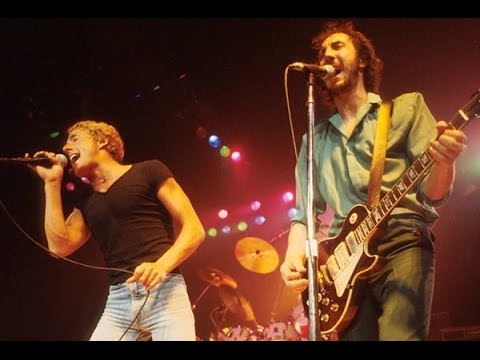
Daltrey sang like a man possessed, Townsend made the sound of a dozen wind milling guitars, Entwhistle harnessed Jones. It was rock perfection. “Pin Ball Wizard / see Me Feel Me” was the highlight.
“Listening to you I get the music, gazing at you I get the heat from , following you I climb the mountain, I get excitement at your feet.”
The song built and soared, the energy exploded past the danger zone, for a few precious moments, everyone was at one, the band, the audience, the emotion, in perfect unison.
Townsend’s lyrics are not of the Springsteen / Ray Davies calibre. Laid bare they look serviceable only, but in conjunction with the dynamics of a live performance, they assume a potency wholly unapparent on the page. The teenage confused inarticulacy of “I’ve got a feeling inside, that I can’t explain” and the rage of “Won’t Get Fooled Again” driven by Daltrey’s angst, and Townsend’s chopped chords, by a process of musical osmosis, metamorphose into something unique. To witness this in a small theatre, when the music felt it was reaching out to greater London and the world was special.
I saw the Rolling Stones in the 90’s, they were a pantomime act. Led Zeppelin at Knebworth in 79 were a bloated, tired facsimile of the band that had reshaped early 70’s rock. The Kinks in the early 90’s kept their flame alive, but few were interested. The Who at the Rainbow were the real deal.
I did not see them live again for over twenty years, until Nov 8th 2000, Birmingham NEC, again with prime seats, this time only eight rows from the front, with Joe Strummer and the Mescalero’s as support. They were fabulous. It was typical of the Who that they should give a platform to a British artist, with a fine pedigree, who needed a helping hand to reinvigorate his career.
Minstrel Boy
Bhindi Bhagee
Gamma Ray
London’s Burning
The Harder They Come
Brand New Cadillac
Rock the Casbah
(White Man) In Hammersmith Palais
I Fought the Law
White Riot
————-
It was a vintage set from Joe who revelled in the big space the arena offered, the surprise highlight being a stunning stretched out version of “Rock the Casbah”.
At 9.15p the lights went down again. A full house. A big stage, twenty years on could they still do it? The answer was emphatically yes.
The setlist follows:
John Entwhistle aka “The Ox”
Thirty years on from their heyday they could still do it, the magic remains. Two years later Entwhistle was dead, a wonderful rock n roll check- out in an expensive Las Vegas suite, with hookers and cocaine- it is what he would have wanted. Beyond that colourful demise he is sparingly sketched as a man who played his bass too loud and had to have Daltrey explain the benefits of light and shade in his playing and solos.
Daltrey is credited as the author of this work, making it an autobiography, with no credits, or acknowledgements, offered. The writing is not lucid. It reminds me of a series of audio recordings in response to questions. Broadly chronological, some time shifts are apparent, but smack of desperate editing by the publishers, rather than inspired storytelling by Daltrey. Just occasionally first person autobiographies work, Brue Springsteen’s and Rick Wakeman’s most notably. The former by dint of his language and observation, the latter by dint of his humour. Both qualities are in short supply with Daltrey’s offering.
Daltrey is at pains to mention frequently that women were always throwing themselves at him. Once he has done this several times, he then does it again. He also stresses the drug addled state of other band members, and his own abstinence. The lad rates himself. It is not difficult to see how the politics of the band were likely to be tense and uneasy.
This is Daltrey’s story, not the story of The Who, but all too often events are described in a way that appear subjective, lack context, and feel incomplete. Daltrey acknowledges the contribution of managers Kit Lambert and Chris Stamp, sincerely, but succinctly. There is no sense of the extent of that contribution, or its impact, not least with Tommy and Quadrophenia whose operatic sweep was envisioned by the erudite Lambert.
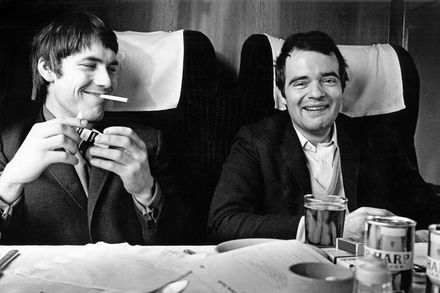
Who co-managers Chris Stamp (left) and Kit Lambert (right)
On several occasions Daltrey makes reference to the financial dynamics of the band, namely Townsend as the writer and beneficiary of the publishing rights rich, Daltrey as the singer dependent upon live performances for his income, poor. A recurring theme is the visceral, pugilistic demeanour of the singer, and the reflective, cerebral Townsend. Lambert is also lambasted as a chancer and swindler, which may have some truth in it, but the extent of his contribution is underplayed. Townsend is condemned as acquiescing to Lambert and Stamp’s excesses.
I suspect that there was more to it than met the eye. When the band fired Stamp and Lambert for pilfering the band’s earnings on their own hedonistic excess they turned to convicted armed bank robber Bill Curbishley, brother of football player and manager Alan Curbishley to take over the band’s affairs. Although not an obvious upgrade, Curbishley was clearly a better band manager than bank van raider, and his talents drew Judas Priest and Plant & Page to his management fold. What he lacked in artistic flair he made up for, curiously, in honesty.
Bill Curbishley
Daltrey is not one for analysing and commentary. He arrived, sang someone else’s songs, lived out someone else’s vision, but added his own innate sense of showmanship gleaned from hours of listening to and performing the hits of other rock n roll and blues stalwarts. He chose well. Yet it was his drive which undoubtedly kept the band going, overcoming the deaths of Entwhistle and Moon. Moon is described unflatteringly as a character, a drunk, and an instinctively brilliant drummer who didn’t practice and didn’t even own a drum kit.
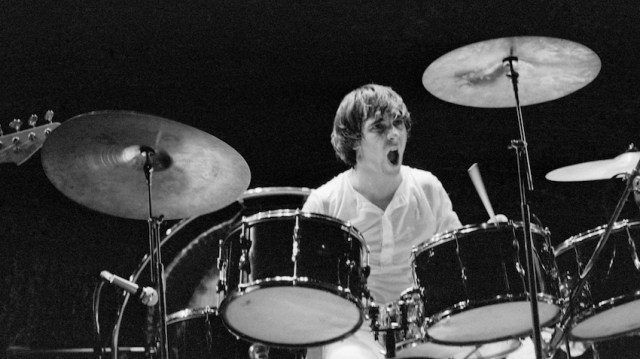
Keith Moon
What is beyond doubt is that he is a fine singer, one of the rock greats. Yet he stuck with the Who exclusively, despite their having produced nothing of note musically post 1978. He claims loyalty to the band. But I think that he, and the fans, missed out on a more diversified repertoire – contrast him with Paul Rodgers.
As a Who fan, and student of the history of pop and rock, the book is interesting. As a literary endeavour it is poor. As a snapshot of the lead singer of a rock band it has validity. As an objective contribution to the band, its songs and members it is a disappointment.
The sinking of the USS Indianapolis is one of the greatest modern maritime disasters, and the single greatest to befall the US Navy. It is a truism that such disasters are rarely simple. Such is the case with the Indianapolis. This meticulously researched book by author Lynn Vincent, and film maker and historian Sara Vladic, has much to go on. The United States and Japanese navies were slaves to record keeping. The story was widely covered contemporaneously by the United States, and world, media whose archives are available. Best of all, some survivors were still alive to give first person testimony and commentary. The credibility, authenticity, and bona fides of the material are about as good as it is possible to hope for. Although the work of two women, the book speaks with a single voice.
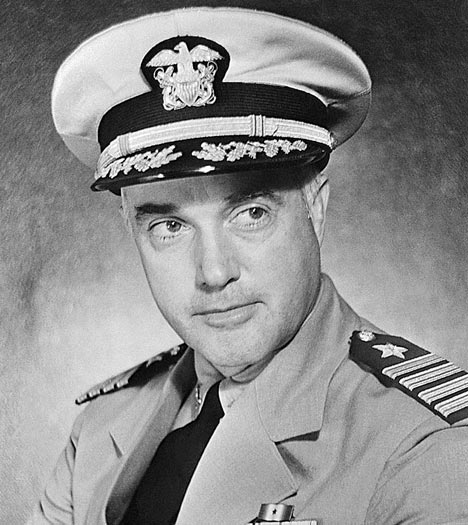
Captain Charles McVay – Court Martialled for failing to zig zag
Running to approaching six hundred pages, the story falls into neat sections, which themselves are sub divided into easily digestible chapters and episodes. It opens with the campaign to take the Japanese held Pacific islands, and the Japanese defence, particularly their use of Kamikaze attacks. Remarkably, we are then introduced to its role in transporting part of the atomic bomb from America to the Pacific which was to be used to such devastating effect. The important, but uneventful, task of atomic bomb transportation gives way to the meat of the story, the sinking and the rescue. The denouement comprises the court martial, followed by the exoneration.
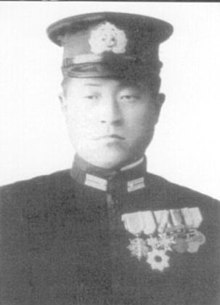
Japanese Sub Commander Hashimoto
The first half of the book is by far the stronger. Individuals are introduced, from commanders to junior enlisted men, for the Islands campaign and Bomb transportation. By the time the Indianapolis embarks upon its final journey we know many of the men, we have seen them in action, we have shared in their triumphs, lows, loves, friendships and losses. The pace is brisk, the dialogue and jargon authentic, the events engaging and gripping.
The I-58 which sank USS Indianapolis
Unsurprisingly, the sinking and desperate fight for survival of its crew is visceral, traumatic and compelling. Of its original complement of around 1500, 300 die with the ship as it is torpedoed, some 900 make it into the water, five days later only 316 survive. No detail of the horrors of open water survival are spared. The fire, the oil, hunger, the thirst, the hallucinations, the violent fights, and sexual predation, as civilisation is stripped away to leave the best and worst of the human condition. The sharks are the stuff of pure horror. Nudging the men’s dangling legs, so numerous it was if the survivors could walk on their predator’s backs, so cruel that men were intermittently snatched from salvation alive when the sharks had bored of dead corpses. This takes us to roughly the half way point in the pagination of the book. That proves to be a problem.
So well told is the story so far that nothing can match the climactic end of the sinking, survival and rescue. So carefully are the circumstances laid out, that the subsequent trial and guilty verdict for Captain Charles McVay are patently to be found wanting. Siphon off all drama.
The re-emergence of the Japanese submarine commander who sank the Indianapolis as, extraordinarily, a witness for the US Navy’s prosecution team, provides interest, but that does not last long, and the narrative sags horribly post trial. Bewilderingly the subsequent suicide of McVay merits barely a couple of paragraphs. Given the impressive background information and research gleaned on virtually everything else, the failure to deal with McVay’s tragic demise is a serious shortcoming in an otherwise densely written work.
A particular skill in histories is not in deploying all the information you have just because you have it, a flaw which the authors fall victim to. A more concise resume of the fight for justice, and a fuller exploration of McVay’s final days would have made a good book great.
Magic is an uncertain theatrical form. You know that you are watching a trick – but in order for it to succeed, you have to believe it, even though you know it is a trick. Furthermore, the better a trick, so the next one has to be even better. It is a suicidal arms race which no magician can hope to win. The requirement to believe brings out the child in us. The desire to crack the artifice draws out the adult problem- solving reflex. Which brings me to Morgan & West, a duo, who at Derby Theatre, at an 11.30am half term school holiday showing, were performing a nominally children’s show to their curious adult escorts.
My expert child reviewers, Reuben and Beau, were aged seven and eight. The oldest children in the audience seemed around eleven, the youngest from three upwards. Any parent knows that trying to keep the simultaneous attention of that age range is not so much magic, as miraculous.
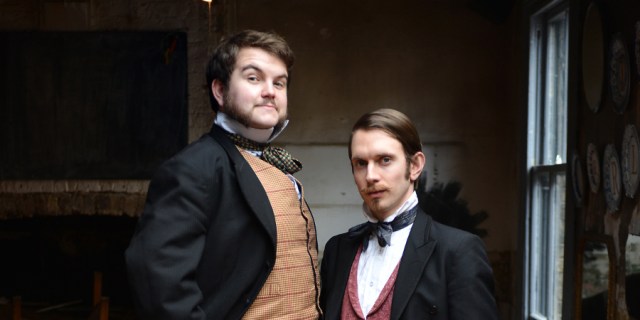
Morgan and West present themselves in Victorian clothes and speech. Morgan, tall and unctuous, West short, and even shorter tempered with children. There is no compromise on language, with many adults almost certainly having to google legerdemain. It works. This other worldly, possibly time travelling, persona only adds to the sense of mystery which finds substance in a narrative which embraces a very loose game show format, with hilarious results.
Understandably, the show majors on physical tricks. An unending supply of umbrellas and coloured eggs is routine. A sawed in half Morgan, and escape from a locked box in which the duo replace each other. is not. I did not know how they did ANY of the tricks.
The audience were enthralled from the start to the finish of the sixty minute show. The test of how enthralling a children’s show is lies in how many decide they would find a trip to the toilet more interesting mid show. No-one did. Even though the dialogue would have been difficult for pre-school children to follow, the characterisation, physical comedy and tricks kept them hooked. The older children, used to You Tube fare, looked on incredulous as magic happened live in front of them in a theatrical auditorium, not on a four inch phone screen. Adults marvelled at both the trickery, and the removal of any need to attend to their offspring for the duration of the performance. The narrative is a vital element of the performance. It not only links the trickery, it also softens the edges, and dulls the memory, so that we are not engaged in an onstage arms race escalating to the “best” trick. The laughs, of which there are many, are the oil for the wheels of the machinery.
Producing a show for children which does not dive for the lowest common denominator, instead of something greater, is no easy task. Morgan and West achieve that. The essential ingredients are there. Kids on stage – who were very good , a hapless parent, and unexpected audience responses , Donald Trump being a comic gift for this performance. The set was also impressive and robust, not the skimpy effort some children’s shows try to get away with. Well- paced, exceptionally scripted, and with impressive on stage magic Morgan and West produced a show that was amongst the best of its genre I have ever seen, with plenty to suggest that there is more magic to come. Rueben and Beau loved it.
Their website provides details of forthcoming performances well in to 2019. Catch them on the way up!
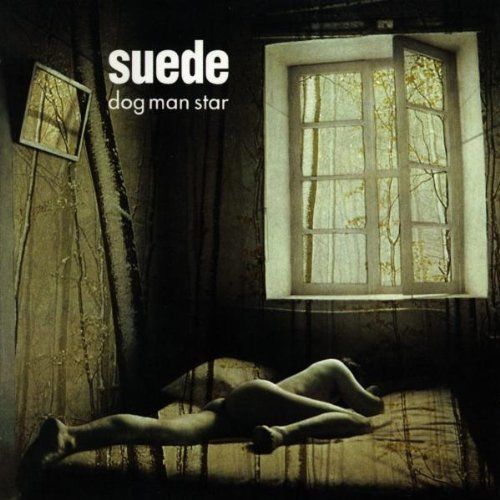
A young family prevented me from swooping into the Britpop explosion. Early Oasis, Pulp, and Blur all came and went. But I did catch Suede, although perhaps just a couple of months after their high- water mark. The good news is that it was on the “Dog Man Star” tour in 1994. The bad news was that it was just after Bernard Butler had left.
I liked their debut album, a bit rough, but with some great songs. But “Dog Man Star”, their second, was a different package altogether. It was ambitious, musically complex, sounded lush, but still with the energy, albeit refined, of the first album. It was Butler’s flawed masterpiece. He had walked out during its recording leaving songs incomplete, there were arguments over arrangements, production and song length- but somehow the results are glorious.
Live, Richard Oakes, then only seventeen years old was hired to play Butler’s guitar parts which he learned note for note. Incredibly, it worked.
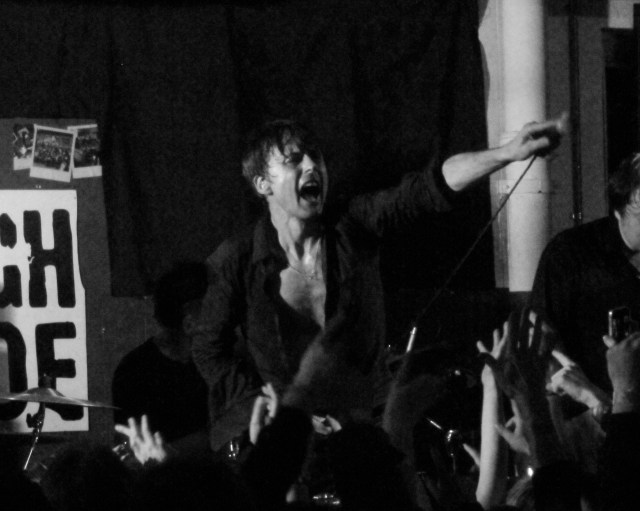
The band could have folded, instead they, and in particular lead singer Brett Anderson, emerged defiant. Wiry, sinewy and sedulous, he combined flamboyance with an instinctive understanding of what a front man should be . Setting himself apart , and distinct, from the likes of Liam Gallagher, Jarvis Cocker and Damon Albarn.
The Wolverhampton Civic Hall is a great traditional rock venue with a large standing floor area, wide stage, and seated balcony. The acoustics are fabulous. It was an ideal showcase for the band with wiry frontman Brett Anderson prowling the stage, as fey as Marc Almond, as arty as David Bowie, with the moves and energy of Mick Jagger.
The set was as good as it would ever get. The high energy “Animal Nitrate”, teenage crie de couer “So Young” combined with the epic sweep of “Stay Together” and “Asphalt World”. They played pretty much all of the “Dog Man Star” album, “Introducing the band/ We Are The Pigs” the obvious powerful opener.
After the second album they drifted away from the edgy, arty, energetic sound in favour of a more commercial, pop one. They became a pop band. Without Butler’s inspired song writing that was inevitable – most thought that Butler’s departure would be the end for the band. But it wasn’t, and “Coming Up” the third album had no Butler songs whatever, but did include the catchy, if lightweight “Trash”. Surprising many, including me, they have survived, endured and prospered through a combination of ability, hard work and determination.
That night it was obvious that the band were something special, but often in pop it is for a moment, when the stars collide, and then tastes move on. But also, there are times when you see a band live and you have caught them at a special moment. Musically, I suspect that a show with Butler would have been better, but that tour caught them at a crossroads, where defiance and determination triumphed over loss and introspection. What a night it was.
I am fascinated by means of communication which transcend our known understanding. Plato spoke of Universal Knowledge. Scientists wrestle with epigenetics – the transfer of knowledge from one generation to another, physicists ponder quantum physics, are there multi-universes? Is everything happening at the same time simultaneously in parallel universes?
On a more mundane level there is animal communication between species, and across species. That it happens is a given, the diversity of how it happens little understood.
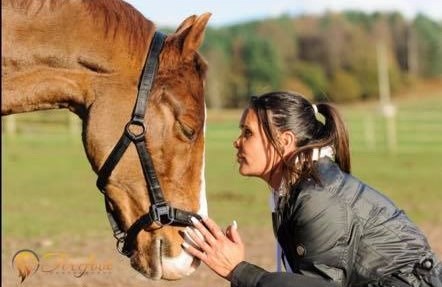
Beyond that there is communication between humans and animals. They seem to understand us, much better than we understand them.
Over twenty years ago I started to ride at the Cannock Chase Trekking centre, based in Brocton back then, but now at fabulous stables at Teddesley Coppice. I rode with my daughter Sarah, then aged nine. It was where she learned the joy of free riding rather than the drudge confines of a riding school. Lisa Gregory, the owner, made an immediate impression. Vivacious, intelligent and personable, she was also clearly an outstanding horsewoman. I have been able to ride to a high standard since childhood. She personally reignited by enthusiasm for riding out, prompting Sarah and I to ride as regular customers.
Sarah loved a pony called Banner . I was never bothered about how nominally good or bad, slow or fast, temperamental or placid my horse was. Instinctively, I could just communicate. I remember several occasions when awkward customers complained about the shortcomings of their mount so persistently that Lisa would swap mounts, giving the complainant hers, and taking the allegedly troublesome horse herself. Miraculously, the troublesome horse became the best horse on the ride, and her own mount played up the complainant something rotten!
I happened to catch the following contemporaneous blog from Lisa about a recent incident of communication between human , and horse. I share it with you verbatim, and if you want a magnificent ride out on Cannock Chase look no further than Lisa Gregory and the Cannock Chase Trekking Centre:
23rd October 2018/in CCHT News, Our Horses / THE BOND OF FRIENDSHIP “Despite spending all my life working with horses there are still moments that give me goose bumps and catch at my heart strings.
Often those are moments that leave me reflecting on the bond of friendship that exists between ourselves and these beautiful and sensitive animals that share our lives. I experienced one of those moments recently here at Cannock Chase Trekking Centre. It might seem trivial to some but it was something that really left me amazed. I will tell you the little story and you can judge for yourselves.
As followers of our Facebook page know, I am currently training our new arrival, a beautiful Andalusian mare called Nymeria. She is quite sensitive and a little bit challenging so I often work her in the arena in the evening when it is quiet with fewer distractions.
I had worked her and then turned her out. The rest of the herd were long gone so, with Nymeria loose, I walked up the field to open the gate and let her through. Unfortunately she spotted them through a gap in the trees and became fixated that she should go the wrong way. With no lead rope or head collar I was stuck and could not persuade her to follow me through the open gate.
She was getting a little agitated when I had an idea and approached my good friend Capulate, who was grazing in the next field. As my blog readers know from when I wrote about him, he was one of the most challenging horses I have ever trained. We spent many, many hours together and as a result we have a special friendship. I love him, he loves me, simple as that.
We had a little chat and a cuddle that evening and I explained my predicament. Then I did some of my natural horsemanship join up technique and he left his grazing to follow me into the other field where Nymeria was still fretting. I really had no clue what would happen next.
I watched in delight as Capulate went straight to her and stood with her for a few seconds. Then he turned, and with Nymeria following closely behind, he led her through the gate and escorted her to her friends before resuming his grazing.
I closed the gate behind them and stood in quiet amazement. I am left with more questions than answers. How did he know what I wanted him to do? How did he understand? How did he communicate with the mare?
All I do know is that he is my beloved friend. I had a problem and he fixed it. The rest must just be magic!”