Brighton Rock – Derby Theatre

br.png

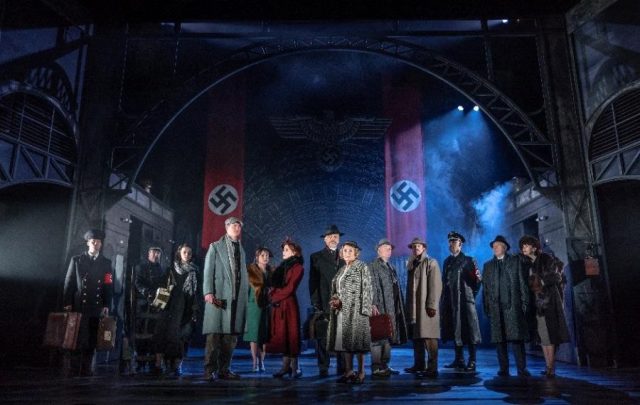
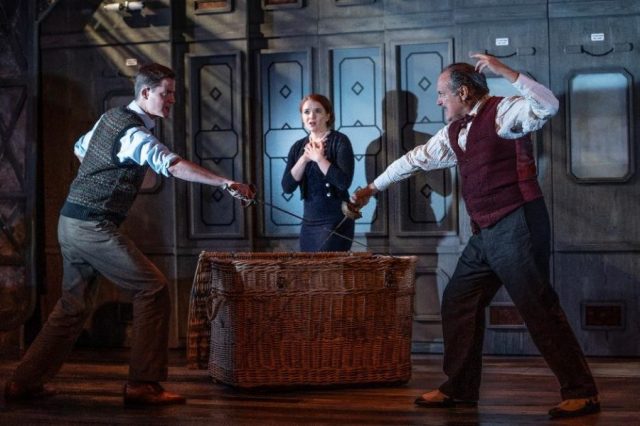
Brighton Rock is one of the great 20th century British novels first published in 1938, later adapted for film in 1947, and again in 2010. This stage adaptation by Bryony Lavery is a timely reassessment of the work set in 1930’s Brighton. A “Peaky Blinders” for the South Coast. Ostensibly, the story is a crime noir, a thriller, visceral, brutal and unforgiving. Lavery offers us a literal and metaphorical noir, with dark space between spotlights, edgy, and riddled with angst. Episodic and jarring. Underpinning it is Greene’s Catholic world view, something rarely given a 21st century outing, a religious prologue, and epilogue, bookending the production.

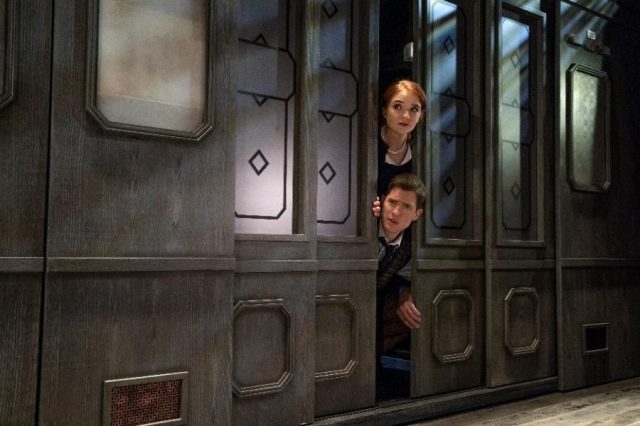
There is a moment in the second act when seventeen year old anti-hero Pinkie Brown (Jacob James Beswick) pauses from his path of psychotic mayhem, his eyes staring out into the distance distant beyond, but simultaneously looking inwards into his own soul. He leads life on the edge, each vicious encounter a dramatization of the real life Russian roulette which Greene used to dabble in. Brown is a thug on the up, a Brighton Face who has stepped into the shoes of his erstwhile boss. But a revenge-murder is witnessed by a young waitress, Rose, whom he decides to marry to avoid the possibility of adverse testimony. An unlikely, love hate, Romeo and Juliet plot evolves. He loves her, he hates her, he loves his life, he hates what it makes him do. Sarah Middleton’s, Rose is naïve, but sound, she understands she is being manipulated, but has no idea of what love is. She is a girl thrust into a bleak adult world. Brown, for all his brash bravado, is a boy struggling in a man’s world. If in doubt- lash out.

pinkieandrose

The entire play is a prolonged contemplation of the melancholy of Brown, a transcription and translation of his despair and the pain of his uncertainty. Moral failure is not only inevitable for Brown; it is also necessary for redemption. The world of sin finds its release in knife pulling, acid attacks, attempted murders, and turf wars. And it is here, amidst these sordid exploits, that Greene searches for Divine Grace. The play revels in social realism, good and evil, and the line between.

idafred

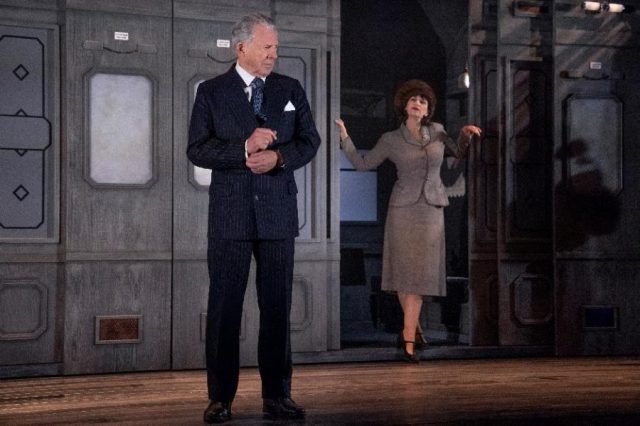
Brown is counterpointed by “tart with a heart” Ida, (Gloria Onitiri), who is the star of the show. Her understated beauty itself counterpointed by a mellifluous, doleful, versatile voice, her statuesque figure swathed in crimson and leopard print.Ida, looks out for Rose, her humanity an antidote for the brutality around her, a beacon of hope. Defiant, it is she who wants to uncover the true circumstances of the death of a man with whom she was fleetingly acquainted. Her face to face confrontations with Brown are highlights as her dominating presence dwarfs that of her rat like opponent. Her relationship with companion Jack, sensitively played by Chris Jack, is a tantalisingly explored sub-plot.

Artistic director, Pilot Theatre’s Esther Richardson, offers us a wonderful period vision. The stage is dominated by an iron walkway, looming above the stage. Sara Perks’ stage design enables it, spot lit to becomes a pier, a bedroom, a nightclub and bar. No brash seaside colours intrude, just an all -pervading sense of gloom. Hannah Peel’s insistent musical score is omnipresent, manifested live by two onstage musicians, driving the tragedy on.

Brighton Rock is a visual delight, the longer second half more satisfying than the first. I was uneasy about the dramatization of the climax, which convention dictates I cannot reveal. A bolder showdown was called for. Continues until 19th May, before finishing its nationwide tour in Manchester the following week.

Gary Longden


Posted in Behind the Arras Reviews | Tagged , , | Leave a comment

Mountains: The Dreams of Lily Kwok – Derby Theatre

Mountains-The-Dreams-Of-Lily-Kwok-web

***

A play, playwright, and story, that were all new to me, adding a large dollop of intrigue on the opening night.

The playwright In -Sook Chappell is a Korean-born, London-based playwright and filmmaker. She studied dance in New York at Alvin Ailey before moving into acting. Her first play won the Verity Bargate Award. Her work for theatre includes; This Isn’t Romance and Tales of the Harrow Road at the Soho Theatre; Absence at the Young Vic; P’yongyang at Finborough; and Mountains at the Royal Exchange. Her work in film includes Full , and Kotchebi , and has made work for Film4 and BBC Radio 3.

The play is based upon a story by Helen Tse, MBE,” Sweet Mandarin”, a memoir of three generations of Chinese women, beginning with her grandmother, Lily Kwok, establishing themselves in Manchester . Before she became an author and restaurateur, she studied law at Cambridge University and then worked in finance and law .

book m

Director Jennifer Tang graduated from UEA in 2004 and is in demand across the country. She specialises in multi-disciplinary work which for this production involves on stage cooking! As a British born woman of Chinese descent she is well placed to present the story.

Ostensibly this is the familiar, but specific, story of an immigrant’s fight to establish herself in a new country. But as it unfolds, the reason for the touring success of this production becomes apparent. It is an Everyman tale which everyone should be able to empathise with, as well as a tribute to the play’s eponymous heroine. Its focus is food and family.

In an era of Brexit, the writing celebrates the qualities and resilience of refugees and immigrants and the contribution that they can make as demonstrated by Lily’s Sweet Mandarin restaurant. Food is used as a connecting theme, the onstage aromas drawing the audience in with real dishes prepared and cooked onstage, uniting cast and audience. Family recipes are offered as a badge of identity and a unifying cross- generational device.

Tina Chiang beautifully unfolds the character of Lily, an ordinary woman doing extraordinary things, an anonymous face which demands prominence. She is the standard bearer for several diverse themes, migration, identity , assimilation, colonialism, faith and superstition, amongst them, as well as the roles and expectations different societies, and cultures, have of women.

RX-Theatre-L-R-Tina-Chiang-Rina-Takasaki-Siu-See-Hung-Ruth-Gibson-Andy-Kettu-in-Mountains-photo-by-Jonathan-Keenan-e1523439959552

Helen (Siu- See Hung) has been brought up in the UK by her Chinese family. She has always felt that a part of her story, and her, her identity, were missing. Thus she heads out to Hong Kong to visit her mother’s birthplace for the first time. However when she swaps Manchester’s Deansgate for Hong Kong she not only finds her grandmother, Lily Kwok, she also discovers things which will change her destiny.

Characters, time and locations do shift in a dream like way, meaning that you do have to pay attention, and sometimes work a bit harder than usual to work out what is going on. It is also narrative driven, told as a story. To illustrate the mix of old and new, samples of traditional Chinese songs are mixed with a modern electronic score, courtesy of Elena Pena, composed by Ruth Chan. Amelia Jane Hankin’s stage set is a marvel featuring a platform that can be deconstructed and reconfigured, Transformers style, into pretty much anything, lit pleasingly by Amy Mae, part of an all -female creative team.

“Mountains” IS different. Pleasingly so. It is also very good, taking the audience on a journey that tugs on the heart-strings, and tantalises the nostrils in equal measure. A set menu to savour- runs until Saturday 12th May.

Gary Longden


Posted in Behind the Arras Reviews | Tagged , , | Leave a comment

Crazy for You – Wolverhampton Grand Theatre

CrazyforYou-web
****
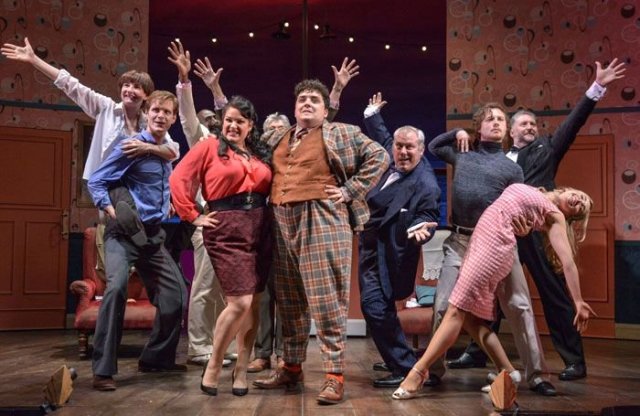
This was the first time I had seen this show. It seems as though it has been around forever, with the songs familiar by a process of popular osmosis. Yet upon conducting some dutiful pre-review research, I was surprised to discover that I was mistaken. It was written as recently as 1992. Ken Ludwig rewrote the book of a 1930 Gershwin musical, “Girl Crazy”, but retained only five of the original 19 numbers. The balance amounts to George and Ira Gershwin’s greatest hits. Thus, in some respects, “Crazy for You” can lay claim to be the first modern Jukebox musical.


Billed as a romantic comedy, we follow the fortunes of Bobby and Polly. Bobby Child is sent to close a failing theatre in 1930’s Deadrock, Nevada. He falls for Polly Baker and, assuming the persona of an Hungarian impresario, Zangler, decides to save the theatre by putting on a show. Mistaken identity, love heartbreak and joy await. The plot utilises a theatrical favourite, the show within a show, but the cast breathe life into the device. Tom Chambers, as Bobby, and Claire Sweeney as Irene, offer the star billing, but it is Charlotte Wakefield’s Polly who dominates the proceedings with a wonderful virtuoso performance.

18. CRAZY FOR YOU. Tom Chambers 'Bobby' and Charlotte Wakefield 'Polly' and Company. Photo Richard Davenport.


The show is vibrant, packed with great songs and awash with a feel-good mood, courtesy of Paul Hart’s direction and Nathan Wright’s choreography. The best known song is,“ I Got Rhythm” , a wonderful set piece of movement and colour. A battery of percussion provides a visceral, as well as a cerebral highlight, enhanced by the onstage musicians, framed by impressive sets designed by Diego Pitarch . Obviously, much work was required to convert the well- appointed, sumptuous Grand Theatre in Wolverhampton, into a ramshackle dive in Nevada!


Having musician as actors on stage is a shrewd move. It reduces the headcount for the tour, but brings an immediacy and zest to the music, ‘They Can’t Take That Away From Me’ and ‘Nice Work If You Can Get It’ come alive spectacularly.


Tom Chambers clearly loves his role, preening and prancing, and showing himself to be an accomplished comic actor too, particularly in a mirror routine with the real Zangler, early in the second half, when Child and Zangler are together, dressed identically, each playing their role to great humorous effect, “I am beside myself”. Chambers can dance too. What he lacks in vocal prowess he compensates for with energy, charm and brio.

Claire Sweeney and Tom Chambers


The female chorus line is a joy, boasting gorgeous costumes, sharp dance steps, and musical instrument playing prowess. The big dance numbers are also sumptuously lit by Howard Hudson. Director Paul Hart, musical arranger Catherine Jayes, and musical director Benjamin Holder have produced a magical alchemy in which all the parts of musical theatre come together in a joyful celebration of the genre.


The first half of the show belongs to the star turns as individuals, the second half belongs to the company. Sweeney is a hugely accomplished actress, her role here slightly underwritten, but being the professional she is, she demonstrates a determination to eke the maximum out of every opportunity she is given to shine.


screen-shot-2017-09-27-at-13-50-54_1f032019

Claire Sweeney


The audience comes to see Tom Chambers dance, and hear the big Gershwin numbers. Director Hart delivers what is required. Narratively the end of the second act is a bit of a mess, compensated for by a big production finish. A very satisfying night which was enthusiastically received by a well- attended opening night house. Last but not least, do buy the large format programme, it is the best I have ever seen for a touring production.

Crazy For You UK TourPhoto Credit : The Other Richard

Crazy For You UK Tour Photo Credit : The Other Richard


“Crazy For You” UK Tour is running until 9th June 2018. For more information, venues and tickets see http://www.crazyforyoutour.com/


Gary Longden


Posted in Behind the Arras Reviews | Tagged , , , | Leave a comment

Sarah Brigham – Derby Theatre


sb.png

Sarah Brigham


As theatre reviewers we tend to focus on the script, score and cast of the shows we see. Production Directors are as anonymous to an audience as they are omnipresent to the cast during rehearsals. Yet their role is pivotal to a production’s success. Their insight, their vision, is what the audience has laid before it. Artistic Directors, as well as invariably producing and directing some shows personally, also welcome visiting productions and one nighters. They determine what the audience sees in their theatre.

Derby Theatre’s renaissance in recent years has coincided with the tenure of Sarah Brigham as Artistic Director. From relative regional obscurity she has established the theatre as a learning, and community, hub in conjunction with Derby University, and a place that offers the best of touring productions, as well as a formidable roster of in house productions. She has made a difference.

Sarah has found herself in the unwelcome position of being diagnosed with a rare form of cancer. Notwithstanding the best efforts of the NHS, a treatment not available in this country is required. Unsurprisingly, the professional and personal esteem in which she is held has resulted in a campaign to raise funds to assist her. The details follow. If you are able to help, please do via her crowdfunding page:

https://www.justgiving.com/crowdfunding/teambrig-aid?utm_id=60&utm_term=Y9zk8MQZK
Weʼre raising £60,000 to get Sarah Brigham the cancer treatment she needs

What is crowdfunding?
Crowdfunding is a new type of fundraising where you can raise funds for your own personal cause, even if you’re not a registered charity.
The page owner is responsible for the distribution of funds raised.
Story
Hello there!
As lots of you now know, our friend Sarah Brigham has been diagnosed with a rare form of cancer. She has a 6cm tumour in her trachea. The cancer is adenoid cystic carcinoma (ACC) and only two in a million people have this type of cancer in the UK. The cancer is slow growing but relentless, and so it’s important that it is stopped in its tracks as soon as possible.
The best way to treat Sarah’s cancer would be surgery. Unfortunately, due to the size and location of Sarah’s tumour, this is not an option for her. This type of cancer doesn’t respond to chemotherapy and has limited response to normal radiotherapy.
There’s no escaping the fact that this is all devastating. But in true Brigham fashion, she is dealing with it like a bad-ass superhero. The amount of research, questioning and chasing of medical professionals that Sarah has done, whilst coming to terms with all of this, whilst also running a theatre and continuing to support artists, young people, friends and colleagues around her, is admirable… incredible… unbelievable… (there is no word big enough here to sum up her response thus far to this outrage of an illness).
And she remains very much herself. To quote Sarah:
“On the positive side (there has to be one right!) I physically feel ok and I remain positive. If you see me you wouldn’t know I have this 6 cm tumour in my windpipe. I’m still working, still laughing, still putting the world to rights and still talking in a broad Hull accent. So Cancer is not winning!”
But Sarah cannot and should not fight this on her own. Here’s where you all come in…
The best treatment option is Carbon Ion Therapy, which will hopefully stop the cancer from growing or spreading and may offer the best long term prognosis. But here’s the spanner in the frankly crappy works: this treatment is not funded by the NHS. Sarah will have to travel to Germany to receive the treatment, and to do this, she needs to raise £60,000. *Gulp* *Pause* *Gulp*
It’s a huge amount of money, but so many people have been in touch to say how much you want to support her, so we’re actually going to try and make this happen.
How do I help raise the money?
60k is a lot of money right? But what if 100 people pledged to raise £600 each? What if 1,000 people pledged £60 each? What if you donate an hour’s wages? A day’s wages? A week’s? Cut out a coffee a day for a month and donate that money! Feeling sweary? Get a swear jar on the go! £1 for slightly bad words and £5 for the really bad ones.. and so on….

If it’s legal, do it, if you can have fun at the same time – even better!
You can help as follows:
1. Contribute directly to this fundraising page
2. Donate via PayPal, fee free: http://www.paypal.me/BrigAid
3. Give cold hard cash to Nicky or Heidi in the Derby Theatre offices
4. Want to put on your own event? Great! We’ve put together some guidelines
Most importantly! Share, shout and shout some more! We have set up a Brig-Aid facebook page, which we will use to for updates and sharing your fundraising adventures. Like the page if you are on facebook and please share far and wide across as many platforms as you can, with your networks, friends, family, neighbours, rich distant cousin…
Important: If you have any questions or ideas relating to the fundraising campaign, please send them all to teambrigaid@gmail.com rather than bombard Sarah with messages and emails. Team Brig-Aid will be monitoring emails and will run things by Sarah if we need to.
Sarah is aiming to start the treatment in June, however we have set a target to raise 60K in 12 weeks. Following that this page will be extended after the deadline if we need to continue raising funds.
Who knows what the next steps will be after Sarah’s treatment in Heidelberg, so please keep sharing and shouting. And as you’d expect, Sarah, in all of her generosity, has already started thinking about where she will donate any surplus funds to.
Team Brig-Aid assemble!
Much love and thanks,
Team Brig-Aid
X


Posted in Behind the Arras Reviews | Tagged | Leave a comment

Not Now Darling – Sutton Arts Theatre

Not now

“Not Now Darling” is a 1967 farce written by English playwrights John Chapman and Ray Cooney, first staged at the Richmond Theatre, in Richmond, London, prior to a long West End run. It is  the tenth play penned by Cooney in an illustrious career.It follows the misadventures of insatiable womaniser Gilbert Bodley in an upmarket London Furriers.
Fifty one years on, inevitably, comedy has shifted. Cooney learned his craft as an actor in Brian Rix’s farces, a tradition carried on today by Torben Betts, who has worked under Alan Ayckbourn, who in turn had worked under Rix. The lineage is formidable. The danger is that the formula has outlived its usefulness. If written today, this  farce would have no hope of making it to the West End ,or to Broadway (as it did then), because it is just about as politically incorrect as you could imagine. Arch feminists and anti-fur campaigners would be in a state of apoplexy. Its short run on Broadway, just twenty one performances, is easy to explain. Its quirky Britishness gives it its appeal, and its limitations.


nn1

Angelique Runnalls – Bould, as Jane McMichael, sporting a pretty hairband for lover Gilbert


The audience was largely the one that would have been around in the 1970’s, it is also one which supports amateur theatre, which is why these farces are put on. Whether the genre can skip a generation will depend upon how effective the likes of Torben Betts are in reinventing the formula.


Fortunately, veteran Director Barrie Atchison is on hand to wrest the maximum out of the script, playing to the play’s period strengths, and not pandering to modern sensibilities. The action moves along briskly, visually there  are lashings of sauce, but no smut, and the physical gags are well acted out. It is an object lesson in producing a farce onstage.


nn2

Arnold Crouch tries to handle a tricky situation as best he can


That means plenty of pretty girls in their underwear celebrating a traditional British bawdiness with structural complication, as characters leap to assumptions, are forced to pretend to be things that they are not, and often talk at cross-purposes.  Harriet Harman was not in the audience on opening night.

f2

Drinking, and remembering which girl is in which cupboard, is not easy

Dexter Whitehead as Arnold Crouch,and Gary Pritchard as Gilbert Bodley, lead  as co- West End fur salon owners, with an unusually strong supporting cast bringing eleven people on stage in total. The action pivots around a fur coat  intended  for Bodley’s mistress, which along with other items of female apparel, are defenestrated with great regularity, much to the bemusement of the staff on the ground floor and passengers on the No 9 bus. Whitehead captures a sense of innocent haplessness with great comic assurance, Pritchard’s swaggering Lothario-like persona unravels with delightful despair.


Richard Clarke plays Harry McMichael with impatient suspicion, while his wife Janie, entertainingly played by Angelique Runnalls -Bould, has all the fun as mistress to Bodley, displaying her shapely figure , as Gilbert’s cash figures unravel.


f3

A rare scene in which the cast are not hidden in cupboards

Elena Serafinas  gives a brief, classy performance, as Bodley’s wife, arriving back from a holiday where she has not been enjoying the sun alone. Indeed it is the men who end up looking foolish, the women who come out on top.


f6.jpg

The genre demands slamming doors, and girls secreted in cupboards, “Not Now Darling” does not fail to disappoint in this regard.


f4

Arnold Crouch upon realising that the phrase “All fur coat and no knickers” is not metaphorical in this instance.


However the real star of the show does not say a single word. It is the set. John Islip and his team have excelled themselves, producing a beautifully presented, and appointed, Furriers salon, balcony with London street scene, and, naturally, capacious cupboards.


f1

Mr & Mrs Bodley, with secrets as yet unrevealed

Amidst the Marx Brothers style mayhem, Louise Farmer, as Miss Tipdale, keeps her clothes on, and attempts to make some sense of the chaos around her with a smile. Maureen George and Phil Shaw are a delight as Commander and Mrs Frencham, the latter worrying about having sixpences for parking, the former amazed at his wife’s reported new found libido.


f7

Miss Tipdale makes a note of the replacement clothing required for the women onstage – it is a long list.


All the players find their stride in the second act when the script and misunderstandings come to a head.

f8


This production is a lot of fun, a couple of hours of gentle escapism, laughs and giggles, delivered with zest, commitment, enthusiasm and discipline. All involved should feel proud. The full house on the opening night showed their approval with warm and generous applause at the final curtain, the cast looking out with deserved satisfaction. Runs until Saturday 12th May.


barrie2

When Barrie met Gary


Gary Longden

Posted in Behind the Arras Reviews | Leave a comment

Spamalot – Derby Theatre


spamalot
*****

This third UK tour of “Spamalot” opened in September 2017 in Blackpool, and reaches Derby as part of its nationwide travels. It is a brand new production of the show by Selladoor. The Monty Python team dominated British television in the 1970’s, the film “Monty Python and the Holy Grail” was a huge success when it was first screened in 1975, a cinema success which was reprised with “The Life of Brian”. In 2005, “Spamalot”, a stage play based on “Monty Python and the Holy Grail”, opened to much acclaim on Broadway, a project masterminded by Eric idle himself, rather than the whole Python team. The television series was always a little hit and miss, a luxury unavailable to a stage show. I was fascinated to see how Idle’s creation would shape up.

spam curtain


I need not have worried. The spirit of Python is ever-present, but the production is a stand- alone piece, no previous experience is required. Director Daniel Buckroyd has not opted for a nostalgia show, instead neatly fusing classic comedy with the demands of a 21st century audience, driving proceedings on at a brisk pace. Sara Perk’s set is quirky, retro, stylised, kitsch and very effective, transforming Derby into Camelot. Ashley Nottingham’s choreography is delivered with brio and enthusiasm. Favourite elements endure, the dancing nuns, the coconut shell created horse, and the dismembered Black Knight amongst them. A contemporaneous script, name checking Piers Morgan and Simon Cowell, is fresh, and funny. The deliberations about the coconut carrying abilities of European and African swallows is laugh out loud stuff.

Selladoor Productions present Monty Pythons Spamalot

Sarah Harlington as the Lady of the Lake


The songs work. Inevitably, “Always Look on the Bright Side of Life” receives more than one outing, including a sing-along end of show reprise, but Sarah Harlington’s diva strop in “Whatever Happened to my Part?” stood out for me, comic, accomplished and dramatic. Eric Idle wrote the musical’s book and lyrics and collaborated with John Du Prez on the music, except for “Finland”, which was written by Michael Palin for Monty Python’s Contractual Obligation Album; “Knights of the Round Table” and “Brave Sir Robin”, which were composed by Neil Innes for Monty Python and the Holy Grail; and “Always Look on the Bright Side of Life”, which was originally written by Idle for the film Monty Python’s “ Life of Brian”.


Derby does not often stage professional musicals. It was a pleasure to see the return of an orchestra pit, and four musicians playing live, led by Musical Director Brian McDermott. There is no substitute for the sound and dynamic, of musicians playing live supporting the cast, and the songs fell naturally into the narrative, rather than feeling awkwardly bolted on.


Selladoor Productions present Monty Pythons Spamalot

Bob Harms as Arthur


Bob Harms is terrific as King Arthur, his double act with coconut shell wielding faithful servant Patsy, played by Rhys Owen, a delight in a performance which echoed Tony Robinson’s Baldrick in Blackadder. Mathew Pennington squeezes every ounce of camp out of fey Prince Herbert, the damsel in distress. The gay Herbert, and macho Sir Lancelot, stereotypes have the potential to go horribly wrong for a modern audience, tastes and comedy has moved on in the past forty years, but they pull it off, culminating in an hilarious and entertaining song and dance number featuring silver lame hot pants which Kylie would kill to wear.

Selladoor Productions present Monty Pythons Spamalot

Selladoor Productions present Monty Pythons Spamalot


At the final curtain, the rousing reception from a very well attended first night was richly deserved for a cast who had given it their all. The show did not feel dated at all. Maybe that is because the comedy, although a feature of Python, was not quite as Pythonesque as appeared so at the time, instead it was just classic comedy, which always endures. At inception, some Pythonistas baulked at the idea of an Idle only creation, but it is that singularity of vision which is the show’s strength, there did not need to be an accommodation with the undoubted talents of other Python team members. I am very fond of the adage that a camel is a horse made by committee.


It is no surprise that this show enjoyed such success in the West End and on Broadway, enjoy a tremendous night’s entertainment, with the Knights, while it pitches camp in Derby – it runs until Sat 21st.


Gary Longden


Posted in Behind the Arras Reviews | Tagged , , , , , , | Leave a comment

Cacophony of Stardust – Al Barz

A poetry collection review:

cac

I have known Al Barz for several years, and seen him perform innumerable times. Live, he has a reputation for quirky, engaging, performance, an appearance is always an event. His first collection, Cacophony of Stardust, draws together established stage favourites, pieces from various anthologies, combined with several newer and unheard pieces. There are a lot of them, over 211 pages, made manageable in a series of chapters whose titles, such as “Pair of Dice Lost”, reflect the wry humour which is ever present.

 
There are short poems:

 
The Tench
The only remarkable thing I can say that’s concerning the tench
It doesn’t waste time writing poems of me while it sits on a bench.


There are wistful nature poems with an edge, skilfully exploring a multiple haiku form as demonstrated by the opening “Cultivation”. What struck me was how diverse this collection is. Al often performs accompanying himself on keyboards. His sci-fi interests can create an off-beat persona and subject matter. But here the depth of the man as poet unfolds, rich, subtle and with something to say.

We are offered rhyme, blank verse, form and freestyle, so there is something for everyone. It is fascinating to see how he matches subject and format. The “Health and Crappiness” chapter, which focusses on the author’s own experiences of cancer, is raw, vivid, and compelling. Unsentimental, and with a trademark dose of black humour, Al always reaches out beyond his own experience rather than looking inwards. The breadth of material is so great that this collection is several books worth in one. The overriding emotion I experienced upon completing this collection was of pleasure and relaxation, and as Seneca said:

 
‘The mind should be allowed some relaxation, that it may return to its work all the better for the rest’ – Seneca

 
Some collections can be hard work. This is not. There is something for everyone, not least plenty of smiles. At the end, I felt I had become far better acquainted with the poet. There is no artifice or pretension, no sense that he is trying to impress, just a sense of a poet whose voice deserves to be heard. I think that Al would like that.


albarz

Al responds to his publisher’s suggestion that he change a line on one of his poems…


Al himself co-designed the cover with Mathew Cash,  Cacophony of Stardust  is  published by Burdizo Bards


If it wasn’t for Venetian blinds,
It would be Curtains for us all

Al Barz

Posted in Blog | Tagged | 1 Comment

Lynyrd Skynyrd – Rainbow Theatre, London, 1977.

There is always a temptation to view one’s youth through rose tinted spectacles. To be of a view that a time that was special to you, was special to everyone. Yet with live rock music, there really is a case that the late 1960’s and 1970’s were a golden era for live popular music. The tickets were cheap, accessible, and affordable. The venues were modest in size, the artists were easy to see and hear. I was able to secure a ticket for every artist I wanted to see. The audiences were young, mostly under 21 years of age with virtually no-one over 30. The live offering was staggering, surfing a wave of cultural freedom, peace, relative youth prosperity, the alchemy was right for many outstanding artists to surface.
In the same way that opera audiences were treated to the best of Verdi, Puccini, Strauss and Wagner in the late 19th/ early 20th Century, so 70’s audiences were treated to Pink Floyd premiering “Dark Side of the Moon”, the Stones “Sticky Fingers” and Led Zeppelin’s “4” as they were written.

I have seen several hundreds of live gigs, maybe thousands. Some brilliant, some lousy. What strikes me is that there is often a “moment” to see an artist live, and then that moment has gone. This feature is part of an occasional series in which I look back on some of the great gigs I had the pleasure of seeing, some great moments.

Lynyrd Skynyrd – Rainbow Theatre, London Jan 28th 1977


ls1

The Classic Line Up


New Musical Express, Melody Maker and Sounds dominated the UK music press in the 70’s, weekly publications for teenagers that covered the bands and music that the mainstream media were not interested in. All three were agreed, Lynyrd Skynyrd, an American blues rock and boogie band from the South, were hot, and they were coming to England. They had played England before in 1974, but had made no impact. Three years had clearly made a big difference and in 76 they had performed admirably as support to the Rolling Stones at Knebworth.

lin

They had formed ten years previously, but it took “Sweet Home Alabama” from “Second Helping” to establish them, and the word was that they were the best live rock act touring. Formed in 1964, they had thirteen years of playing together behind them. Although new to the England limelight, they were no rookies, and were touring on the back of “One From the Road”, a live album which showcased their talents. I bought tickets without even having heard it, once I had, I could not believe my luck.


With the benefit of hindsight, they were a band on the cusp, of greatness, and tragedy. In 75, Artimus Pyle took over on drums, a dervish like presence with a rock steady ear. In early 76, the Honkettes, three female backing singers were added, together with Steve Gaines, re-establishing a three guitar attack. But the demons were surfacing with Collins and Rossington involved in car crashes which affected the bands touring schedule. The two London shows were able to showcase some “Street Survivors” material from their new album, and the new reinvigorated line-up.


Support was from “Clover”, a journeyman outfit, notable for being Elvis Costello’s uncredited backing band on his first album and for containing Huey Lewis, later of “The News” and “Power of Love”, John McFee later of the Doobie Bros, and Jeff Porcaro founding member of Toto. After a perfunctory support set, at 9.15pm the lights dimmed, and from our third row seats the band sauntered onstage.

I have an ambivalent relationship with American Rock, at its best (Springsteen, Neil Young – I know he is Canadian) it is imperious, at its worst ( Aerosmith, Kiss, Journey, Toto, Boston) it is preposterous and affected. But us Brits WANT to buy into authentic outlaw/cowboy/ rebel chic.


ls4 rvz

Ronnie Van Zandt


Ronnie Van Zandt seized the microphone stand as an opening batsman seizes his bat for the opening ball in a Test against the Australians. Barefoot, denim waistcoat, cowboy hat, he looked straight out of a scene from A Fist Full of Dollars or The Searchers. Then as the pounding pulse of “Workin’ for MCA” blasted out he laid into the vocals with the determination of a ranch hand holding his first bottle of whiskey after a month on the Drive.

Most rock concerts are a succession of songs, a few achieve symphony status, where a mood appears and takes hold which transcend the individual parts. This was the latter. The set list? “One More From the Road” without “Needles and Pins” and “Tuesday”, but with “That Smell “ and “Ain’t No Goodnight”. Ronnie barely spoke apart from a cursory “Good evening London” after the opener, and “what song is it you wannna hear?” for the final encore. Gaines was a visible beacon for the band, and “That Smell” smoked. Rossington and Collins traded lead parts with him without ego or favour.


ls3 sg

“Okie” Steve Gaines


Highlights? The opening “MCA” setting a standard below which the night did not fall. “Travelling Man” soared and told a more complete story than “Freebird”. “Whiskey Rock a Roller” emerged as the band’s theme song and “T for Texas/ Call Me the Breeze” was where the triple guitars of Collins, Rossington and Gaines were showcased at their best. Yes, they finished with “Alabama” which chimed, chanted and roared. Yes, the final encore was “Freebird” which swooped, soared and immolated in a blazing final guitar duel.

It was one of those shows which left you with your ears ringing, your voice sore, your palms tingling, as you stumble out into the dark ,stillness of the night staggered at the heights which the evening scaled. And you wonder whether you will ever see a show better? A bitter sweet reflection as nine months later that incarnation of the band would be no more.


ls2

The eerily prescient cover of “Street Survivors”


I bought my copy of “Street Survivors” and felt uneasy at the image of the band half engulfed with flames. The album itself is not a classic, although “That Smell” as a song is. When I heard the news of the crash, that image immediately came to mind. Over the years they reformed in various incarnations with Ronnie’s doppelganger younger brother taking vocals. I never felt the need to see them again, as I would not be seeing “them” again. Some memories are best preserved, of a band of young men, enjoying the excesses of a rock n roll lifestyle, yet dedicated to the cause. Authors in “Freebird” and “Alabama”, of two of a very few rock songs which sit at Rock’s Top table. There will always be a sense of regret that they never had the opportunity to scale the heights which this line up achieved, but there again, who has?

Set list

Workin’ for MCA
I Ain’t the One
Saturday Night Special
Searching
Travelin’ Man
Simple Man

What’s Your Name?

That Smell
Whiskey Rock-a-Roller
Gimme Three Steps


Call Me the Breeze

T for Texas

Sweet Home Alabama


Needle and the Spoon

Crossroads
Free Bird

Posted in Classic Gigs | Tagged , , , , | 12 Comments

Football Grounds – memories

I attended my first football game in 1968, Doncaster Rovers v  Barnsley, as a nipper. I was instantly hooked, not simply on the game, but on the ground, on the atmosphere. What follows is a series of recollections of grounds that I frequently visited, and meant something, for a variety of reasons.

Portman Rd Ipswich

I visited Ipswich regularly from the early 1980’s, lived there in the late 80’s/early 90’s and had a season ticket. So far, in my “memories” series I have recounted in detail the Abbey Stadium, Kenilworth Rd and Elland Rd. They were all very distinctive grounds, for very different reasons. Portman Rd was remarkable – for being unremarkable.

It is amongst the most remote league clubs when it comes to the proximity of other football clubs. Cambridge is 55 miles away, to the east, Colchester 27 miles to the south, Norwich 45 miles to the north. There is not much competition when it comes to watching a decent level of football, London being the closest otherwise to guarantee top flight football, with West Ham the favourite destination for all travelling down to Liverpool St station. It is a rural, non -urban fan base, with a big hinterland.

The club was rightly renowned for the quality of is football, and its perseverance with managers. Sir Alf Ramsey, John Lyall and Bobby Robson all prospered here. The fans were knowledgeable and committed – but I would not describe them as noisy and partisan.

The big games were West Ham, Arsenal, Spurs and Chelsea, Liverpool and Man U, and Leeds, who for some reason always brought a big travelling support. Just once, the big game was Cambridge Utd, when they were challenging for promotion to the PL and won 2-1 with the biggest travelling league support they have ever taken, around 5000. It will be a long time before that happens again.

The home stand was the North Stand, a medium sized covered terrace divided into three pens with horizontal screening to prevent the throwing of missiles. I found it an odd place to watch the game from. I am not a fan of split home ends. The numbers, and volume, of home support is reduced, the sense of identity “this is OUR end” removed. The Barclay End at Norwich, and Spion Kop at Leicester (another oddity as it was also a double decker), were also split, I am sure there are others.

north stand

I always found the “Derby” games against Norwich strange affairs. The clubs are forty- five miles apart, the fans are drawn from different geographical areas, they are not going to work, to school to the pub, with opposition supporters. The rivalry always felt a bit contrived, the nastiness, nastiness for the sake of it. But with the other contenders being Colchester and Cambridge, you have to do what you can with a derby.

My favourite was the covered terrace at the other end, Churchman’s. There was rarely any singing, but it was solidly Ipswich, and the view was excellent.

churchmans
On one side lay the new Pioneer Stand ( aka West Stand, Brittania, with two seated tiers and a paddock. The view from anywhere was tremendous. The current name “The East of England Co-op Stand” is amongst the most ridiculous nomenclatures ever. The approach is bizarre. After passing through the turnstiles there is a large training pitch in front of you. That sense of anticipation as you enter the bowels of a ground is completely lost, evaporating into an expansive park.

Pioneer stand

Opposite lay the Portman Rd stand, a conventional large seated stand with a terraced paddock below.

portman stand
The ground was converted easily to all seater in the summer of 1990 without announcement or fuss, resulting in the away fans moving to the Upper Churchmans wing of the Portman stand. It was an unsatisfactory arrangement ,That corner offered poor views, but at the seating “firebreak” it was adjacent to amongst the most expensive home seats. The away fans had no-one to bait, the Suffolk gentry were not impressed by the behaviour of the great unwashed. The converted seating below has always been a bit of a mish mash too. Sometimes a family stand, the club didn’t like selling the lower tier tickets to home fans as they were bombarded from the away support above, but didn’t like selling the lower tier to away fans as segregation and control was difficult. The bolted on executive boxes were amongst the worst appointed I have ever been in.

When the North and Churchmans stands were redeveloped, the new seated capacity of 30,311 far outstripped the converted seated capacity of around 22,600, but the capacity of the ground has never really been tested. 37,000 at its peak in the early 1970’s, when they won the 1st Div they only averaged 22,863. In 1977, 26,672 was the highest average they had ever managed. By contrast, Norwich have built their average support much more solidly in the PL era.

The railway station is so close to the ground, barely five minutes away, the coach and fan parking so generous, that beyond the immediate environs of the ground, the town is largely untouched on matchdays. Ipswich does not catch big game fever. But the Station hotel immediately opposite the station, has always done a roaring trade for home games and is a bit of a favourite with away fans. Near the corner with Portman Rd the “Drum and Monkey” is the home fans favourite, not least because the away fans come close to enter their section of the Portman stand.

My three favourite memories?

Brian Clough’s final game as a manager, managing Forest on the last day of the season,8th May 1993. It was a glorious late spring day. Both Forest and Ipswich had a reputation for good football, and for punching above their weight in the league and Europe. As the teams came out, the whole stadium rose to give Clough a standing ovation, chanting his name. It was very moving, with the man himself physically shaking at the thunderous applause. We all knew he wasn’t an angel, that he had flaws, but perhaps that is what made him human, like us? I also like it when the home side is generous to the opposition- then beats them, as Ipswich did, 2-1.

On 3rd Sept 93 Ipswich were top of the champ table and hosting Swindon on a balmy late summer’s evening. Swindon were a run of the mill side, but with a world class player playing as sweeper, Glen Hoddle. Hoddle is one of the finest footballers England have ever produced, he is certainly amongst the best I have ever seen play. That night he was imperious. He ran the game. He had space. Ipswich did not close him down. He played a part in each one of Swindon’s four goals in their 4-1 win, creating opportunities and goals where none seemed to exist with majestic 50 yard passes. Although he did not score, he won the game, against a very good Ipswich side, and was rightly applauded off by the Ipswich fans at the end. He oozed class. He had time. He was head and shoulders above everyone else on the itch. The best 90 minutes from a footballer I have ever seen, anywhere.

In August 92 Liverpool were the visitors, always a big game at Portman Road. Ipswich had a decent side and up to 69 mins it was a good close game, 1-1, with Ipswich on top and looking to grab a winner. In the 70th minute,Jan Molby launched a pin point 40 yarder ( he didn’t like to run with the ball) for Dean Saunders to run onto in front of the Ipswich penalty area. Deano  was lightning quick onto it. All looked lost. But from the far touchline teenage defender Phil Whelan was sprinting back even quicker. Rush was two steps into the penalty area ready to deliver the coup de grace when Whelan launched a sliding tackle from the side, Rush came down with the tackle, the ball cleanly taken, kicked by Whelan’s leg, went for a throw in, the Ipswich players raced to defend, the Liverpool players positioned themselves to attack, Deano had dusted himself down to receive a Liverpool throw in… but the ref was pointing to the penalty spot.

NEVER have I seen a worse penalty decision. There was bedlam. Ipswich are a quiet crowd. They are not vociferous. But they do care about their football. They went mad. I mean everyone went mad. Jan Molby placed the ball on the spot, apologised to all the protesting Ipswich players… and scored. Cue pandemonium. Pretty much everyone is trying to reach the pitch, including matronly ladies from the upper tier of the Pioneer.

Somehow, the stewards and police prevailed. Somehow the game restarted. Somehow the incandescent Ipswich players and staff regained some composure. The last twenty minutes were like the Alamo, as wave after wave of incensed Ipswich players surged forwards. The Liverpool players sensed the injustice, and although they tried to counter-attack, they couldn’t. It seemed as though the combined weight of Suffolk was pressing them back. Then, in the 90th minute, Chris Kiwomya equalised. Forget the quietness of a normal Ipswich crowd. It was the loudest, most passionate roar I ever heard at Portman Road, amongst the loudest anywhere. This was not about a goal This was not about an equaliser. This was not about not losing to the mighty Liverpool. This was about Justice. This was about the theatre that just occasionally takes over a game, with a closing line, at the final curtain that takes your breath away. It was such a moment.

Ipswich’s current mediocrity is a shame, they are still paying the price of flying too close to the sun in the Burley PL era. The redeveloped ground is fantastic. Amongst the best appointed in the professional leagues, but the curse of the twin tier redeveloped ends damns it. As happened when they did the same to the North and South Banks at Upton Park. The sound is more than halved, as is the togetherness. A ground that is a credit to the club, and will see them through many years to come, but whose feel is not a match for the classic two covered end terrace, and two side stands with terraced paddock configuration.


Elland Rd Leeds

My aunt lived in Headingley when I was a child, and I went to University at Leeds. As usual, I did not miss an opportunity to sample the local team, and in Leeds United, and Elland Rd, there was something undeniably special. As a small child my first game, and only my second game ever, was Leeds v Newcastle, 26th Dec 1968, attendance 48,000. Admission to the best seats was £1, we couldn’t afford that so stood on the Lowfields terrace for 5’6, 27.5p in today’s money. The Scratching Shed was still there, a brooding, ramshackle terrace, the size of the new South stand later to replace it, and with a wooden barrel roof which was acoustically outstanding. It was rammed with Geordies, I recall the atmosphere being overwhelming, and was treated to my first ever hearing of “The Blaydon races”. Elland Rd on a big match day was only matched by Stamford Bridge, Upton Park, Anfield, Villa Park, Old Trafford, Maine Road and the Victoria Ground, Stoke for a combination of scale, intensity, and, critically, occasion.

The-Scratching-Shed-Elland-Road

Don Revie built Leeds United, but polarised the Club. The trench battle of the FA Cup Final and replay established the team as scrappers as well artisans. Revie’s attention to detail and incremental gains mentality, thirty years ahead of its time, was seen by others as being cynical and unsporting, certainly when juxtaposed with the glamour of Busby’s European Cup Winners, the City Slickers of Chelsea, and the increasingly successful Shankly inspired Liverpool, Shanks’ manner endearing himself to a broader public in a way that Revie could not replicate.

Catching the “Super Leeds” side of the early Seventies was like watching Barcelona. Football on a different level.

west stand 2

west stand elland rd

Two photos from 1949 show the West Stand which was to burn down twice, the small scratching shed, and how big the Kop was.

Elland Road was a superb amphitheatre for the side. The home end which I quickly graduated to when I could go without my Dad, had historically been known as the Kop, as had many big ends of the era. But as the seventies unfolded it became clear that there was only one Kop, and that was at Liverpool, and it quickly became known as the Gelderd (Rd) End, now rebranded the Revie stand. A large, single tier, covered terrace, at the time it held around 17,000. Rough, tough, and partisan, only Celtic for the European Cup tie in April 1970, succeeded in infiltrating and holding it. This was in no small part due to the number of Scots who lived in Yorkshire, historically drawn by the work in the mines. Counter chants of “Celtic” / “Rangers” followed by a unified chant of “United” was a regular feature of home games. When the chant went up, post 1970, of “No-one takes the Gelderd End”, they meant it. Like the Liverpool Kop, the Leeds fans enjoyed a surge. I liked to stand just above the central concourse entrances. All you would hear is a rumble of feet, then your body would be hit like a pile driver (think 50 steps of terracing behind you, 11st average, around 4 tons of force) and you would be carried a dozens or so steps forward before the sheer weight of compressed bodies halted you.

gelderd end
Seated quadrants book ended the Gelderd End setting a fashion which would be replicated around the league.

The Main, East Stand was unusually all seated with no terraced paddock by the 1970’s. Opposite lay the Lowfields Rd side terrace and West stand. The seated stand, elevated above a fairly big terrace, offered fantastic views. But it was odd in that it did not extend the full length of the touchline on either side, nor did it cover the standing terracing.

lowfields terrace
When the Scratching Shed was redeveloped in 1974 as the South Stand, it initially was split between a seated upper stand and lower terrace, the latter of which held 4000. The away fans were then moved to the wing section of the Lowfields terrace. This conspired to create one of the most hostile environments for away fans anywhere. Hard core Leeds support would mass on the Lowfields terrace adjacent to the away pens, on the South Stand terracing, roared on by the Gelderd End and, unusually the seats in the West Stand who would always join in the singing. The away support was surrounded. Furthermore, when they arrived, and left, there was always the thousands who would mass at the Old Peacock pub car park which, pretty unhelpfully, was located immediately opposite the access to the away turnstiles.

Three games stand out. Leeds hate southerners. All London teams were given a torrid time, and on the morning of the visit of QPR,in the late 70’s Stan Bowles was on the front of the tabloids for playing away with a page three model as well as for Rangers. It was a gift, and pretty much every sexist chant you can imagine was trotted out, with the added bonus that Stan was taking corners so could hear everything at maximum volume. As he was taking one, the chant “Does your missus know your here?” erupted. He paused, shook his head, and put his fingers to his lips. Cue the whole ground laughing and cheering his every touch thereafter. Leeds fans admired class, and Stan

In their Div 2 promotion in the late 80’s season they played a dirty Swindon side, featuring Chris Kamara, who were determined to kick Leeds off the park. It was goalless, but the refs notebook was full of Swindon cautions when Kamara scythed down crowd favourite Johnny Hendrie clearly just outside the penalty area. The entire Leeds support, and team had had enough, the Gelderd End were scaling the fences, Hendrie was motionless. Kamara looked petrified as a lynch mob massed from four sides of the ground. Fortunately, the Ref had had enough too. With amazing quick thinking, firstly he awarded Leeds a penalty, even though the offence was outside of the box, drawing roars of United approval, then sent Kamara off with the tunnel conveniently very close by. Kamara sprinted off thanking his lucky stars for an escape route. Hendrie was then stretchered off, badly injured, but as the crowd chanted his name, he propped himself up on the stretcher, ordered the bearers to stop momentarily, then saluted the crowd, before collapsing onto the stretcher again in what was undoubtedly an Oscar winning move. Cue further hysteria from the Leeds support. Their goalkeeper didn’t even bother to try to save the shot, the rest of the game Swindon barely made a tackle as, when any Swindon player drew close to a Leeds player the baying for him to be sent off started. Leeds won 4-0.

In 1977 Leeds were home to Liverpool on a Saturday in which the Bunch of Stiffs New Wave Tour was playing Leeds Uni that night, a gig for which I had a ticket. It drew a crowd of 45,500, Leeds lost 2-1. The natives were not happy. The buses heading back to the city centre were overwhelmed so we decided to walk back which involved walking past the away exits on the Lowfields terrace. The Leeds mob surged towards the exiting Liverpool fans who looked , understandably, concerned. None more so than a waif like, bespectacled young man. “ Don’t hit him, that’s Elvis Costello” I shouted watching on. Sure enough, in a gesture of remarkable musical good taste, he was spared. “Thanks mate” he shouted, disappearing into the throng. It was a great gig that night, for which I continue to take considerable credit…

900px-Elland_Road_panarama
I still watch out for their results. The, relatively new, West Stand a monument to financial folly, broken dreams, bad management, and unfulfilled promise as the YRA wait to rise again.


Abbey Stadium, Cambridge

I will always have a soft spot for Cambridge United. My parents lived in Cambridge in the early 1970s, so that was where I watched my football. The 106 bus into town, then another bus to the football ground from outside Boots. The crowd milling around the bus stop was so different to the other Saturday afternoon shoppers. A pall of cigarette smoke, Woodbines and No6, hung under the shelter roof, as a mixture of the local youth and old boys in flat caps gathered for the journey. The bus dropped you off opposite the car park entrance on the Newmarket Road, the closer you approached the ground, the more the ribbon of pedestrians along the pavements swelled. The Club had invited local schools for open days. Mine was not one of them. As a precocious schoolboy I wrote to the Chairman, David Ruston, to complain. He replied by inviting my friends and I to be his guests at the next home game!

Early abbey

The home end was a strange affair. The turnstiles opened pitch side. To the right was the supporters club. It has always looked awkward, and non-league, but the fans like it and it is to the credit of the Club that it has been retained as a quirky characteristic of the ground. To the left lies the home terrace which has four names. Geographically it was the Newmarket Road End. Older supporters called it the Corona End after the eponymous depot. But to the young fans that populated the end closest to the entrance, it was ”The Abbey”. More recently some have called it the North Stand. Cambridge is divided between town and gown and the gown was nowhere to be seen back then. Nick Hornby had not discovered the club’s joy. But as young schoolboys, the place had an irresistible lure. As often happens in provincial towns and cities, the locals had their own unique take on youth fashion. On entering the league in 1970, the club had a strong skinhead following, as did Peterborough, with Richard Allen’s “Skinhead” book essential reading. But that quickly morphed into Suedeheads, with a smattering of Clockwork Orange devotees. Immediately behind the goal, boys to the front, lads to the back massed in teenage scowl.
The walk to the ground across Coldham’s Common has always been an eyeopener for visiting fans, past grazing cows and horses. In the early days, when it was an open terrace, sometimes the local urchins would dig up assorted vegetables and lob, mortar style, carrots and celery, from the allotments, over the rear wall, onto the away fans behind. Cambridge was a backwater then, and as the club rose from modest rivalry with the likes of Colchester and Peterborough, so the arrival of the big boys in Divisions Three and Two marked the arrival of routine humiliations by away fans, with Chelsea and Millwall distinguishing themselves in this regard. Tellingly the only notoriety the United fans gained was at an FA Cup tie away to Hitchin.
Amongst our gang was classmate Mark Saggers now of Talksport celebrity. He was an excellent all- round schoolboy sportsman, and a regular on the Newmarket Road End.
To the right was the Habbin, a covered terrace which ran the length of one side, and which offered an excellent view of the game. The favoured spot for older supporters and dads with lads. The opposite end to the Abbey was the allotments end. A small uncovered terrace. Opposite the Habbin lay the main stand, which then only just made it to the half way line. What you have to remember is that in the 50 ‘s and 60s, Cambridge City, at the far better sited Milton Road, were regarded as the senior club. They treated the patchwork Abbey Stadium as a bit of a joke. The success of the club’s rise was down to good management, and some shrewd managerial appointments. In the 16 years from 1967, United only had three managers. Bill Leivers, Ron Atkinson and Jon Docherty. They all did brilliant jobs with some fine players passing through the club, from Ian Hutchinson, Brendan Batson, Andy Sinton, Steve Claridge to Dion Dublin, to name but a few.

The Abbey stadium was a bit haphazard, not expecting its league elevation. For a few seasons after joining the league it was still possible to walk all around the ground and switch ends at half time. Many did. Colchester became the new rivals, along with Peterborough. The songs were largely borrowed. “You’ll never walk alone” was a staple as it was at many grounds in the 70’s. Most of the lower division supporters borrowed songs from their more illustrious betters. “Bertie Mee said to Bill Shankly/ have you heard of the North Bank Highbury?/ Shanks said no I don’t think so/ But I’ve heard of the Abbey Boot Boys” was a favourite, even though, in retrospect, I now suspect that Bertie was unaware of the existence of United’s faithful. There was an undeniable community spirit there though. The local “Arbury” toughs, from the adjacent Arbury Council Estate thought they were the top dogs, the village lads from Histon and Bottisham thought different. For evening games all of our parents made us do our homework first, before we climbed on our bicycles, cycled to the ground, padlocked them and entered the ground at half time, when the gates were opened for free, and we had to ask those there what the score was. We did it because we thought they needed us. With gates around three to four thousand, they did. Today, with £50 not unusual for football tickets, football clubs no longer need, or deserve, that sort of support.

Later abbey
The curse of fencing blighted the Abbey stadium after a few years, as the thrill of league football met the routine violence that was endemic in football back then. The allotments end became the away end, access to transfers to the Main Stand was ended, the Habbin was sealed off, and football lost its innocence at the Abbey Stadium. A high perimeter fence in front of the vociferous section in the Newmarket Rd End obscured the view for about a half of the terracing behind, but, curiously, it didn’t extend the whole length of the stand, only about half of it. Very sportingly, none of the “Abbey Boot Boys” ever attempted the simple tactic of moving about twenty feet to one side to invade the pitch! It was a different story at the Allotments end though. The fencing was so high that only the last few steps at the back “enjoyed” (I use the term loosely) an unobstructed view. The best view for away fans was from the away corner of the Habbin which was split from the home fans terrace on the side by some hastily installed seating, a combination of height and angle giving a better perspective.

The most exciting game I ever saw at the Abbey was the last game of the season in 1974 versus Mansfield Town. It is probably still the most exciting game I have ever seen. If Cambridge won, they were promoted, if Mansfield won, they were promoted, if it was a draw, Newport or Aldershot could win a promotion slot at their expense. It was the ultimate one game shoot out. The gate of 10,542 still stands as a record for a league game. Mansfield took the lead, Utd equalised, Mansfield took the lead again, United equalised, and then late in the second half, United were given, and scored a penalty, courtesy of Bobby Ross, which won the game. The tension, excitement and post -match euphoria was unbelievable. Subsequently United gained a tidy reputation as cup giant killers knocking out Villa’s European Cup winning side and Coventry (both games I attended) amongst several memorable scalps.

British clubs have such a rich history, it is easy to take the present day for granted. But back in the 1960’s it was Cambridge City, with a ground that held in excess of 20,000, the largest non- league ground at the time, who looked likeliest to win league status.

c ciry
Milton Road – home of Cambridge City

Yet United have a history of fans, physically building the ground, as well as financing it, in the 1960’s, and more recently helping to save the club. The Abbey Stadium has always been imperfect, half a main stand, half a home end, but somehow it has always been enough. The Habbin is a fine side terrace. The redeveloped Allotments End as a seated stand has a brilliant view, but tradition makes it the away end, therefore, in the lower divisions it is rarely full, so is a bit of a waste commercially, even though aesthetically it is a big plus. The Main Stand was extended, a good job was done, and the entire structure still has plenty of years left in it. The obvious improvement is to extend the Newmarket Road End. But tradition demands that it remains a terrace, and the extra 1000 capacity that doing so would offer, is rarely required.

It is approaching fifty years since the club was elected to the league at the expense of Bradford Park Avenue, another city where really, only one senior club will do. As a physical city it has changed beyond all recognition, the population has grown significantly, the city now has a strong vibrant commercial/ technological sector, it is far more affluent, it is no longer a sleepy backwater famed only for its University. But it still has yet to find its sporting potential. Cambridge University would traditionally open the cricket season on Parker’s Piece at Fenners against MCC, and touring Test sides would sometimes play warm up games there. But there is no purpose built cricket ground of county standard. With two rugby playing Public Schools and a fine University Rugby tradition, again with combined university sides sometime taking on touring rugby international sides, the city should be able to support a top flight rugby side, but it doesn’t. CRFC plays at the 1250 capacity Grantchester Rd in the third tier. Planning in the City is notoriously difficult, but you have a sense that a new 15,000 capacity stadium which served the university, Cambridge Rugby fc and Cambridge United could just elevate Cambridge United again, as well as sport in the city. Where they are now, a fourth tier club, with the occasional cup flurry, and temporary stay in the third tier, is about right.

current abbey
I still keep an eye out for the “U’s” results.


Kenilworth Rd. Luton

As a young teenager living in Bedford in the 70’s, Luton Town’s Kenilworth Road was the closest, and most accessible football ground. Twenty minutes by train, forty minutes by road. My first game, with my dad, was sat in the Wing Stand for a game versus Fulham in 1973. I recall the crowd being around 12,000, there was no Fulham support whatsoever. Both teams were Div 2 mid table, Luton won 1-0. “Happy” Harry Haslam was the talented effervescent manager, comedian Eric Morecambe the celebrity Director. There was talk of a stadium move…

main stand
Incredibly, over forty years on, the ground is still recognisable. In front of the Wing Stand and Main Stand, there was a terraced paddock, where the Main Stand ended, the Maple Road terrace hugged the touchline. Now seated. To the left was the Oak rd Terrace, then the home end. Quite small, the terrace quite shallow, but fully covered and capable of generating a lot of noise. Opposite was the Bobbers Stand, so called as it used to be a covered terrace for which you paid a shilling, a “bob”, 5p, to get in, it had already been converted to seats, before being subsequently converted to “Executive Boxes” (don’t laugh).

bobbers

To the right rose the large open terrace, the Kenilworth Road End, which then held around 8000. The view was fantastic, and it was the best place to view the game from- unless it rained.

Luton was a dump. The ground, located in Bury Park, was now in an area with a mainly first and second generation Asian population. They did not care for football, football fans did not care for them. The walk from the railway station was through narrow streets, across a large roundabout with overhead walkways, through a run down shopping centre, then up the Kenilworth Rd for visitors. The quick train times into London, some 20 minutes, meant that many in the area supported London clubs, Arsenal, Spurs, Chelsea and West Ham particularly pretty much proportionate to how long it took to get to the grounds on the tube from St Pancras station. “Knees Up Luton town”, appropriated from West Ham and the East End was a favourite.
My next visit, in 74, could not have been a greater contrast. Luton were promoted and finished second that season, but M’Boro went up as Champions under Jack Charlton, and their visit at the end of March confirmed their Champions status. The ground was packed, the atmosphere crackled, and Boro had brought down around 4000, all in the Kenilworth Road end, they were an older crowd who all looked like either miners or shipyard workers. They probably were. Boro won 1-0 sealing the second division championship, and being with the Boro fans, and Jack Charlton their manager celebrating at the end was quite something. Upon leaving the ground with my Dad and brother two football life lessons came into focus. Firstly, the time spent in the ground had given the Luton fans time to mob up and launch a fusillade of missiles at us as we left the ground into the street. Secondly, in a football confrontation it is always best to be on the stronger side, as Boro charged, scattered and annihilated those who had sought to spoil their party.
My brother was a Chelsea fan so I would often join him for home games at Stamford Bridge. Rail travel was quick and cheap. We had caught the home third round FA Cup game against Sheff Wed on the Saturday. In the Shed the chant of “If you’re all going to Luton clap your hands” was a favourite – and it seemed that everyone was. The following Saturday 23,096 crammed into the ground to see a 1-1 draw. What struck me was how young the Chelsea travelling support was, mostly 13 -20 years old. At 2.30pm, about a thousand of the five thousand or so Chelsea fans in the KRE stormed onto the pitch, and “took” the Oak Rd End, a feat they repeated with almost identical numbers the following August, this time in the Second Division, after both teams had been relegated. The perimeter fences went up immediately after.

luton-town-kenilworth-road-kenilworth-terrace-north-goal-1-bw-august-1969-legendary-football-grounds

The town had always been depressing, the ground now started to follow suit . Due to its good rail and road links and central position it was a favourite awayday for pretty much any visiting teams to wreck the town, which they did with clockwork regularity. As the team prospered on the pitch, so things deteriorated off it. In addition to the perimeter fences, the KRE and Oak Rd end were soon divided into three pens, such was the regularity of mass movement disturbances. But this had two unintended consequences that made matter worse. Firstly, it is very easy to be brave taunting the opposition when there is a caged eight foot high steel bar walkway with five foot firebreak dividing you from the opposition. Secondly, if a pen was heavily infiltrated there was no way out, with terrifying consequences. The nadir was the home game With West Ham when around two thousand West Ham fans infiltrated the Oak Rd End. For the Chelsea games, the Luton fans had been able to flee to the wings or onto the pitch, this time with the cages there was no escape.

oak r d end
The routine was familiar. Chelsea and West Ham always “took” the Oak Rd End, everyone else didn’t but just trashed the Town. Attendances plummeted , the core support deserted the Oak Rd End, with a new, very small band reappearing in the Maple Rd Corner, the away support safely caged in.
My last game at Kenilworth Rd was the Millwall game in 1985. I worked in Upper George St in the town centre then, from lunchtime, mid-week, they started arriving. It was a cup game with no London fixtures of any note. The entire London hooligan population turned out for an evening jolly, irrespective of who they supported. Millwall FC had heard what was brewing and pleaded with Luton to make it all ticket, but Luton refused, they wanted the money from a pay on the gate fixture. The gate was just short of 18,000, Millwall’s following was around 9,000. The initial invasion was not aggressive, it was as a result of a massive crush as the 8000 capacity of the KRE was breached after the gates were demolished as officials tried to close them. The picture below shows how overcrowded that central pen was, I should know, I was in there somewhere.

Luton millwall

That game soured my view of football, for a long while. Luton installed a primitive plastic pitch which was great for them, but bad for football. The away fan ban of almost five years adding to the surreal miasma which hung over the club at that time. I had grown up, and had a car so could get to Villa Park and Villa aways more easily. Leaving Luton, and Kenilworth Rd, behind became easy. The shame was that on the pitch they had some great players, the Futcher brothers, Ricky Hill, Brian Stein, Mitchell Thomas, Brian Horton, Paul Walsh, and in Haslam and Pleat some great managers. The subsequent mismanagement, failure to move ground, and piecemeal ground improvements, making the Oak Rd End the away end, only reinforced my detachment from a club that provided me with some great memories, great games, and fine footballers.


2024/25


Ashton Gate Bristol City 4/1/25

My first new ground of the year v Derby on a bleak, misty, bitterly  cold winter’s day. the four box stands impressed, particularly the Lansdown west stand where i was sat. Even the lower tier is elevated giving excellent views.. Derby brought 3500 fans to a 27000 seater in a 22000 crowd. The ground was fine, the 1-0 defeat for Derby was not.

Posted in Blog | Tagged , , , | 2 Comments

Rosliston Retreat Writing

Continue reading

Posted in Blog | 1 Comment