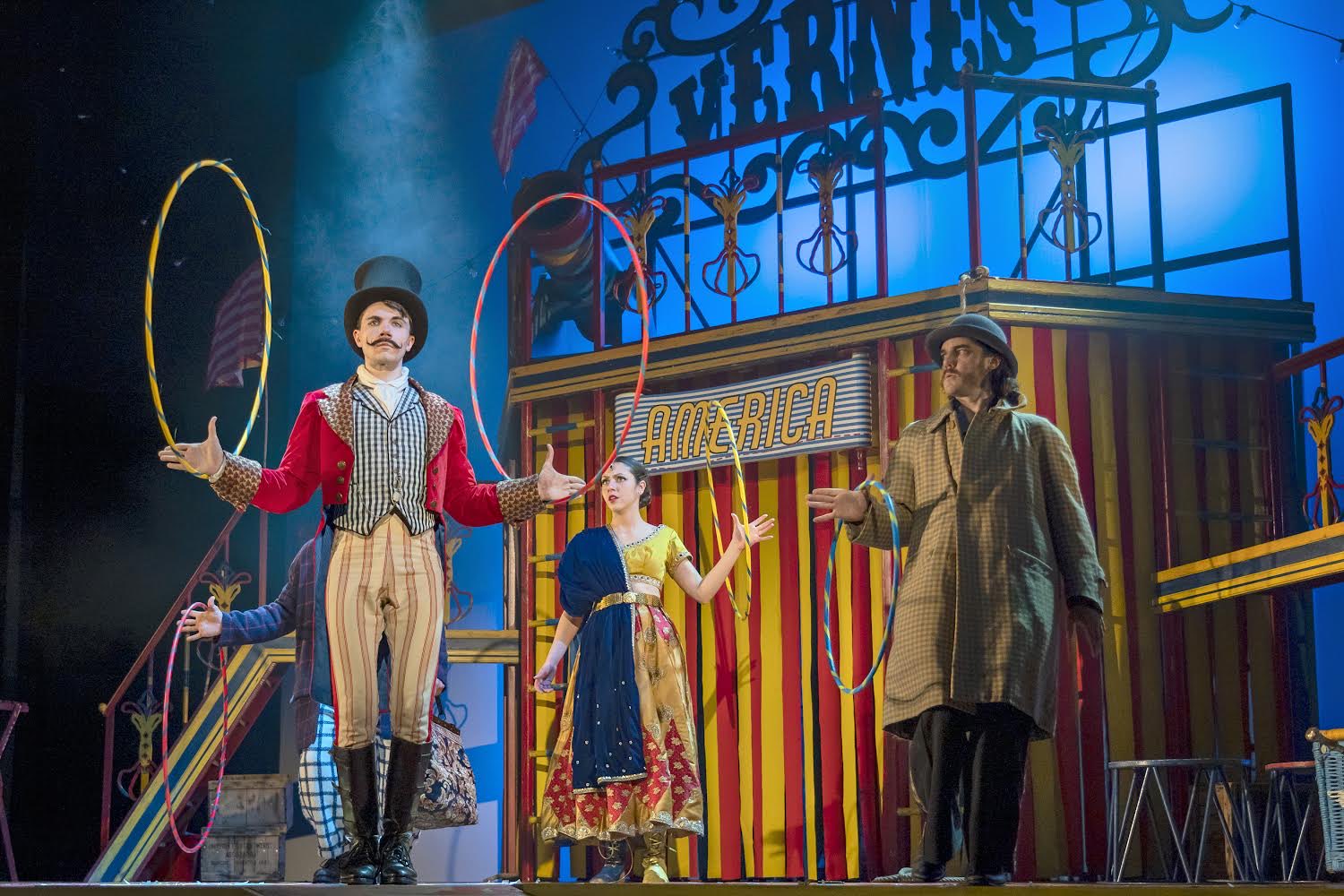
Robin Hood & the Major Oak

Robin Hood & the Major Oak- Derby Theatre

*****

A fine new Easter production for all the family written by Deb McAndrew who has rebooted the classic tale  for a 21st century audience in a seamlessly integrated BSL production, signed and captioned.

All the traditional elements are here for mums and dads but with plenty of child friendly ingredients, not least a powerful eco friendly message about the importance of trees and the environment. In an era when Boris Johnson , Emanuel Macron, and Benjamin Netanyahu have come under the spotlight for perceived abuses of power, the morality tale of the excesses of the Sheriff of Nottingham and Guy of Gisborne has lost none of it contemporaneous impact. And after a Liz Truss/ Kwasi Kwarteng government thought that it was a good idea to take from the poor to give to the rich, Robin Hood is back to offer his own more  egalitarian views on wealth redistribution ably assisted by Little John ( Oraine Johnson).

McAndrew made her name originally as Angie Freeman in 1990’s  television soap opera Coronation St, but has gone on to forge a distinguished career as a dramatist and playwright with several other productions appearing around the country this year. In April 2018, McAndrew was announced as Leeds Trinity University’s new Chancellor and has worked with  the Hull Truck theatre Company, Northern Broadsides and Claybody theatre.

Emily Bestow has created a lush set which effortlessly transforms from castle to  forest. Tim  Heywood’s costumes  are lavish and colourful. Musical stalwart Ivan  Stott has composed the score and plays with an onstage ensemble of musicians, along with lead singer Joanna Simpkins  as  Alana Dale who ensures that we all party like its 1499.

 A strong cast is notable for its character parts, with several traditionally male roles reimagined as female. Laura Golden is brilliant as a rumbustious Tuck, Abbey Bradbury dashing as Scarlett,  the angular, comic Becky Barry delivers withering apercus as Roger the Reeve.

A fast paced production ensures that proceedings are concluded within two and a quarter hours ensuring that the attention spans of younger audience members are not tested while amplified electric music segments inject zip and chutzpah into the narrative.

The dynamic of some of the character roles has shifted, Maid Marian ( Mia  Ward)  is less simpering female heroine and more Palace insider, Guy of Gisborne’s ( Dominic Rye)  dastardliness is  throttled back, while the Sheriff  ( Adam   Bassett) channels his inner Basil Fawlty as his plans are frustrated and a splinter in his backside  adds as much discomfort to him as Robin Hood does. The gross medicinal remedies offered to him delighted  the young audience. My two expert child theatre goers,  Sol aged nine, and May aged seven, loved it.

Craig Painting portrays a youthful, exuberant  Robin Hood with brio and energy, relishing the freedom of the forest in the second Act after the constraints  of his time as a prisoner in the castle in the first Act. Director Sarah Brigham and writer Deb McAndrew  never lose sight of the need to entertain in this brisk and lively family show which runs until Saturday 8th March

Gary Longden

Posted in Behind the Arras Reviews | Leave a comment

Like Some Cat from Japan

David Bowie’s love affair with  Japan,  and Japanese style, underpinned his early career. He sold 1,000,771 Albums in a country whose western tastes otherwise were dominated by Maria Carey and Michael Jackson. This feature is intended as a reminder that although London, Berlin,  New York and Los Angeles were important  cultural influences – so was Japan.

David  had a longstanding association with Japanese designer Kansai Yamamoto , instantly assimilating the Japanese tradition of fusing fashion and music.

His signature fashion styling for Aladdin Sane featured  a costume by Japanese designer Kansai Yamamoto for which International make up artist Pierre la Roche borrowed from  Lindsay Kemp. Yamamoto designed for Bowie through both his Ziggy Stardust and Aladdin Sane eras. Among his most famous outfits for Bowie was Space Samurai, a black, red and blue outfit adapting the hakama, a type of loose trousers which samurais wore and which are still worn by martial arts practitioners.Yamamoto’s outlandish costumes became a central element of Bowie performances.

That association went back to the early 1970’s and manager Tony Defries’s far sighted decision to have Main Man offices in London, New York and Tokyo meaning that Bowie was the only international popstar to have representation in Japan itself. David’s  androgynous face and body, perfectly suited Kansai Yamamoto’s unisex style”.

Davids interest in Japanese theatre was ignited in the late 1960’s  when, he studied dance with Lindsay Kemp, a British performance and mime artist who was heavily influenced by the traditional kabuki style, with its exaggerated gestures, elaborate costumes, striking make-up, and “onnagata” actors – men playing female roles. That dramatic  make-up used by kabuki became part of the Ziggy Stardust look . He  learned  from celebrated  onnagata Tamasaburo Bando how to apply traditional kabuki make-up – its bold highlighted features on a white background, evident in the lightning bolt across the Ziggy face.

The quick change tradition of Japanese theatre fitted perfectly David’s needs for his stage show. The dramatic cape could be whipped away on stage mid-performance and he also wore a kimono-inspired cape with traditional Japanese characters on it which spelled  out his name phonetically. He  was also  the first  Western artist to employ the hayagawari – literally “quick change” – technique from kabuki,  with unseen stagehands ripping off the dramatic cape on stage to reveal another outfit.

The elaborate clash of prints on his  famous knitted bodysuit were also  a reference to yakuza (organised crime syndicates) tattoo patterns. It wasn’t just his appearance – references to Japan are scattered through Bowie’s music – his 1977 album “Heroes” features the track “Moss Garden” on which he plays a Japanese koto.

‘Crystal Japan’ was an instrumental recorded  during the sessions for the  Scary Monsters album with Tony Visconti, but the song itself was one of Bowie’s oldest, written when he was 16, and worked up from a contemporaneous demo. . It was  originally titled ‘Fujimoto San’, and was  intended to close the album, before Bowie  being replaced  by a  reprise of ‘It’s No Game’ which features Japanese spoken word guest vocals.

The synth layered  instrumental “Crystal Japan” is reminiscent of  of  “Low” and “Heroes”, possibly the reason for its ultimate omission from the album. It  was used as a   soundtrack  for a 1980 Japanese television advertisement for the Shōchū drink Crystal Jun Rock, a Japanese distilled spirit made by Takara Shuzo Co. Bowie appeared in at least three different commercials, all of which featured the song. A hugely successful product, the saturation coverage the advert provided, sometimes twenty times a day,  both reflected his historic and contemporary status in Japanese pop culture, it also cemeneted it long into the future. Sharp move. ‘Crystal Japan’ was released as a single in Japan in July 1980.

In “Move on” from lodger David references “Spent some nights in old Kyoto/Sleeping on the matted ground” Bowie’s determination  to champion Japanese culture  as distinct from a generic Eastern  vision endeared him enormously  to the Japanese . Kyoto was his favourite Japanese city which he visited frequently over a period of many years particularly: Tawaraya Ryokan, where he stayed with Iman on their honeymoon, David befriended another David, leading  U.S. Sinologist David Kidd,  who had a house in Kyoto called Togendo, as well as a school dedicated to teaching traditional Japanese arts. Bowie stayed at Togendo in 1979 for some weeks,  even contemplating moving there full time at one time. He played a gig at the City in 1983 as part of the “Serious Moonlight” tour.

 Japan embraced Bowie back, where he remains one of the best known western rock and pop figures. Leading Japanese  rock guitarist Hotei Tomayasu, who composed   the theme for Quentin Tarantino’s Kill Bill films, cites David as an important influence and played with him onstage at the Nippon Budokan in Tokyo in 1996. Between 1978 ( isolar2) and 2004 ( Reality), David played the legendary Budokan arena in Tokyo  nine times.

 It is easy to forget that as Bowie’s career took off, World War 2 was only 25 years distant with memories of Japanese  ill treatment of Allied, and in particular British and Australian, prisoners of war, still fresh in the public’s mind with many survivors still living. Thus his leading role in the feature film “Merry Christmas Mr Lawrence” alongside Tom Conti  is even more extraordinary  as Maj Jack Celliers directed by the renowned Nagisa Oshima. It was controversy free instead winning plaudits as a vehicle for  Japanese and western reconciliation.

The film, set during World War Two in a Japanese  POW camp , pits Bowie’s character and another soldier against two Japanese officers, one of whom is played by the  musician Ryuichi Sakamoto who contributed the memorable film score.

Not a war film, but a film set in war time  Bowie’s character  tries to bridge the cultural divides between the  P.O.W. s and the Japanese camp commander in order to avoid blood-shed in a subtle synthesis of life and art. It is my favourite Bowie performance on film.

Although the Japanese dimension to Bowies life and career is relatively well known, it is only when you pull the strands together as I have attempted here, that its significant impact becomes apparent

Posted in Blog | Leave a comment

The Kinks, Aston Villa Leisure Centre, Birmingham, England Mar 24th 1994

There are good times to  catch bands, bad times, and times when you are just grateful to have seen them at all. This gig falls into that  latter category, thirty years after their inception, this was their last full tour, played to a quarter full sports hall. That it should have  come to this…

The always volatile dynamic between  brothers Ray and Dave was never far from the surface, but Ray’s professionalism won through. On  some previous dates, Dave had done an opening solo set. Fortunately we were spared that tonight, the fans had come to hear the Kinks play together, not a rotating variety bill.  Acknowledging the poor turnout, around 400 in a 2000 capacity venue, Ray dedicated  the show to the faithful  who were there supporting them, the faithful were not disappointed with a sprawling set which took in  their entire career.

Many argue  the question, who was our greatest sixties band, the Beatles, or the Stones ?  I have  long felt that the Kinks should be part of that equation. Their best songs are a match for either. Jagger may have had the edge in showmanship, the Beatles in range of composition, but Ray Davies ‘ quintessentially English outlook and David’s growling guitar were some combination.

It was a night drenched in nostalgia, and Ray was happy to supply numerous illuminating   supporting anecdotes. As a young child I used to love “Apeman “and “Autumn Almanac” on Radio 1’s junior choice. “You Really Got me”, “All day and all of the Night”, “Til the end of the Day”  rocked, “Sunny Afternoon”, “Waterloo Sunset” and “Village Green Preservation Society” were as English as strawberries and cream or “fish  and chips,” “Lola” was the inevitable singalong, but “ Come Dancing” was the surprise standout,celebrating the golden era of the Davies’ parents youth and the Dance Halls.

As the band left the stage there was a valedictory air. They seemed relieved to have got through it, the fans were pleased to have been there, and there was a distinct sense that this was to be their last time.[

I saw Ray several times later doing solo shows which were not only superb affairs allowing Ray to be Ray, and demonstrably so, musically probably better and with more heart. But I had seen the Kinks play, and that was all that mattered.

A Well Respected Man

Autumn Almanac

The Ballad of Julie Finkle

Sunny Afternoon

Dedicated Follower of Fashion

Do It Again

I go to Sleep

Till the End of the Day

Give the People What They Want

Village Green Preservation Society

Celluloid heroes

Low Budget

Scattered

Apeman

Too Much on My Mind

Death of a Clown

Missing Persons

Phobia

Come Dancing

Aggravation

All Day and All of the Night

Welcome to Sleazy Town

Waterloo Sunset

Lola

Days

Encore

You Really Got Me

Twist and Shout

 Ray Davies, Symphony Hall, Birmingham , England May 28th 2007

The contrast  with the AVLC gig could not have been greater. A packed out Symphony hall, acoustically superb, and from the minute that Ray bounded out it was clear that we were in for a very special night,rapturously received with  no less than three encores. The opening “Im not Like Everybody else” was extraordinary played with the vigour of a teenage

Ray Davies from The Kinks performs at the “Barclaycard British Summer Time Hyde Park”.

Set List

I’m Not Like Everybody Else

Where Have All the Good Times Gone

Till the End of the Day

After the Fall

A Well Respected Man

Autumn Almanac

Dedicated Follower of Fashion

Celluloid Heroes

20th Century Man

No One Listen

Come Dancing

Village Green Preservation Society

Sunny Afternoon

Dead End Street

Tired of Waiting for You

Set Me Free

All Day and All of the Night

Encore:

A Long Way From Home

The Getaway (Lonesome Train)

Lola

Days

Encore 2:

Imaginary Man

Waterloo Sunset

Encore 3:

You Really Got Me

Ray Davies, Symphony Hall, Birmingham , England May 28th 2007

Set List

“Victoria” was the surprise highlight in another set of evergreen classics

You Really Got Me

I Need You

Apeman

In a Moment

Dedicated Follower of Fashion

Autumn Almanac

A Long Way From Home

Sunny Afternoon

Dead End Street

Morphine Song

Vietnam Cowboys

Till the End of the Day

All Day and All of the Night

Shangri-La

Victoria

Working Man’s Café

See My Friends

Village Green

Picture Book

Big Sky

Do You Remember Walter?

Johnny Thunder

Village Green Preservation Society

Postcard From London

Celluloid Heroes

Waterloo Sunset

Encore:

Days

All Day and All of the Night

Posted in Classic Gigs | Leave a comment

A Virtual Future for David Bowie?

The Abba Voyage revenues are jaw dropping. Average £70 a ticket, 3000 capacity, seven shows a week two dark days, two with matinees equals £1.47m a week before merchandise/ refreshments. That is £76.44m per annum.

Production costs, exclusive of live band/staff are estimated at around £140m. Start date May 2022, ticket sales currently to end Jan 2024 but will almost certainly run for the whole of 2024.

BUT, Abba also “own” the Abba dome which can be sold to a new host city with Dubai, Sydney , Kouga South Africa and Las Vegas all keen.

“Mama Mia” the film has grossed £3bn to date.

The stage musical has grossed £3.5bn

Queen are banking £22m a year from the stage musical “We will rock you”

The Rolling Stones are currently grossing £100m a year when they tour.

Abba also “own” the digital technology which could be a massive future earner. As can be seen, the origination costs are massive, and each new artists show will want to keep those down, not reinvent the wheel.

However, motion capture is far easier on live performers than dead. The number of performers who can virtually sell out a venue for a year is very small. Probably only Elvis Presley, Michael Jackson, the Beatles and the Rolling Stones . David Bowie, the Doors, Buddy Holly, the Who, the Eagles Dolly Parton, Whitney, Madonna are a maybe. And what about a virtual Woodstock?

A big tourist destination with a turnover of visitors is essential. And if you can have shows running simultaneously in Dubai, Las vegas and London that would help.

In time, origination costs will come down, but as it evolves it could go up again!

As the golden age of rock and pop dies as its protagonists become too old, infirm or die too it is inevitable that those , and their estates, who can cash in will.

Posted in Blog | Leave a comment

Mother Goose – Wolverhampton Grand Theatre

What’s this? Panto in Wolverhampton at  the end of February?  Oh yes it is.

Having stormed the normal panto  season first in Brighton, then  the Duke of York’s Theatre in London, the audience response was too positive for  it to wither with the Christmas decorations, thus  it has continued on a short victory parade around the country taking in Wolverhampton this week with further dates thereafter.

Mother Goose is a Christmas stalwart as a story, and is often performed. What sets this production apart is the cast, specifically  Sir Ian McKellen of Lord of the Rings fame as  Mother Goose.  

– 

The all important script is by Scouse novelist, playwright and satirist Jonathan Harvey who just happens to have  fellow  Liverpudlian John  Bishop as his comic hitman on stage. The recent political farce in government is a gift for satire, and Harvey dos not miss a trick in singling out the obvious targets, Boris Johnson, Suella Braverman, Camilla Parker Bowles and the energy companies amongst them. He has been a regular on the Coronation St scriptwriting team since 2004, his populist credentials and touch are a given.

This is a traditional show, affectionately delivered by  Director Cal McCrystal, narrative driven with no over reliance on special effects, still music hall rather than 3D cinema . However that does not preclude copious Tolkien references and a rather wonderful foray into a Shakespeare soliloquy. There is plenty of razzle and dazzle courtesy of  Lizzi Gee’s lively choreography, Prema Mehta’s colourful  pink and green lighting , and Ben Harrison’s sound with Lady Gaga’s “ Born this way”  a showstopper, closely followed by Anna-Jane Casey’s “Cilla” powerhouse : ‘Don’t Rain on My Parade’

Although inevitably MCkellen and Bishop rightly dominate proceedings, the supporting company is strong and effective. Son Jack  ( Oscor Conlon- Morely)is exhaustingly frenetic, villainess  Malignia gloriously enjoyed by Karen Mavundukure, is suitably malign at every opportunity thankfully thwarted at every turn by good witch   soprano  Encanta ( Sharon Ballard), Anna Jane Casey is the goose that lays the golden egg, all of whom sing remarkably well.

The denouement is messy, Bishop is  very funny, Mckellan is a vision in a frou frou nightdress and delivers his apercus with consummate style.

The ensemble menagerie of  all singing, all dancing puppeteer  animals are terrific initially shivering in a closed  Debenhams store , Liz Ashcroft’s street set is stunning. The animals are very much part of the fun.  A  donkey that self  identifies as a llama,  Richard Leeming  flickers wonderfully  as  a bat, Genevieve Nicole as Puss wonders if she is in the right panto,  other animals are available!

This  wonderful comic  production runs at Wolverhampton until 25th February then continues on nationwide our at Liverpool, Oxford, Leicester, Cardiff, Dublin, Salford and Bristol.

Posted in Behind the Arras Reviews | Leave a comment

Shinrin- yoku

From Japan comes the Shinrin-yoku: the “forest bath” .

In the 6th century BCE, Cyrus the Great planted  gardens in the middle  of cities in the Persian Empire   to improve  human health. In the 16th century ,  the Swiss philosopher  and physician Paraselsus wrote: “The art of healing comes from nature, not from the physician.  But it was the Japanese who actively developed the idea with Shinrin-yoku.

You can do  Shinrin-yoku on your own- or turn to an experienced forest guide  too manage the (often very slow) pace and direct you to the best places. Unlike a simple walk, “forest bathing” invites you  to enjoy the moment not just with sight but with all five senses.  You are encouraged to live in the moment, to fully enjoy the place in which one find yourself f, to abandon technology to find a true relationship with nature.

What can be done in the Shinrin-yoku?

The centrepiece of forest bathing is undoubtedly meditation mindfullness, that is, being present with body and mind in the present moment, focusing on oneself and the natural world around. Other activities can be long, slow walks, meditation, breathing exercises and tree hugging.

The benefits of the Shinrin-yoku

The positive effects are innumerable, in a 2010 study  published at New York Times evidence was produced that it can stimulate natural immunity to diseases.. An increase in immune function is one of the most immediate benefits, but other benefits have also been noted, as reported in another study, “Shinrin-yoku: the Medicine of Being in the Forest”. In this article, decreased heart rate and blood pressure are reported, as well as decreased stress and cures for depression.

The premise is to really try: it is an active exercise.. The crux of the whole matter is that it is not enough to take a jaunt into a forest to feel immediate benefits. It is more of a mental exercise that one comes to with time, practice and concentration. You  need to make an effort to perceive all things with the five senses, you  must try to abandon thoughts of the city and technology. Immersing yourself in the forest is a conscious exercise that must be embraced in its entirety if it is to be effective.

Posted in Blog | Leave a comment

Poems 2023

Going Equipped

The officer stopped me, fairly, but firmly

Could you open your bag please?

What do we have here?

Alliteration

Assonance

Onomatopoeia

Metaphor

Simile

Personification

Repetition

Hyperbole

Enjambment

Anaphor

Epistrophe

Caesura

Couplets

Refrains

Rhythms

I Suspect  you of

Going equipped to write a poem

It’s a fair cop, I replied

But have committed no crime

For as you can see

I have included no rhyme

The Hat

No governess should be without,

A hat must whisper, it does not shout.

Sitting neat and prim and proper,

with its own special hook in her locker.

Below stairs girls  wear  pinafores  and bonnets,

But respectable heads need a statement on it.

A cut above the hoi polloi,

Looking classy, not sexy, demure and coy.

“gloves scarf and cloak”, bish bash bosh,

Finished off with  a neat blue cloche.

The Worm

Ever since I saw the bird pecking

With persistent dull thud

I have wondered

Are they really imitating the sound of rain?

Or do the worms think that it is a bird pretending precipitation again?

Do they think worms are stupid?

That they do not notice the absence of the fresh flow of water

Permeating the ground?

A perfect shower

Over their expectant dry bodies

Writhing, wriggling to its cool soft touch

Falling in love

This morning i fell in love with one sock

And realised that I was half way to finding the other

I discovered a partially consumed jar of home made marmalade

What love fomented its fermentation !

I found a feather

I should cherish it as it original owner had

I was bathed in sunlight, but shut it out

I should have relished its warmth and brightness

William Perry – Prizefighter

Heavyweight Champion of England

A knock kneed knock out

Six foot tall and sound

He defeated Tom paddock

Over twenty seven rounds

A useful navvy in London

But famed for his fives

Any daring to face him were risking their very lives

19 rounds for  a tenner, for your day in the sun

Was all that he wanted, But before he had taken  his fun

His opponents would flee, they would cut  and run

A brute rhino of a man , a formidable basher

As his opponents went on he run he became the Tipton Slasher

The Fountain inn at Dudley was where he earned his name

His pub, his turf, his undisputed domain

The neighbourhood lion

A fiery disposition and fists made of iron

And anyone who wanted to pass by to the adjacent lock gates

Would find that the Tipton Slasher for them lay in wait

For him they had to ask

Before they earned their pass

Symmetrical robust

With a herculean bust

he could turn and wheel, pivot-like, on that crooked pin

Feint to the left, feint to the right before he filled you in.

You could pay for your passage

Or challenge him for a purse

But the Tipton Slasher

Never came off worse.

In retirement he took over the bricklayers Arms

Ensuring no customer ever came to harm

A statue now stands on Coronation gardens

To one of Tipton’s own, their championship winning hardman.

Robert Plant

He stalked the stage

He sought the spots

He tossed his lions mane hair

Tousled teased preening

Impossibly so fair

His snake hips shimmied

His bare chest shone

He exploded like a supernova

He  walked  like Johnny depp  right into the sun

Then danced just like a Casanova

And all who heard would  see them there,

And all would  cry, Beware! Beware!

His flashing eyes, his floating hair!

A gift sent down from the skies above

Giving us all a whole lotta love

Inviting us in, nearer for a clinch

Closer than a yard,  or foot, nearer to an inch

Weave a circle round him thrice,

And close your eyes with holy dread

For he on honey-dew hath fed,

And drunk the milk of Paradise

Not water, uncompromising, unyielding

Giving up no quarter

Knowing that there aren’t three but seven

Stairway steps to heaven

The Refuge

The Refuge

It was makeshift

Sheets and blankets draped over the edge

It could be dark and cold too

With enough space to hide  a little  food and drink

Under some clothes, and books, and a pillow

There I was shut off from the world

But safe

There I could dream. Just me.

My hopes close by, my fears beyond

Me on the inside

Everything on the outside

Time nestles neatly folded

Unmoving

Like an old coat

In the corner

A window  shudders, freshly rinsed

Peeling paint  perilously flutters

Against a  capricious breeze

It holds fast

Against the onslaught

For now.

Mumbles beach

Not caviar on a silver salver

Not fine cutlery

But wooden forks

And the meaty tang

Of vinegar soaked fare

To share

Posted in Poems | Leave a comment

Wodehouse in Wonderland – Derby Theatre , 13th-15th Feb 2023

****

Touring theatrical companies are having a tough time as costs escalate everywhere. This production by the Cahoots theatre Company, has the answer, reduce your company to one.

Robert Daws brings Wodehouse in Wonderland to  Derby  in a single-hander which tells the extraordinary tale of Wodehouse’s life ,  and his canon of writing, which was amongst  the most prolific  of the 20th century. The script was prepared by William Humble, providing Daws with numerous amusing apercus.

The play is set at PG Wodehouse’s home in Long Island, New York state, on a single stage set in the late 1950s, for good reason. He was living in exile there.  A vista of a  beautiful garden lies  beyond, with lighting effects  marking time by gradually changing and dimming  from day to night.

My parents and grandparents generation had a jaundiced opinion of Wodehouse. They saw him as a German collaborator in World War 2.

In the 1930’s Wodehouse was earning over £100,000 a year from his writing, playing fast and loose with the taxman by dividing his time between England, America and a home in le Touquet France.

He was living in France in the 1940s when the Nazis occupied the country and he was sent to Berlin for internment. He was persuaded by his captors to make a series of broadcasts on German radio ‘How to be an Internee without previous training’. It became a cause celebre in the British press with divided opinion. He had a penchant for luxury hotels. He was “interned” in the prestigious Hotel Llardon in Berlin at his expense and lived in the Hotel Bristol in Paris when the allied bombing of Berlin became too intense, all paid for from a German bank account holding the proceeds of his book sales. At the outbreak of the Second World War he was earning £40,000 a year from his work. In May 1909 Wodehouse on a visit to New York, sold two short stories to Cosmopolitan and Collier’s for a total of $500. He was a very wealthy man.

The retrospective consensus was that he had been ill advised rather than treasonous in his broadcasts , but there was support for the nazis amongst the English Upper classes to which Wodehouse, aka  Plum ( a contraction of his first name Pelham), unquestionably belonged. The extent to which the establishment closed ranks behind one of their own is unclear.

Daws has his work cut out  as a solo performer using   extracts from  novels and  lyrics in musical interludes from the likes of George Gershwin, Cole Porter and Ivor Novello.  Wodehouse also wrote plays and contributed lyrics to 25 musicals including the lyrics for ‘You’re the Top” for the British version of “Anything Goes. At one point, Wodehouse had five shows running simultaneously on Broadway and  referred to his novels as “musical comedies without music”.

Wodehouse wrote more than 70 novels and 200 short stories, creating numerous iconic  characters.  Jeeves and Wooster, Lord Emsworth , the Empress of Blandings, Mr Mulliner, Ukridge, and Psmith all feature in the show. Daws portrays Wodehouse primarily as a comic poet, but sometimes the relentless flippancy becomes wearing and tedious.

Dramatic devices to ease the pressure on Daws include  off-stage conversations with his wife, letters to his  step-daughter, interviews with his would-be biographer and conversations with his two  Pekingese dogs.

It is an evening of  Wodehouse’s world comprising  gentle wit and humour framed within  a helpful biographical context.  It is  quintessentially English, and somewhat archaic,  so much so that I expected Jacob Rees Mogg to appear at any moment. As  a one man show the production succeeds as an homage to one of England’s most prolific authors and plays at Derby until the 15th before continuing on nationwide tour.

Posted in Behind the Arras Reviews | Leave a comment

Lindisfarne – leeds university refectory, Dec 8th 1979

Lindisfarne were not my usual musical milieu . Yet their folk rock credentials were indisputable, as was the strength of their hit singles which, combined with a strong travelling contingent from Tyneside, filled the hall to capacity for the reformed line up.

 Line up changes had resulted in them reforming again in 76, The original line-up of Alan Hull, Ray Jackson, Ray Laidlaw, Rod Clements and Simon Cowe reformed in 1976 to perform a one-off gig in Newcastle City Hall  but  was so acclaimed that the band repeated it a year later and decided to get back together on a permanent basis in early 1978, Jack the Lad  comprising  the old members of the bandhaving disbanded after none of their singles or albums on two different labels made the charts. They continued to perform at Newcastle City Hall every Christmas for many years performing a total of 132 shows at the venue overall. They gained a new record deal with Mercury Records and returned to the charts in 1978 with the UK chart top 10 hit “Run For Home”, an autobiographical song about the rigours of touring and relief at returning home.

Wisely, the crossover blockbuster “Lady Eleanor”, a folk “Stairway to  Heaven” and UK no3  was played early to an ecstatic reception, strategic placement of other hits  “Fog on the Tyne” “Meet me on the Corner”, “we can swing together” and “Run for Home” kept the energy levels high while fan favourite  “Clear white Light” wrapped things up.

The band are effectively a vehicle  for Alan Hull’s song writing, all of which are strong. Described by some as he Uk’s Bob Dylan, that soubriquet probably overplays his stature, but that does not men that he is not a fine talent on the Uk song writing scene and one of the few to have had several folk rock hits.

Setlist

Court in the Act

Warm Feeling

Lady Eleanor

Juke Box Gypsy

Winter Song

Make Me Want to Stay

Kings Cross Blues

Brand New Day

Fog on the Tyne

Meet Me on the Corner

Marshall Riley’s Army

We Can Swing Together

Run for Home

Encore:

Clear White Light, Part 2

Posted in Classic Gigs | Leave a comment

Home, I’m Darling – Derby theatre, 8/2/23

*****

Derby Theatre and Artistic Director Sarah Brigham have done it again. A superb award winning   new play which won plaudits and awards in London  has arrived in town!

This production has  very strong credentials. Having played, pre Covid , in London’s  National Theatre and the West End, Laura Wade’s Olivier Award-winning comedy embarks on its first UK tour produced by Bill Kenwright , who is probably pleased to have his mind taken off Everton football Club at the moment of whom he is a director,  winning the 2019 Olivier Award for Best New Comedy. Wade is prolific and talented and it is a privilege to see her work performed at Derby. The tour reunites the show’s original creative team: Theatr Clwyd Artistic Director and Co-Director Designate of the Royal Shakespeare Company, Tamara Harvey directs with co-director Hannah Noone, set and costume design by Anna Fleischle, lighting by Lucy Carter, sound design by Tom Gibbons and choreography by Charlotte Broom.

The stage set is stunning,  a house  in Welwyn Garden City, on two levels, the ground floor awash with period detail. Jessica Ransom knows how to carry a  1950s swing dress, her every movement and pose on stage stylised and pouted, her waist impossibly trim, her reluctance to sell some surplus dresses is strangely convincing and is  physically  omnipresent on  stage. Both set and costume are the meticulous work of Anna Fleische.

But it is not long, specifically when she opens a drawer and removes her laptop, that we realise that this is the 21st century, and Judy’s seeming authenticity is not what it seems.

Hitherto the concept of the 1950’s Stepford wife has been a male, sexually driven one, but here playwright   Laura Wade  turns the idea on its head challenging numerous gender and  feminist stereotypes and having a lot of fun with it as she does so whilst simultaneously our fondness for retro chic on the bonfire of reality.

Judy’s husband John turns out, to be is  a good cook.  Alex,  ( Shanez Pattni) his  manager, has a genuine self confidence in herself  that Judy can only dream of. Judy’s friend Sylvia (  Diane Keen)  is  seduced by the idea of 50’s glamour but not the reality of it in the same way that she has been seduced by the dancing skills  of her husband Marcus (  Mathew   Douglas)  unaware of his lascivious proclivities.

In rehearsal.

Her husband, Johnny delivers  performance  of understated power initially glorying in the benefits of a supine wife hen railing against the reality of it.

As the first half unfolds so the financial and emotional price of this charade unfolds as she acts out something she is too young to have experienced personally, which is where her Mum , Fran ( Cassie  Bradley) comes in. she didn’t march and burn her bra in the 1960’s to put up with this sort of nonsense and in a powerhouse exchange , then monologue delivers some home truths to her prissy daughter as the cohorts of similarly aged women in the audience silently roared her on.

Wade creates a fantasy of nostalgia, then cruelly strips it away under Tamara Harvey’s skilful direction. Ransom’s  frenetic brash fragility is memorably exposed as she fears infidelity by her husband, moving from frothy skirts and petticoats to  a buttoned up pink dressing gown as she waits to confront him.

Was  life in the ’50s simpler, less hectic and more satisfying with more time albeit with fewer possessions and disposable cash? Not really concludes Wade.

“Are you happy?” Johnny asks Judy. “Yes, desperately,” she replies unconvincingly.

This is  a social comedy whose humour lies in its acerbic observation rather than belly- laughs. Scene changes are memorably executed  by a dancing Marcus and Sylvia to a rock n roll soundtrack

This  brilliant contemporary production was warmly acknowledged by a well attended first night which runs until  Sat 11th.

Posted in Behind the Arras Reviews | Leave a comment