
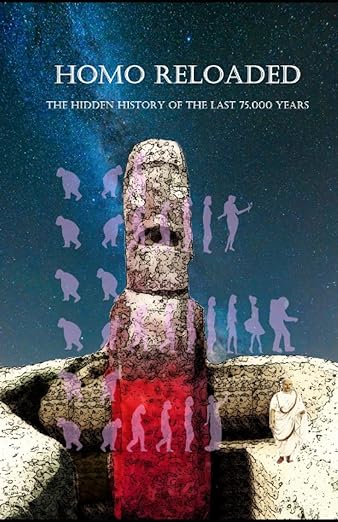
**** out of 5
An astonishing book which skilfully weaves science, geology and geography with informed conjecture to reappraise 75000 years of human history
Origin, Evolution, and Transformations of Human Civilization and Earth: Evidence of Cosmic Impacts, Climate Changes, and Ancient Civilization Decline are all pulled into the equation
Bisceglia takes readers on a journey through time, exploring life’s beginnings and the cyclical nature of human civilizations. He presents evidence of catastrophic events, such as cometary bombardments, climate changes, and reductions in genetic diversity that have shaped our past. He challenges conventional theories and presents compelling evidence for the existence of advanced ancient civilizations like Sundaland and Mount Atlas, which have been lost to time.
Life and Universe: “Living” Vs “Dead” Perspective Emergence-
Bisceglia challenges the traditional view that the cosmos is “dead,” presenting a “living” perspective based on evidence of abundant life in the cosmos. He examines different origin theories and delves into the hypotheses of life arising from non-life and being distributed by space dust, exploring evidence for microorganisms across the Universe.
Origin Theories: “Big Bang” and “M-Theory”-
Bisceglia argues that the theory of the Big Bang, while widely accepted, is outdated and proposes that the “M-Theory” provides a more fitting explanation for the Universe’s origin. The “M-Theory” suggests that infinitely small, vibrating strings form an endless number of three-dimensional membranes, each representing a universe. These membranes, existing in eleven dimensions, occasionally collide, creating “collisions” that might have been previously misunderstood as the “Big Bang.” He suggests that our perception of time is merely an illusion and that reality might have no beginning or end.
The Big Bang theory is a simpler explanation for the observable universe, adhering to the principle of Occam’s Razor, which suggests that the simplest explanation is often preferred until more complex theories are proven necessary.
The Big Bang theory has been successful in predicting various phenomena in cosmology, which lends it considerable credibility that M-Theory has yet to achieve.
The concept of “infinitely small, vibrating strings” is a theoretical construct that has not been observed directly, and thus its existence is speculative.
The concept of eleven dimensions is purely theoretical and has not been empirically verified; it remains a mathematical construct without direct physical evidence.
The idea of membranes colliding in higher dimensions is a feature of a specific branch of string theory, which is not universally accepted even within the theoretical physics community.
Psychological studies show that humans and other animals have an innate sense of time, necessary for survival, which suggests that time has a basis in biological reality.
Philosophical and theological perspectives often posit a creation event or a prime mover, implying a specific beginning to reality.
Theories About Life’s Origins: Spontaneous Generation and Panspermia-
Bisceglia examines two contrasting theories about how life began here: the concept of life forming from inorganic substances and panspermia. Abiogenesis, the more accepted theory, proposes that life spontaneously arose from non-living matter, inorganic materials combining by chance within hydrothermal vents. However, Bisceglia highlights the improbability of complex enzymes assembling randomly, citing calculations suggesting a one in 10^40,000 chance.
He then presents panspermia, supported by scientists like Fred Hoyle and Francis Crick, which suggests that microorganisms predate Earth’s ability to generate life, arriving from space. Evidence of microorganisms in ancient meteors and fossils dating back 4.3 billion years strengthen this argument. Bisceglia concludes that life’s existence on Earth predates Earth’s ability to spontaneously generate it, leading to the possibility of extraterrestrial origins.
The hydrothermal vent hypothesis relies on the presence of specific minerals and environmental conditions that may not have been prevalent or stable enough on the early Earth to facilitate abiogenesis.
The improbability argument does not consider the role of natural selection, which can act on small, random changes to gradually increase complexity and function over time.
The discovery of extremophiles on Earth—organisms that can survive in extreme conditions—suggests that life could have originated in harsh environments on Earth without the need for extraterrestrial sources.
Fossils dating back 4.3 billion years may not be definitive evidence of life, as the interpretation of these fossils can be contentious and alternative abiotic explanations for their formation might exist.
The improbability of complex enzymes assembling randomly does not rule out abiogenesis if alternative pathways or mechanisms for the origin of life exist that have not yet been discovered or fully understood.
Life Evidence Across Universe, Including Space Microorganisms
Bisceglia further supports panspermia by showcasing the abundance of life evidence across the Universe, particularly as microorganisms. He cites research indicating Halley’s comet contains biological substances, organic molecules and ethyl alcohol on comet 67P/Churyumov Gerasimenko, and potential bacteria or archaea in 4.5 billion-year-old meteorites. This evidence suggests that existence beyond Earth is not confined to our planet and travels through cosmic bodies. This leads to the notion of a Universe that is alive rather than dead, challenging the traditional physics model where life is merely a “local accident.”
While Bisceglia points to evidence of organic molecules and potential microorganisms in space, the presence of these substances does not necessarily confirm life, as abiotic processes can also produce complex organic compounds.
Homo Reloaded Summary
Mysterious “Reloads,” Civilization Near-Extinctions, Sundaland Disappearance, and “Y-Chromosome Catastrophe” are at the centre of this well researched and simply explained work
Bisceglia dives deeper into several mysterious “restarts” that human civilizations have faced throughout history, focusing on the near-extinction events, examining the factors that contributed to the disappearance of advanced civilizations like Sundaland, and dissecting the “Y-Chromosome Catastrophe” and its potential causes.
Decline in Homo Sapiens Population 75,000 and 12.8 Thousand Years Ago
Bisceglia examines two significant population declines in Homo sapiens history. The first, approximately 75,000 years ago, possibly triggered by the eruption of the Toba supervolcano and a subsequent volcanic winter, significantly reduced the Sapiens population. The second decline happened around 12,800 years ago, coinciding with the comet impacts and the Younger Dryas period. He explores various possible causes for the demographic collapse, including climate change, warfare, and catastrophic events, proposing that these factors might have acted in conjunction.
“Genetic Bottleneck” Reduced Sapiens Population to Low Levels
Bisceglia analyzes the idea of “bottlenecks” and how they affect a species’ genetic diversity. He highlights the severe bottleneck that our specie experienced
Human Civilization Origins: Göbekli Tepe, North Africa, Sahara (E.G., Atlantis)
Bisceglia challenges the conventional view of human civilization origins, exploring evidence of advanced pre-agricultural societies in Göbekli Tepe and North Africa. He examines the possibility of a sophisticated civilization in the Saharan region, potentially linked to Plato’s Atlantis, before its desertification. He analyzes the evidence of advanced construction techniques and sophisticated understanding of astronomy, challenging the traditional narrative of human development.
Göbekli Tepe: Unearthing and Implications of a 12-Millennia-Old Stone Site
Bisceglia examines Göbekli Tepe, a megalithic site in Turkey that’s 12 millennia old, highlighting its significant implications for our understanding of humanity’s civilizational origins. He describes the site’s remarkable stone structures, suggesting it could mean that an advanced pre-agricultural society with sophisticated organizational and construction capabilities existed. The lack of burial evidence at Göbekli Tepe leads Bisceglia to explore alternative theories about its purpose, suggesting it might have served as a ritualistic centre or a site for communal gatherings. The Site’s Stone Structures Suggest Advanced civilistaion
Facilitators of Civilization: Connections Between Akhenaten, Moses, Jesus, and the Turin Shroud
Bisceglia explores the role of people he calls “facilitators,” who significantly influenced how human consciousness and civilization developed. He focuses on the enigmatic Pharaoh Akhenaten, suggesting a connection to Moses and their shared monotheistic beliefs. He then delves into the person of Jesus Christ, examining his origins, features, and possible connections to the Turin Shroud, ultimately questioning whether he was a “revolutionary” from another world.
The Revolutionary Religious and Cultural Changes Under Akhenaten-
Bisceglia examines the reign of Akhenaten, the Egyptian monarch who initiated a radical religious revolution, introducing the worship of Aton, the “one true God” depicted as the solar disk. He describes Akhenaten’s monotheistic beliefs, rejection of traditional Egyptian gods, and the establishment of Akhetaten as a capital city dedicated to Aton. Bisceglia analyzes how these theological shifts includingAkhenaten’s Monotheism and Reverence for Aton in Egypt impacted Egyptian society, leading to conflict with the powerful priesthood and ultimately contributing to Akhenaten’s downfall.
The only flaw in the book is a tendency to over-argue astonishing claims. Sometime raw simplicity is best
,…
 Garyswordz