

St Michaels Church Horton, Staffs
As a past Staffordshire Poet laureate I have always been fascinated by George Heath, the gifted poet who died aged only 25 years old of “Consumption” or what we call Tuberculosis a major killer up until the early 20th century.

Originally, nobody knew what caused the various forms of tuberculosis, so called from tubercle bacillus (usually the offending microbes are specifically Mycobacterium tuberculosis).
The word “tuberculosis” was coined by Johann Lukas Schönle in 1839, from the Latin “tuberculum,” meaning “small, swelling bump or pimple.” However, it wouldn’t be until 1882 when Dr. Robert Koch discovered the tubercle bacillus, for which he won a Nobel Prize in 1905, that the name “tuberculosis” began being exclusively used to refer to the disease formerly popularly known as consumption.
The microbes that cause the disease have been around for at least 15,000-20,000 years with known human deaths being caused by the bacteria dating back at least as far as 5,000 years ago, so the current name is an extremely recent moniker relative to how long the disease has been around.
The much older name originally came from the ancient Greeks who called the disease something meaning “consumption,” “phthisis,” specifically referring to pulmonary tuberculosis, with the earliest references to this being in 460 BC.
The “father of Western medicine,” Hippocrates, estimated that phthisis was the most widespread disease of his age. He further told his students that they shouldn’t attempt to treat patients in the last stages of phthisis, as they were sure to die and it would ruin his protégés’ reputation as healers if they made a practice of attempting to heal such individuals.
The disease seemed to consume the individual, with their weight drastically dropping as the disease progressed.
St Michaels Church Horton is beautifully located even if the building itself is routine. A Parish church built in C15 with C17 alterations and largely internal circa 1864 restoration by Sugden. Coursed sandstone; red tile roof to nave
and chancel, with verge parapets.
The Victorians loved their Church cemetries. This one is atypical.
Serena Trowbridge ( Reader in Victorian Literature, Birmingham City University) writes:
” Victorians ritualised death. Black mourning clothes were worn for set periods of time after bereavement, the length of time depending on the relationship. After this, grey or purple would then be worn. Jewellery was made of the hair of the deceased and photographs were taken of the corpse with their family. Curtains in the house were drawn after a death, and the bell and door-knocker muffled.
The Victorian attitude to death was epitomised by the public mourning of Prince Albert in 1861. Queen Victoria’s consolation, beside the Bible, was the reading of Alfred, Lord Tennyson’s In Memoriam (1849), a long poem which explores the undulating patterns of grief. Victoria’s response to the poem exemplifies the Victorian approach to death, in which the dead are mourned and memorialised rather than seen as lost forever. This Christian approach is also reflected in the graveyards of the period.
From 1832 or 1841, cemeteries were constructed around London to cope with the growing problem of the burial of the dead. Cremation was rare and seen as unacceptable, and existing graveyards were overflowing, with coffins often stacked up.
Perhaps the most famous of these London cemeteries is Highgate, opened in 1839. It became the resting place for many famous figures, including the author George Eliot, the poet Christina Rossetti, and members of Dickens’ family.
Another cemetery, at Brookwood in Surrey, was opened in 1854 after the cholera epidemic of 1848-9 overwhelmed the system. It was served by the London Necropolis Railway, which ran trains from Waterloo carrying mourners and coffins. The Necropolis Railway emphasised the class-bound nature of death and mourning, with carriages and waiting rooms (which doubled as funeral parlours) divided into first, second and third class.
Sacred space
Graveyards offered a sacred space for bereaved families to reflect on their losses. This encounter between the living and the dead provides one of the most famous scenes in Victorian literature, when young orphan Pip visits the graves of his family in the opening pages of Charles Dickens’ Great Expectations (1861).
Pip explains how his images of his family were formed by their tombstones:
The shape of the letters on my father’s, gave me an odd idea that he was a square, stout, dark man, with curly black hair. From the character and turn of the inscription, ‘Also Georgiana Wife of the Above,’ I drew a childish conclusion that my mother was freckled and sickly.
The site of the burial of the dead also proves a turning point for Pip’s future. He is surprised by the appearance of “a fearful man”, Magwitch, who demands Pip’s help. The child’s terrified acquiescence alters the course of his life in ways he does not yet fully understand.
This tendency to situate significant encounters among the dead is widespread in Victorian fiction. In The Woman in White (1860) by Wilkie Collins, a key encounter between the hero and the elusive woman in white takes place in a graveyard:
Under the wan wild evening light, that woman and I were met together again, a grave between us, the dead about us, the lonesome hills closing us round on every side.
As the hero-narrator points out, “the lifelong interests which might hang suspended on the next chance words” make him anxious and add drama to an already tense scene.
As spaces charged with emotion, then, in which one may reflect on one’s own future as well as past, graveyards provide a fruitful literary backdrop. Thomas Hardy uses this concept regularly, notably in Tess of the D’Urbervilles (1891), in which the tombs of the heroine’s supposed ancestors provide uncomfortable settings for several encounters with her past and present, leading to her ultimate downfall.
Death and resurrection
Death was not an end for the majority of Victorians, but the beginning of a new future. As Tennyson wrote in his poem “Crossing the Bar”:
I hope to see my Pilot face to face
When I have crost the Bar.
The conviction in resurrection and ascension to Heaven which sustained the mourners was accompanied by a growing interest in séances and spiritualism as a way to remain in contact with the dead, and of course the graveyard consequently featured in many ghost stories.
Truth is even stranger, however. In 1869, the body of Elizabeth Siddal, painter and poet, was exhumed by firelight in Highgate Cemetery, to recover the manuscripts of poems tossed in with her body by her grieving husband, the Pre-Raphelite artist Dante Gabriel Rossetti. it was said that her body was perfectly preserved, and that her red hair had continued growing and filled the coffin.
The worm-eaten manuscripts are now in the British Library, and it has been suggested that Siddal’s exhumation inspired Bram Stoker in his portrayal of Lucy Westenra in Dracula (1897).
Graveyards are a place where different human concerns meet: sadness, loss, history, tragedy, and uncertainty for the future. Yet these fictional graveyard encounters contain seeds of hope, in which the characters move from loss to a brighter future.

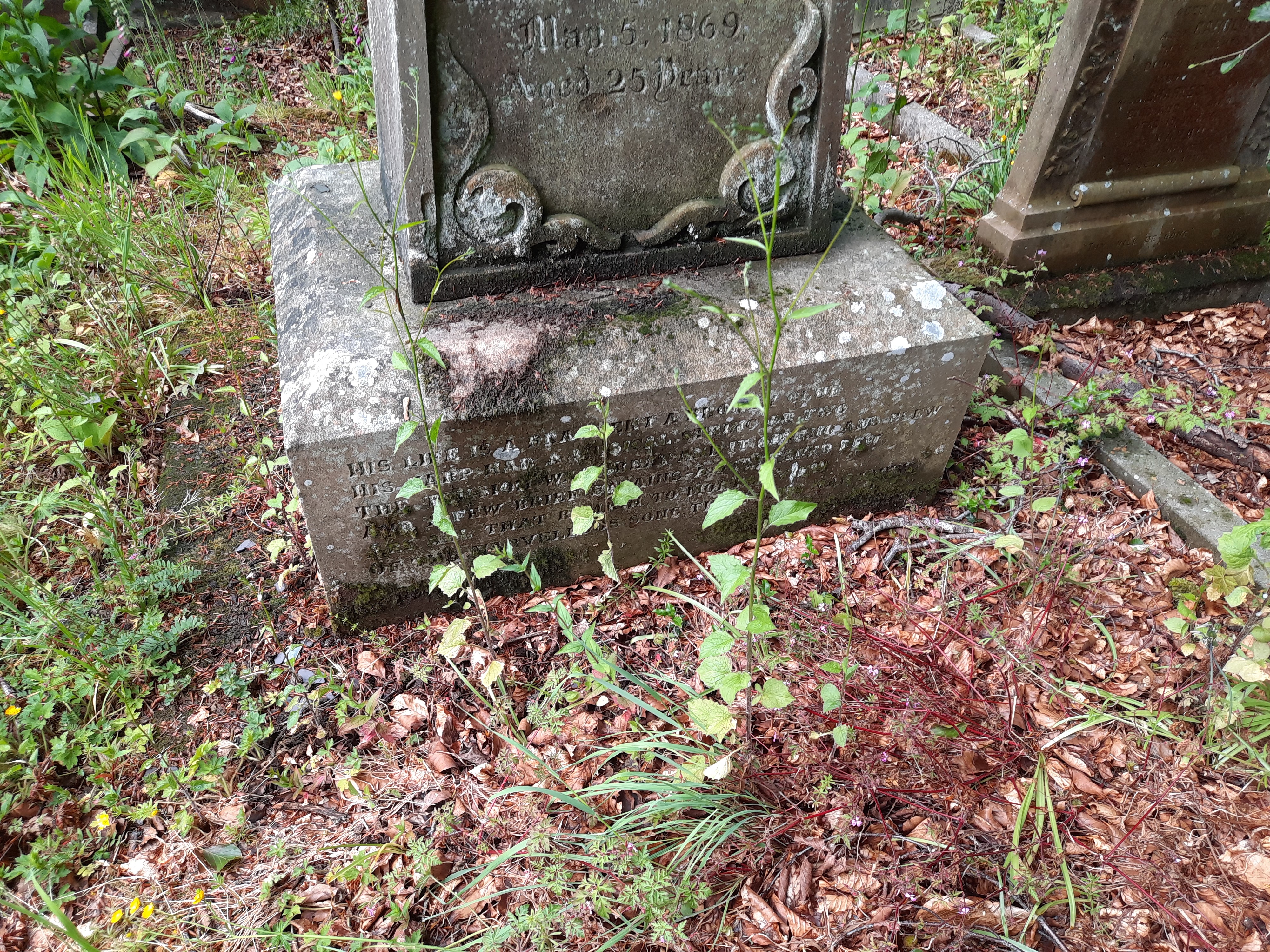
“George Heath was born in the village of Gratton in the Staffordshire Moorlands in 1844.
Educated at the village school, he worked on his father’s farm, then was apprenticed to a builder.
While working on the church in the neighbouring village of Horton, he caught a chill which developed into consumption and he died five years later at the age of 25.
…He was also a poet. During his brief lifetime he achieved little more than local fame as ‘the Moorland Poet’…
He was also a poet. During his brief lifetime he achieved little more than local fame as ‘the Moorland Poet’ and ‘the Invalid Poet’.
He published two slim volumes of verse but after his death his friends produced an edition of his poems and also arranged for a memorial stone to be erected over his grave in Horton churchyard.
Death and the frustration of unfulfilled ambition are the two major themes of his poetry, and the epitaph on his gravestone (quoted above) reveals his own belief that his work would be forgotten. Hopefully he will be proved wrong.”
-Robert Buchanan.
http://www.robertbuchanan.co.uk/georgeheath/index.html – A great website full of information about George Heath and his poems.

George Heath (1844 – 1869)
George Heath’s Poem about Rudyard:
RUDYARD.
SUNSET MUSINGS.
Glorious Rudyard; gorgeous picture,
How I love to gaze on thee,
Ever fraught wtth sunny memories,
Ever beautiful to me!
Whether blushing Spring enwrap thee
In its robe of virgin pride,
Whether golden Summer steep thee
In its mellow gushing tide;
Whether drooping Autumn flood thee
With its dreamy chastened light,
Whether chilling Winter drape thee
In its vest of spotless white;
Whether storms sweep grandly o’er thee,
Light or gloom their charms impart,
Ever grand, sublime, majestic,
Ever beautiful thou art.
And I love to roam in twilight,
From the busy haunts of toil,
From Oppression’s galling fetters,
From Deception’s soulless smile,
Here to sit and gaze upon thee,
As I gaze upon thee now,
With the balmy zephyr playing
On my hot and aching brow.
How sublimely grand the picture
Stretching out before my gaze;
Deluged with the glowing splendour
Of the sun’s declining rays,
Lies the lake in tranquil beauty,
Like a model mimic sea,
Like a brightly polished mirror,
In a frame of ebony;
Like a flood of molten silver,
Froth of gold and sapphire dipped,
Flashing back the efflorescence
Of the summer’s blazing light.
And away, far up the valley,
Rising from the sunlit tide,
Towering hills in stately grandeur,
Bound the view on either side,
Turning, twisting, undulating,
Sinking low or peaking high,
Throwing up a jaggy outline,
Quaintly cut against the sky.
Bulging mounds and blocks of granite
Rise in beauty all around,
Lichen grown, and moss enamelled,
Ivy wreathed, and bilberry crowned.
Rugged cliffs of mouldering sandstone
Break abruptly here and there,
Like a patch of coarsest fustian
On a robe of beauty rare;
In whose fossil-bedded strata,
Like an ancient crypt unsealed,
Lies the bloom of bygone ages,
To the curious eye revealed,
Seeming placed to point this moral
To the thoughtless and the gay,
All that’s fair must fade and perish,
All that’s beautiful, decay.
And above and all around me
Stalwart trees bedeck the scene,
Tendril-twined and ivy-mantled,
All enrobed in richest sheen;
Like a mighty host of giants,
Armed and ready for the fight,
With the lightning’s gleaming falchion,
And the tempest’s awful might;
And the sun in haze of beauty,
Sinks in solemn peace to rest,
’Neath the bright and mystic curtain
Of the crimson-glowing west.
Fleecy mists of gorgeous splendour,
Clouds of shapes and forms untold,
Sail like argosies of tinsel,
O’er a sea of burnished gold;
Softly breaking up and parting,
Gently gliding to and fro,
Mirrored in the glassy bosom
Of the peaceful lake below.
And the mason’s busy hammer,
And the mower’s tinkling scythe,
And the whistle of the teamster,
And the song of milk-maid blithe—
All are hushed, and peaceful Silence
O’er the scene its mantle throws;
Not one sight or sound discordant
Breaks the spell of sweet repose.
And the stilly, dreamy motion
Of the vapours gliding o’er,
And the plashing of the wavelets
As they break upon the shore,
And the calm and saintly murmur
Of the tall and stately trees,
As they chant their thrilling vespers
To the music of the breeze—
All combine to soothe my spirit,
Panting, yearning, sad, and sore;
Waft my thoughts from present sorrows,
To the happy days of yore:
When I met my noble Mary
Oft amid this shady bower,
When the flush of day was fading
In the mystic twilight hour;
When together oft we wandered
Through the flower-enamelled glade,
Sat in silent contemplation
In the cool and leafy shade;
Watched the unsuspecting rabbit
Frisking through the bushy grove,
Heard the rooks in noisy confab
In the giant trees above;
Went in search of curious flowerets,
Climbed the rocks for fern and heath,
And together, for her forehead,
Twined a rainbow-coloured wreath;
Watched the mighty locomotive
Rushing grandly on its way,
And the snow-white wreath of vapour
Softly break and die away;
Sought for shells amid the shingle
On the lakelet’s rugged side,
Watched the ever busy swallow
O’er its shining surface glide;
Launched our skiff upon its bosom,
When the wind was calm and still,
Gazed enraptured on the picture,
And of beauty quaffed our fill.
Then when passion or ambition
Filled my soul with wild unrest,
Or, when sorrow or affliction
Quelled the demon in my breast,
Standing grandly there before me,
With her cool hand on my brow,
Gazing fondly, sadly on me—
Ah! I seem to see her now—
She would breathe the balm of kindness
O’er my sufferings and my wrongs,
Read me thoughts of grand old authors,
Sing me sweetly soothing songs;
Speak in strangely thrilling accents
Of that land beyond the sky,
Where “the weary, heavy laden”
Find eternal rest and joy—
Till my brooding soul, enraptured,
Soared on Fancy’s glowing wings
Far beyond this realm of turmoil,
Up to brighter, nobler things.
But those days of halcyon glory
Like a vision passed away,
Like a fitful gleam of sunshine
On a dreary winter’s day;
Leaving nought behind to cheer me
Through this world of storm and blight,
But the sweetly soothing memory
Of their evanescent light;
For the summer waned and deepened,
Softer grew the twilight’s hush,
Meeker grew the morning’s dawning,
More subdued the noontide flush;
And disease, like deadly night-shade,
O’er my Mary cast its blight,
Paler grew her cheeks of beauty,
Grew her eyes more large and bright.
Whiter grew her brow of marble,
Softer grew her hand of snow,
Fainter came her voice’s music,
Feeble fell her steps and slow.
Then we wandered here but seldom,
For it only seemed to cast
O’er our lives a deeper shadow—
We were dreaming of the past—
And the tender, chastened aspect
Of its beauty, seemed to say,
“All that’s fair, alas! must wither,
All that’s beautiful decay.”
But we never spoke of parting,
Though we knew that we must part,
Either strove to hide that knowledge,
From the other’s bleeding heart.
But the Summer passed, and Autumn,
Meek-eyed Autumn, came again,
With its wreath of faded flowerets,
And its wealth of golden grain.
’Twas the solemn hour of midnight,
And the moon shone clear and bright,
Silvering o’er the silent landscape,
With its weird mysterious light,
When I stood among her kindred,
Gazing on her features fair,
Stroking back the silken tresses
Of her wavy ebon hair.
And she looked so like an angel,
In her mute and dreamless sleep—
All the past came flooding o’er me,
And I turned away to weep.
Came her voice serene and saint-like,
“Do not leave me yet awhile;“
Then I looked, her eyes were brilliant,
And her features wore a smile
As she gazed around upon us,
Pointing with her snow-white hand,
Through the vista of the future,
To that brighter, better land.
Softly whispering “Loved ones meet me,
On that far celestial shore,
Where the noble faithful-hearted
Meet again to part no more.”
Then her hand dropped down beside her,
O’er her features passed a change,
Pallid grew her lips and rigid,
Glassy grew her eyes and strange.
And I knew, though almost frantic,
As the dear white hand I pressed,
That the worn and weary spirit,
Had at last gone home to rest.
Time passed on, and sunny summer
Came again to deck our bowers,
With its robe of gold and emerald,
And its wreath of ferns and flowers.
All around was love and beauty,
All seemed happy as of yore,
But the bliss of vanished moments
Came to cheer my heart no more.
And a weary, weeping wanderer,
O’er this wilderness I roam,
Till the summons come—“’Tis finished!
Leave thy toil and hasten home.”
 Garyswordz