
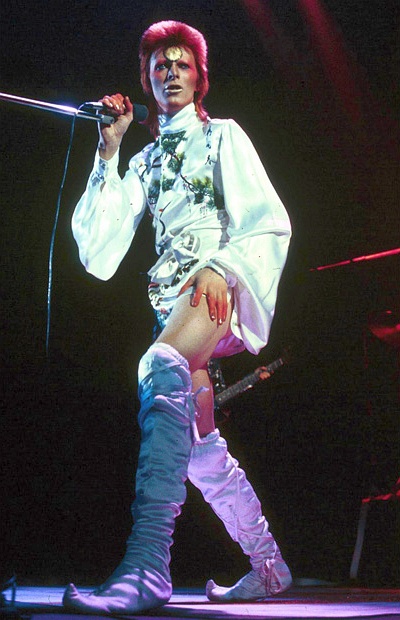
David Bowie’s love affair with Japan, and Japanese style, underpinned his early career. He sold 1,000,771 Albums in a country whose western tastes otherwise were dominated by Maria Carey and Michael Jackson. This feature is intended as a reminder that although London, Berlin, New York and Los Angeles were important cultural influences – so was Japan.
–
David had a longstanding association with Japanese designer Kansai Yamamoto , instantly assimilating the Japanese tradition of fusing fashion and music.
–
His signature fashion styling for Aladdin Sane featured a costume by Japanese designer Kansai Yamamoto for which International make up artist Pierre la Roche borrowed from Lindsay Kemp. Yamamoto designed for Bowie through both his Ziggy Stardust and Aladdin Sane eras. Among his most famous outfits for Bowie was Space Samurai, a black, red and blue outfit adapting the hakama, a type of loose trousers which samurais wore and which are still worn by martial arts practitioners.Yamamoto’s outlandish costumes became a central element of Bowie performances.
–
That association went back to the early 1970’s and manager Tony Defries’s far sighted decision to have Main Man offices in London, New York and Tokyo meaning that Bowie was the only international popstar to have representation in Japan itself. David’s androgynous face and body, perfectly suited Kansai Yamamoto’s unisex style”.
–
Davids interest in Japanese theatre was ignited in the late 1960’s when, he studied dance with Lindsay Kemp, a British performance and mime artist who was heavily influenced by the traditional kabuki style, with its exaggerated gestures, elaborate costumes, striking make-up, and “onnagata” actors – men playing female roles. That dramatic make-up used by kabuki became part of the Ziggy Stardust look . He learned from celebrated onnagata Tamasaburo Bando how to apply traditional kabuki make-up – its bold highlighted features on a white background, evident in the lightning bolt across the Ziggy face.
–
The quick change tradition of Japanese theatre fitted perfectly David’s needs for his stage show. The dramatic cape could be whipped away on stage mid-performance and he also wore a kimono-inspired cape with traditional Japanese characters on it which spelled out his name phonetically. He was also the first Western artist to employ the hayagawari – literally “quick change” – technique from kabuki, with unseen stagehands ripping off the dramatic cape on stage to reveal another outfit.
–
The elaborate clash of prints on his famous knitted bodysuit were also a reference to yakuza (organised crime syndicates) tattoo patterns. It wasn’t just his appearance – references to Japan are scattered through Bowie’s music – his 1977 album “Heroes” features the track “Moss Garden” on which he plays a Japanese koto.
–
‘Crystal Japan’ was an instrumental recorded during the sessions for the Scary Monsters album with Tony Visconti, but the song itself was one of Bowie’s oldest, written when he was 16, and worked up from a contemporaneous demo. . It was originally titled ‘Fujimoto San’, and was intended to close the album, before Bowie being replaced by a reprise of ‘It’s No Game’ which features Japanese spoken word guest vocals.
–
The synth layered instrumental “Crystal Japan” is reminiscent of of “Low” and “Heroes”, possibly the reason for its ultimate omission from the album. It was used as a soundtrack for a 1980 Japanese television advertisement for the Shōchū drink Crystal Jun Rock, a Japanese distilled spirit made by Takara Shuzo Co. Bowie appeared in at least three different commercials, all of which featured the song. A hugely successful product, the saturation coverage the advert provided, sometimes twenty times a day, both reflected his historic and contemporary status in Japanese pop culture, it also cemeneted it long into the future. Sharp move. ‘Crystal Japan’ was released as a single in Japan in July 1980.
In “Move on” from lodger David references “Spent some nights in old Kyoto/Sleeping on the matted ground” Bowie’s determination to champion Japanese culture as distinct from a generic Eastern vision endeared him enormously to the Japanese . Kyoto was his favourite Japanese city which he visited frequently over a period of many years particularly: Tawaraya Ryokan, where he stayed with Iman on their honeymoon, David befriended another David, leading U.S. Sinologist David Kidd, who had a house in Kyoto called Togendo, as well as a school dedicated to teaching traditional Japanese arts. Bowie stayed at Togendo in 1979 for some weeks, even contemplating moving there full time at one time. He played a gig at the City in 1983 as part of the “Serious Moonlight” tour.
–
Japan embraced Bowie back, where he remains one of the best known western rock and pop figures. Leading Japanese rock guitarist Hotei Tomayasu, who composed the theme for Quentin Tarantino’s Kill Bill films, cites David as an important influence and played with him onstage at the Nippon Budokan in Tokyo in 1996. Between 1978 ( isolar2) and 2004 ( Reality), David played the legendary Budokan arena in Tokyo nine times.
It is easy to forget that as Bowie’s career took off, World War 2 was only 25 years distant with memories of Japanese ill treatment of Allied, and in particular British and Australian, prisoners of war, still fresh in the public’s mind with many survivors still living. Thus his leading role in the feature film “Merry Christmas Mr Lawrence” alongside Tom Conti is even more extraordinary as Maj Jack Celliers directed by the renowned Nagisa Oshima. It was controversy free instead winning plaudits as a vehicle for Japanese and western reconciliation.
–
The film, set during World War Two in a Japanese POW camp , pits Bowie’s character and another soldier against two Japanese officers, one of whom is played by the musician Ryuichi Sakamoto who contributed the memorable film score.
–
Not a war film, but a film set in war time Bowie’s character tries to bridge the cultural divides between the P.O.W. s and the Japanese camp commander in order to avoid blood-shed in a subtle synthesis of life and art. It is my favourite Bowie performance on film.
–
Although the Japanese dimension to Bowies life and career is relatively well known, it is only when you pull the strands together as I have attempted here, that its significant impact becomes apparent
 Garyswordz