
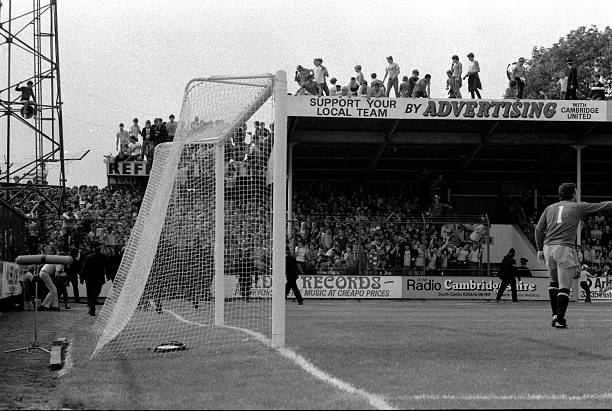
Chanting does go back to the late 19th century with its origins in Scotland and folk songs popularised by Ceilidhs. The Old Firm popularised insulting and confrontational chants in the 1920’s
–
But it became popular and more widespread in the 1960’s as pop songs formed the basis for chants. And the pop songs perpetuated them. We all live in a Yellow Submarine, quickly morphed into “we all piss in a Blue and white ( replace to suit) box, the chorus of Hey Jude was a staple everywhere. “La, la, la, la la la la – Ipswich ( replace to suit).
–
War cries were known to have been used by football fans from the 1880s onwards, with the earliest recorded in Scotland after the Scottish Cup final of 1887. The first known song which references football, “The Dooley Fitba’ Club” later known as “‘Fitba’ Crazy”, was also written in the 1880s by James Curran, although it was intended for the music hall rather than the terrace.In the 1890s Sheffield United fans adopted a music hall song, the “Rowdy Dowdy Boys”, while Southampton fans sang a “Yi! Yi! Yi!” chant based on a war cry. Blackburn Rovers fans were reported to have chanted “We’ve won the cup before – many a time” before their 1891 FA Cup Final match against Notts County. Composer Sir Edward Elgar wrote a football song in honour of the Wolverhampton Wanderers striker, Billy Malpass, in February 1898 “He Banged The Leather For Goal”,
–
“Blaydon Races”, a Geordie folk song from 1862, which was adopted by Newcastle United fans in the 1930s. Some of the songs sung at football ground by the 1920s were modified from popular music hall songs, for example “Kick, Kick, Kick, Kick, Kick it” from “Chick, Chick, Chick, Chick, Chicken” and “Keep the Forwards Scoring” from “Keep the Home Fires Burning”.
–
Fans of the early period also had a limited repertoire of chants, which become more varied as singing was encouraged by the use of brass bands before games and the community singing movement that arose in the 1920s (the tradition of singing “Abide with Me” at FA Cup finals started in this period).
–
The mixing of fan cultures from different countries through international football matches that started to be broadcast, such as the 1959 England’s tour of South America and the 1962 World Cup gave exposure to intense chanting by South American and Italian fans ] They also picked up different type of chants from other countries; Liverpool fans for example, used a Brazilian chant “Brazil, cha-cha-cha” and turned it into the “Li-ver-pool, [clap, clap, clap]” chant.
–
Televised games spread chants , “Abide with me” had been sung at FA Cup finals since 1927. The FA Cup final had been televised since 1938.
–
During ww2, ENSA provided music hall entertainment, and Music hall itself was popular through to the late 1960s, both taught popular songs to the masses “Knees up mother brown”
–
Club songs have been sung for a [very long time, most notably “On the Ball City” at Norwich. “Keep Right on” at Birmingham City, “Glory Glory Hallelujah” at Spurs , and”Sky Blue Song” Coventry city 1961, “when the Saints go marching in” Southampton, and Play up Pompey “Portsmouth”
–
“on the Ball City was sung by Swifians and Norwich CEYMS before being adopted by Norwich City in 1902.
–
Unquestionably the 1960’s were the time when pop culture, youth culture and televised football were the catalyst for an explosion of chanting in variety and content. “”Youll never walk alone” ws sung everywhere, including Old Trafford, “Knees Up Mother brown” was an popular at Cambridge as it was in Luton, despite its West Ham origins.
 Garyswordz