
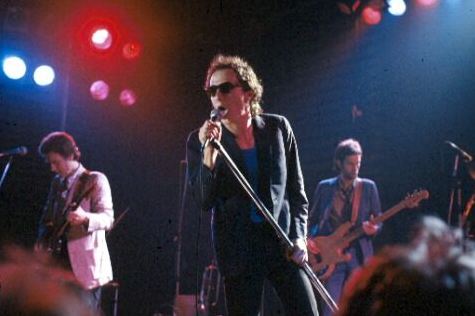
The mid to late 70’s was an incredibly diverse time for music. The early 70’s was experimental and primarily featured disco building upon 60’s soul, prog rock developing hippy rock and hard rock, pop, and Rnb rock n roll. . Graham Parker and the Rumour built upon all of those traditions as Pub rock broke, with chief fellow protagonists being the likes of the Kursaal Flyers, Dr Feelgood, Kilburn and the high Roads, Hatfield and the North, Burlesque, Kokomo, Brinsley Schwarz, Ducks Deluxe, and Ace.
Music is a fluid entity, and the forces which spawned pub rock also spawned punk in the summer of 76, and in turn, New Wave. Very little in music is original, but Pub Rock was overtly derivative, that was what drew crowds, you were listening to something that you seemed to already know. Punk seemed new, I was a teenager going to live gigs, it felt exciting, and fresh ( in truth was it any more new than the New York Dolls ( who were not gigging in the UK), early Who, or early Rolling Stones? Probably not, but that was the music of old people, and this music was for me.
By 1975 the Rumour had been assembled in London by the Hope and Anchor above which Dave Robinson of Stiff records fame, had a studio. Parker became a staple artist at the Hope and Anchor, and Fulham Greyhound in Hammersmith two of the hippest venues in London with a burgeoning live reputation boosted by the seminal “live at marble arch” bootleg. His early sound , vocals and presence was reminiscent of Van Morrison. Contemporaneously Elvis Costello with a formidable family music tradition, and Joe Jackson with formidable compositional ability, were the competition.
And so in 1978, on the basis of the above and the great “Hold back the night” hit single cover, I went to see them live at Leeds university. It was to be one of the best shows I had ever seen.
I arrived early, early enough to chat to Graham as he arrived for the sound check to claim my place at the front, and what an experience . Parker’s passion, Brinsley Schwarz’s searing guitar , Bob Andrews’ keyboards, Andrew Bodnar’s bass, Steven Goulding’s drums and the Rumour Horns, a live rock n roll combination only Bruce Springsteen’s E Street Band could match. The 2000 capacity all standing venue packed with under 25s was perfect.
This was the perfect setlist of their early material with his cover of Ann Peebles’ “I’m Gonna Tear Your Playhouse Down” absolutely showstopping. He channelled Peebles later in the set for a magnificent, soulful “Watch the Moon Come Down”, Parker crouching under a solitary spotlight. It was a great time to see hi. He had broken out of small venues, the Rumour was tour tight.
Like the most powerful gospel soul from the early sixties, “I’m Gonna Tear Your Playhouse Down” serves notice on a cheating lover (or is it white supremacist America?) declaring that the free ride has come to an end. It’s a restatement of the revolutionary gospel anthem “Samson and Delilah,” and the message is the same: “If I had my way, I would tear this building down.”
Peebles is a pivotal figure in understanding early Parker. She was also influenced by R&B performers, including Muddy Waters, Mary Wells and Aretha Franklin. Her first record, “Walk Away”, reached the R&B chart in 1969, as did the follow-up, “Give Me Some Credit”, and she released an album, This Is Ann Peebles. All her early records on Hi Records featured the signature sound of the Hi Rhythm Section and Memphis Horns, a sound that the Rumour were to duplicate In 1970, her single “Part Time Love” – a version of Little Johnny Taylor’s 1963 hit – reached no. 7 on the R&B chart, and no.45 on the pop chart, and she began working with the Hi label’s songwriter Don Bryant.
Two of her most popular songs were “I Can’t Stand the Rain”, which she wrote with her husband Don Bryant and radio broadcaster Bernie Miller, and “I’m Gonna Tear Your Playhouse Down” She was also the only female singer on Hi to release a string of albums, including Straight from the Heart and I Can’t Stand the Rain, which contained many tracks that she co-wrote with Bryant. The title track of the latter album, written by Peebles and Bryant with DJ Bernard Miller, was her biggest commercial success, reaching no. 6 on the R&B chart and no. 38 on the pop chart in 1973.
The set opener was a storming “Stick with me”, horns blaring, Parker snarling, setting a pace and energy that never let up, we really did want to “Hold back the Night” one that was too good to end. Every show has its purple patches, here it was the triumvirate of “Fools Gold” featuring Schwarz’s guitar, “Playhouse” and “Hey lord” a classic audience call and response number.
Set list
Stick to Me
White Honey
Lady Doctor
Fool’s Gold
I’m Gonna Tear Your Playhouse Down (Ann Peebles cover)
Hey lord, Don’t ask me Questions
The Heat in Harlem
Silly Thing
Gypsy Blood
Back to Schooldays
Heat Treatment
Watch the Moon Come Down
Thunder and Rain
The New York Shuffle
Soul Shoes
Encore:
Hold back the Night
Just under a year later I caught him again in London with a setlist significantly bolstered with songs from the excellent “Squeezing out Sparks” album several of which were new set highlights, particularly “Passion is no ordinary word” “You cant be too strong” and “Nobody hurts you” even if the cod reggae of“Protection” and vitriolic “ Mercury poisoning” were unsubtle and raw cries de Coeur.
Hammersmith Odeon, London April 3rd 1979
Discovering Japan
Local Girls
Thunder and Rain
Don’t Get Excited
Back to Schooldays
Passion Is No Ordinary Word
Fools Gold
You Can’t Be Too Strong
Love Gets You Twisted
Mercury Poisoning
Heat Treatment
Howlin’ Wind
Stick to Me
Crawlin’ From the Wreckage
Saturday Nite Is Dead
Nobody Hurts You
Soul Shoes
Encore:
Hold Back the night
Protection
Ultimately there was only room for one angry young man songwriter, and Graham and Joe Jackson played second and third fiddle to Elvis Costello. Live this was his high water mark of popularity, although he was to return to the Odeon, while other bands moved on to arenas, he was stuck in theatre sized venues, which for a numerically big band will always create financial pressures. Subsequent tours saw him play the smaller Hammersmith Palais, then by 85, without the Rumour ,he was playing Dingwalls and the Marquee while the Jam and Stranglers had played Wembley arena.
Subsequent to this, having borrowed from Dylan on his first few albums he courted Springsteen, but was not in the same league on vinyl although “Fools Gold” was a great tribute. The ill-advised collaboration on the subsequent “ Up escalator” with Springsteen was to be his swansong.
In those days a show at the Hammersmith Odeon was a prestige date, and this was one of two sold out nights, rapturously received by a home crowd and bizarrely featuring a stage invasion from a fan on crutches! It was a night in his career he never bettered.
“mercury poisoning” was his take on his demise I think it was more complex than that.
–
Mercury records themselves were a fine, large, established, diverse record company, producing hit singles and albums for Paper Lace, bachman turner overdrive, 10cc and Rod Stewart- a pretty impressive contemporary roster.
–
I think that GP was a victim of bad luck, bad timing and bad judgment.
–
Unquestionably GP& The Rumour were the toast of the Pub Rock scene. But before pub Rock crossed over to the mainstream, punk broke, and the band were no punk band. Some rode the wave, adapted and survived after a fashion, most notably Eddie and the hot Rods. Some stuck to their guns and prospered, most notably Dr Feelgood. Some great bands were overwhelmed like the Kursaal Flyers and Ducks deluxe, some adopted, adapted and developed like Kilburn and the high Roads/ Ian Dury. Bad luck.
–
As punk morphed into new wave, two singer songwriters emerged, Elvis Costello and Joe Jackson. Ian Dury also reinvented himself both as a singer songwriter, and with the Blockheads as a first rate live act. It was a crowded market, bd luck and bad timing.
–
Ditching his horns section for “Squeezing out Sparks” had no negative creative effect, possibly the reverse, and saved him money, but the soul sound of the band was gone. His subsequent flirtation with Springsteen for “The Up Escalator” had some commercial upside, but it was short-lived. Graham was no Bruce. Bad judgment
–
The Uk pop market in the late 70’s and early 80’s was unbelievably fast moving from month to month. Parkerrhad neither the time, nor the money, to commit to touring America for months on end and abandoning his home market to the competition. Bad luck and timing.
The talented racing Cars and Motors were both consumed by the vicissitudes of that era. Tom Petty & The Heartbreakers rode it out, the Cars faked it. That’s the music business for you.
–
To graham’s great credit, he has kept going, and continued to earn a living from music which is more than most
 Garyswordz
Gary, I was also at the Leeds Uni gig which was amazing. Do you have any recollection as to whether there was a support that night?
i think there was but cannot remember who. Great times,