
These shows require context.
There had been huge disappointment at the disbandment of the Spiders. But a combination, of delight, bewilderment and excitement at the directions suggested by the albums Pin Ups, Young Americans and Diamond Dogs then Station to Station, David was losing and gaining fans with each successive album at a rate of knots. “Who IS David Bowie now?” was a valid question. These shows were a litmus test of his old, and new support. How would it respond to the post Ziggy persona ? The shows sold out quickly but had the potential to be a homecoming, day of reckoning, triumph and car crash rolled all into one. The front of house hospitality restaurant/ bar/ viewing terrace at Wembley was packed every night with London’ s invited glitterati. There were as many pics of Jagger, Ron Wood, Michael Caine, Streisand , Brian Eno, David Hockney, Christopher Isherwood etc as there were of Bowie in the newspapers, particularly the Evening Standard, the RCA PR machine was in overdrive. Bowie was in town and everyone knew it. Bowie Had specifically invited Eno out of admiration for his work with Roxy Music and his subsequent left field, obscure recorded output. The rest is history.
The Spiders had been much loved, with Ronson seemingly the indispensable studio side man. His three subsequent post Spiders original albums had buried the idea of Ronson’s musical indispensability, Bowie grew without him and benefited from alternative collaborations, but his place on stage as David’s axe man and visual foil was another matter. On the Station to Station album Earl Slick had proved to be a musical upgrade, and he looked the part- but was unavailable for the tour after a row over money an the departure of Michael Lippman who also manged Slick,, with the unknown Stacy Heydon getting the gig, a man who auditioned once, had only ever left Canada once, and didn’t know a single Bowie song , let alone the guitar parts. After successfully auditioning he was given a cassette player and tape for an afternoon with the tour set list. The first full band rehearsal was the following day. Bowie insisted on his set up including a Maestro Phase Shifter. hooked up, unusually to THREE 100 watt Marshall heads! Heydon asked Bowie whether David wanted as note for note reproduction of the album guitar solos, buT was told no, and to “be himself”.
He had sacked manager Michael Lippman at the end of 1975 for failing to organise accommodation and a welcome when he arrived in New Orleans, Lippman’s defence was that Bowie had been uncontactable for weeks. Roy Bittan had left before rehearsals began to return to the E Street Band leaving tour manager Eric Barret to track down ex Yes keyboard player with whom he had worked before to fill in . Barrett also peeled Heydon’s name out of his contact files as “a good guitar player”!
I mention all of this to explain that the success of the tour in general, and the May Wembley dates was by no means a given. The minimalistic stage and lighting set, together with a relatively small touring band was also not an artistic decision, but primarily a move to save money for RCA and finance his impending bewlay bros production company. If the tour had not been a commercial success there would have been no Idiot/ Lust for Life or Heroes and Low.
The six shows had sold out in an instant. Bowie was in creative maelstrom mode. Six albums released in a four- year period from Ziggy onwards, each one packed with a dizzying array of ideas and musical references. Ziggy Stardust had morphed into the Thin White Duke. After the debacle of his 1973 shows at Earls Court where a poor sound system, poor stewarding, poor organisation and a physical set inadequate for an arena show had damaged his reputation, he had something to prove live. His formidable recorded presence needed to take that leap to live superstar. His arrival in London at Victoria Railway Station in an open topped Mercedes, greeting his fans with a one handed, fascist style salute had not augured well.

Support bands were the norm. The motivation was that they should be the warm- up, and a bit of added value. Not this time. Instead the infamous 1929 short Bunuel / Dali film, Un chien Andalou, featuring an eye slicing, was shown. Its shock value had not diminished almost fifty years later.

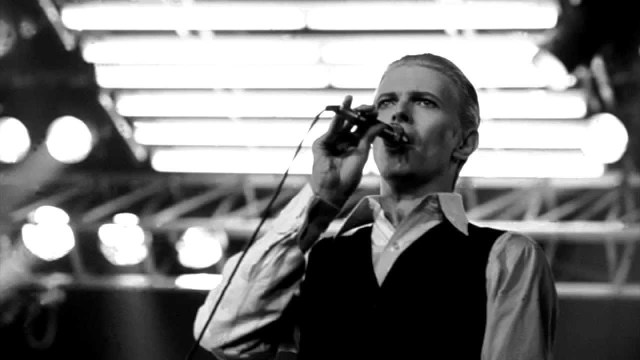
The tour had opened on 2nd Feb in Vancouver, this was the fifth of six shows. The band were tour tight. My only disappointment was that Stacy Heydon had lead guitar duties rather than the unavailable Earl Slick, otherwise the excellent rhythm trio of Alomar (guitar), Davis (drums) and Murray (bass) were to serve Bowie live and on vinyl for many years to come. There was no conventional coloured lighting rig, just banks of fluorescent white light set against black backdrops on a stage stripped of props other than the band and their instruments.
“Station to Station” could have been written as a show opener with its long instrumental, swelling introduction and wailing guitars heralding ‘ the return of the thin white duke throwing darts in lover’s eyes’. Dressed in black shoes, trousers and waistcoat, teamed with a white shirt and slicked back blonde hair, Bowie looked pin sharp, every bit The Thin White Duke. After the extended workout of the opener, the whiplash “ Suffragette City” could not have offered a starker or more compelling counterpoint, sharp, short and crowd frenzy inducingly brilliant.
Thereafter highlights included the vocal gymnastics of “Fame”, the only offering from the Young Americans album, a neat “Life on Mars/ Five Years” segue and a fiery “Stay”. He finished with a rock-out “Diamond Dogs” cementing a decidedly Rock feel to the set, shorn of the glamour of the Diamond Dogs tour, and the soul of Young Americans. Without the keyboards dexterity of Mike Garson or Roy Bittan, keys man Tony Kaye was functional, but uninspired, he filled the sound, rather than creating one.
A killer double encore of “Rebel Rebel” and “Jean Genie” wrapped up a killer show, the sound was fantastic, organisationally it was fine. The sceptre of Earls Court banished. At fourteen songs it barely beat the ninety minutes mark despite an already mountainous back catalogue, but as a set it worked brilliantly. The best selection of songs I saw him play.
The Set List
Station to Station
Suffragette City
Fame
Word on a Wing
Stay
I’m Waiting for the Man
Queen Bitch
Life on Mars/ Five Years
Panic in Detroit
Changes
TVC15
Diamond Dogs
Encore:
Rebel Rebel
The Jean Genie
 Garyswordz